
Trending

At the sector level, the undisputed hotbeds of artificial intelligence (AI) investing are technology and communication services – two groups that combine for more than 44% of the S&P 500.
Those were also the two best-performing sectors in 2025. Again. Last year was the third consecutive in which communication services and tech were the top two sectors and much of that bullishness is attributable to AI. As advisors know, trends like that don’t last forever, right? On the other hand, it’s increasingly difficult, if not foolhardy to bet against those two sectors.
A recent communication services anecdote confirms as much. On Monday, Google parent Alphabet (NASDAQ: GOOGL) joined the $4 trillion market capitalization club, becoming just the fourth company to accomplish that feat. The other three all hail from the tech sector – Nvidia (NASDAQ: NVDA), Apple (NASDAQ: AAPL) and Microsoft (NASDAQ: MSFT). Specific to that sector, there’s an undeniably bright outlook.
“Despite massive spending in AI over the past three years, companies within the communication services sector are working diligently to monetize their AI models to show they can drive revenue growth. In my view, we have yet to witness the full impact of these investments—and I believe the market could be underestimating the long-term positive impact of this technology,” notes Priyanshu Bakshi, manager of the Fidelity Advisor® Communication Services Fund.
It’s All Fun and Games…
In a standard, cap-weighted communications services index fund or ETF, Meta Platforms (NASDAQ: META) and Alphabet combine for approximately 40% of the portfolio, give or take a few percent depending on the phone.
Obviously, those are bellwether stocks, but there’s more to this sector, including AI’s intersections with other communication services industries, including video games. That remains a high-growth space.
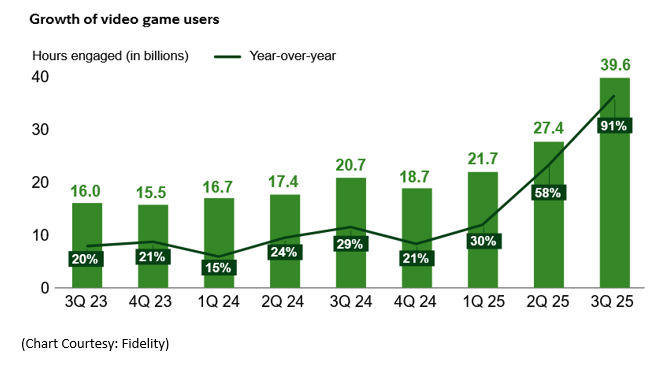
(Chart Courtesy: Fidelity)
For example, AI is a key component of Roblox’s video game offerings. With more than 85 million daily users, the company provides video game creators with an end-to-end platform, as well as services and support, to help them build immersive experiences,” observes Bakshi. “Roblox also uses AI to moderate content and power a safety feature to determine the age of users on its platforms. These are just some of the ways the business has integrated AI to drive its value proposition, which, in turn, is attracting more users and driving free-cash-flow generation for the company.”
AI Tech Spending Has Durability
Moving over to tech, the largest sector weight in the S&P 500, AI spending is likely to prove durable again this year, which is likely to bode well for enablers such as Nvidia (NASDAQ: NVDA) – the largest company by market value.
“Nvidia has been highlighted so often in connection with AI that some investors might be tiring of hearing about it or wonder if some other company is set to swoop in and steal its thunder,” says Adam Benjamin, manager of the Fidelity Advisor® Technology Fund. “In my view, though, Nvidia merits all the attention it gets because it really is that far ahead of the competition. No other company is close to offering products with the combination of integrated hardware, software and algorithms that Nvidia does, especially since its Blackwell chipset was introduced in 2024. Blackwell was developed specifically for use in high-performance graphics processors and delivers significant improvements in performance and energy efficiency. Nvidia’s Vera Rubin superchip, the company’s next generation of AI hardware, should be in production sometime in 2026.”
Taking Nvidia’s commentary at the Consumer Electronics Show (CES) and subsequent sell-side fawning into account, the semiconductor giant is well on pace to become the first $5 trillion company, perhaps dragging other AI enablers along for the ride.
Related: Chasing 2026 IPOs? This ETF Offers Exposure Without the First-Day Risk