
Trending

SpaceX went public on June 12, making 555 million shares available for trading. Although that sounds like a lot, it isn’t. Following the IPO, SpaceX has approximately 13.075 billion shares outstanding and over the next year, they will all become eligible for trading.

Although SpaceX is an exciting new public company, the most important story for investors isn’t actually about rockets or AI at all. For the next year, it’s all about stock supply. Every scheduled lock-up expiration changes the balance between buyers and sellers, and that may matter just as much as the company’s fundamentals in the short run.
At IPO, only about 4.2% of the company was offered to the public. The rest is still restricted within the phased lock-up schedule outlined in the prospectus. Unlike most IPOs, which have a single 180-day lock-up expiration schedule (all or nothing), SpaceX insiders and investors’ shares will become unrestricted in various installments.
Shares becoming eligible for sale does not mean they will all be sold immediately. However, market history suggests that many early investors and employees will use these opportunities to realize gains or diversify their holdings after years of owning the rapidly appreciating private shares. Given the massive number of restricted shares relative to the current public float, even a modest percentage of selling could dramatically increase the supply of shares available to the public market.
The Share Count Takes Off
Stock float is the number of a company’s shares that are available to be publicly traded on the open market. SpaceX is about to rapidly expand theirs.
Think of the public float as the inventory available for investors to buy and sell. When that inventory expands dramatically, the balance between supply and demand can shift quickly, often leading to increased volatility. The faster the supply of shares grows, the harder it is for investor demand to absorb additional shares without putting pressure on prices.
Spreading the lock-up over many months is unusual, but it makes sense in this case. Releasing so many shares all at once could create selling pressure that would be difficult for the market to absorb. Even still, it will be difficult despite the inherent demand from both retail investors and the index fund buyers who will expand their allocations as the volume of publicly available shares grows.
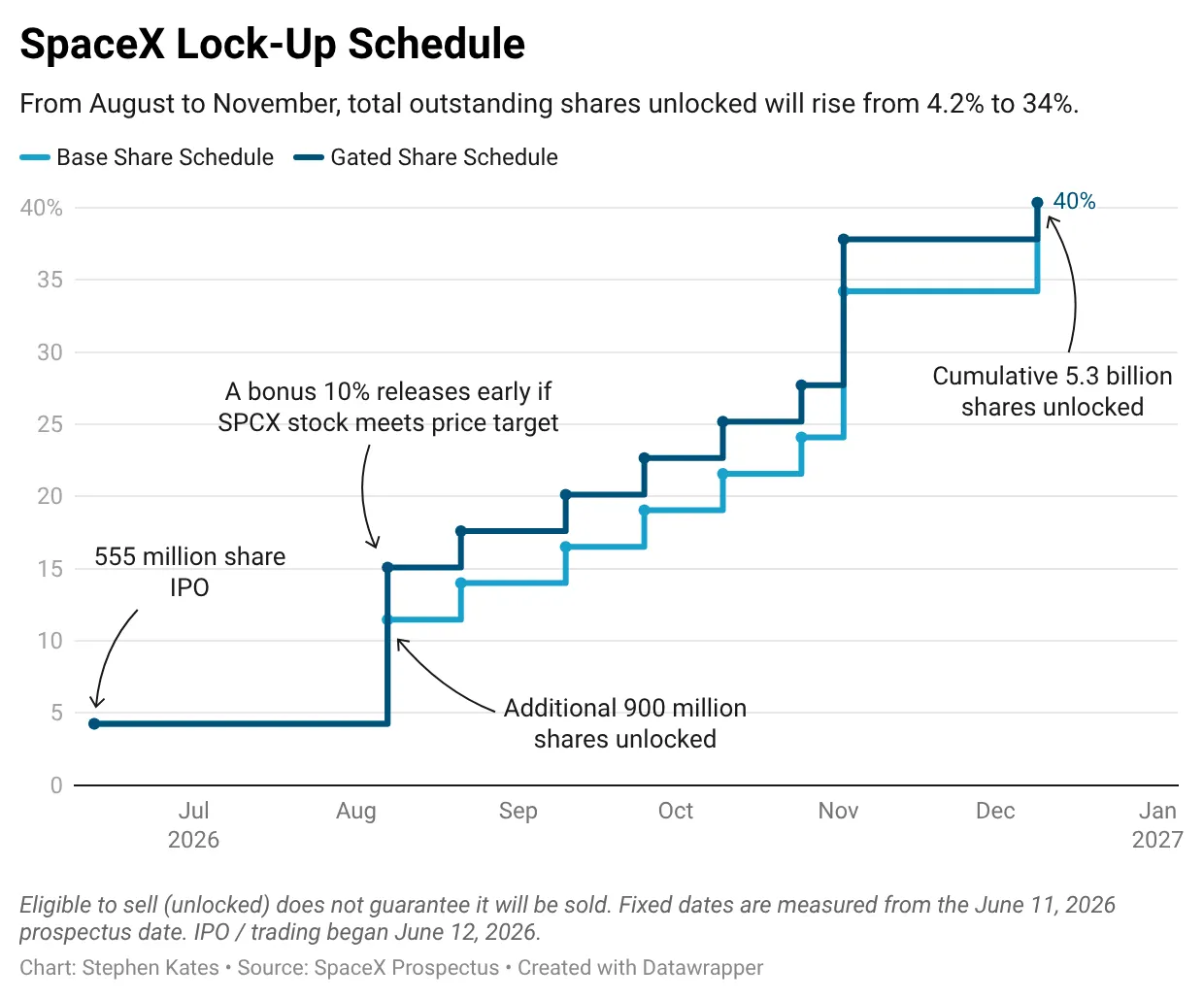
Large waves of selling could produce sharp price swings as buyers and sellers adjust to the expanding supply. If you are a long-term holder of SpaceX (or plan to be), you should keep some Alka-Seltzer handy because it will get bumpy.
No one knows where SpaceX shares will trade over the next three months, one year, or five years. Long-term returns will ultimately be driven by earnings growth and the company’s execution, not anyone’s price target. What we can measure is supply. Over the next year, billions of additional shares will become eligible for trading, and that changing supply will likely be one of the biggest forces driving short-term volatility.
Initial 180-Day Lock-Up Period (2026)

The initial 180-day lock-up period runs through 2026, with a steady stream of shares being unlocked between August and December. By the end of 2026, close to 5.3 billion shares will be available. This is nearly ten times the size of the IPO’s initial public float, and if even a fraction of these shares are sold publicly, it could have profound implications for the current share price as the market absorbs the new supply.
Note: At current prices, the stock-price trigger is unlikely to be met. The trigger requires SpaceX shares to close at least 30% above the $135 IPO price (or $175.50) for five of the ten trading days ending on August 4, 2026.
Extended Lock-Up Period (2027)

The extended lock-up period runs through the first three quarters of 2027, and will unlock another 7.8 billion shares. The majority of these are Elon’s own shares that he isn’t likely to sell. The other investors, such as venture capital firms, high-profile individuals, and large institutional investors, may choose to sell some or all of their positions which again could cause some fresh volatility in the market for SpaceX shares.
Investor Takeaway
Lock-up expirations don’t tell us where SpaceX shares will trade over the long run. They do tell us when the supply of tradable shares will increase. Over the next year, investors should pay just as much attention to the lock-up calendar as they do to earnings reports.
If I were interested in taking a long position in SpaceX, I would be looking for a much lower entry price than today. SpaceX has an Amazon-sized valuation with Macy’s-sized revenue, and the company is still losing money. We’ll learn much more when SpaceX reports earnings and provides guidance in a few weeks. That report should provide a much clearer picture of whether a buying opportunity could develop.
If you’re a strong believer in Elon Musk or SpaceX, and you have the patience and nerves to ride out significant volatility, then have at it. But I don’t see the urgency. With billions of shares scheduled to become eligible for sale over the next year, supply will likely have a greater influence on the stock price than almost any other factor in the near term.
The Current SpaceX Trend
Now that we’ve mapped out what’s ahead, let’s look at how SpaceX got here. Since the IPO in June, SpaceX stock has been through a lot. Pre-IPO hype was in overdrive, generating enormous interest in the stock. Opening above its $135 IPO price, the stock surged out of the gate and didn’t look back.
At least for a few days.

On IPO day, SPCX opened at $150, hit a high of $177, and closed at $161. Two trading days later it hit a high of $226, but closed at $201. The following day hit an intraday high of $214, but never closed above $200 again.
Since those first few trading sessions, the momentum has faded and the shares have drifted back toward their IPO price. As of publication, SpaceX trades at approximately $122, down 9.6% from its IPO price and well below its early post-IPO peak.
Short interest has steadily increased, with roughly 200 million shares sold short as of last week. Elon Musk has warned that short sellers will regret betting against SpaceX, much as they did with Tesla. However, SpaceX is entering a very different phase of its public life. Over the next year, billions of insider shares are scheduled to become eligible for trading, creating a supply dynamic that Tesla never faced to the same degree in its early years.
SpaceX stock is not immune from the laws of supply and demand. Over the next year, SpaceX may continue to lead the industry in rocket launches, but investors will also be watching billions of existing shares gradually launch into the public market.
The next major catalyst arrives on August 4, when the company reports earnings for the first time as a public company. Just days later, roughly 900 million additional shares are scheduled to become eligible for trading. Together, those two events could shape the stock’s next major move.