
Trending

Time will tell total 2026 initial public offering (IPO) activity will look like, but as things stand today, this year could bring a spate of offerings from some of the most recognizable companies that are currently privately held.
Signs point to possible IPOs from Elon Musk’s SpaceX, Plaid and Revolut, among others. Those are three of the most valuable, widely recognized unicorns. The point is at least a few of the private companies retail investors (and more) have been craving access to are likely to shed their private status this year.
Before rushing to grab those stocks on their first days of trading, advisors and investors may want to consider a broader, potentially safer approach. Those valuable traits are offered by the First Trust US Equity Opportunities ETF (NYSE: FPX). FPX, which turns 20 years old in April, was previously known as the First Trust US IPO Index Fund, confirming its ties new stocks. That lineage lives on, making the ETF pertinent against the backdrop of what could be a notable year of IPO activity.
One important housekeeping item: FPX isn’t an actively managed fund, meaning it’s unlikely to add shares of say SpaceX or Plaid on the first day those stocks trade. However, the ETF does a history of adding some ballyhooed names soon after they make their public debuts.
FPX Methodology Matters
Understanding how FPX is essential for various reasons, including avoiding disappointment and surprises. The underlying index’s selection universe includes IPOs, spin-offs and “as well as select acquirers of recent IPOs.” Those rules allow for GE Vernonva (NYSE: GEV) and IBM (NYSE: IBM) of all stocks ranking among the ETF’s top five holdings. IBM is there by way of acquisitions.
Advisors and investors considering FPX should also note that when a new stock is added to the fund, it can remain there for up to 1,000 days. Translation: Not all of FPX’s 101 holdings are new per se, but there are benefits in how this ETF does business. By opting for FPX’s broad approach over selecting individual IPOs, asset allocators and investors mitigate risks associated with individual newly public companies.
For example, after the first day of trading, 56% of new stocks posted negative returns over the subsequent 12 months with a median loss of 7.69%, according to First Trust research. Over 24 months, the median loss surged to 18.59%.
“In our view, this dynamic underscores a critical consideration for investors seeking to capitalize on new listings: greater uncertainty surrounds younger companies, making diversification essential,” observes the issuer. “Historically, the effective ‘cost’ of gaining exposure to the potential upside of ‘winners’ has been to accept the inevitable exposure to ‘losers’ as well, both of which are difficult to predict without the benefit of hindsight.”
FPX: More Winners Than Losers
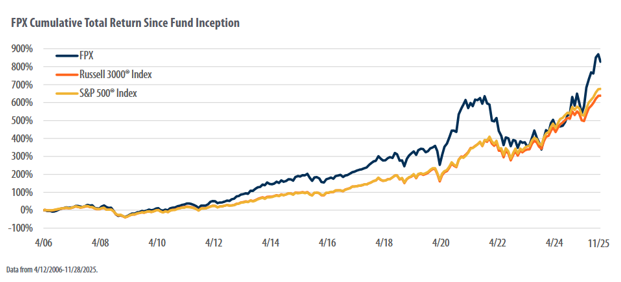
As noted in the chart below, FPX has an enviable track record. How it was accumulated is important, too.
(Image: First Trust)
First Trust acknowledges that in recent years, FPX added some stocks that hindered performance, including well-known names such as electric vehicle maker Rivian Automotive (NASDAQ: RIVN) and Coinbase Global (NASDAQ: COIN). However, those “turkeys” were made up for with prescient additions of several story stocks.
“Direct listing on September 30, 2020; added to the S&P 500® Index in September of 2024. 5 From its addition to FPX in November of 2020 through its S&P 500® Index inclusion, Palantir had a cumulative total return of 155.1%,” adds First Trust. “IPO on April 15, 2021; added to the S&P 500® Index in September of 2025. 6 From its addition to FPX in June of 2021 through its S&P 500® Index inclusion, AppLovin had a cumulative total return of 636.3%.”
Today, AppLovin (NASDAQ: APP) and Palantir (NASDAQ: PLTR) are the ETF’s second- and third-largest holdings, respectively, combining for more than 11% of its weight.
Related: Why Model Portfolio Adoption Is Surging—And Why Young Advisors Have the Most to Gain