
Trending

Frequent targets of criticism for some grizzled analysts and veterans in the world of exchange traded funds (ETFs), some thematic ETFs provide juice that is worth the squeeze.
A prime example is the Global X Defense Tech ETF (SHLD). As its name implies, the $5.75 billion SHLD – one of the largest ETFs in the Global X suite – refreshes the defense investing proposition by marrying that industry with technology. Thematic ETF naysayers may want to reconsider some of their critiques because since SHLD debuted in September 2023, it’s trounced the largest old-guard aerospace and defense ETF.
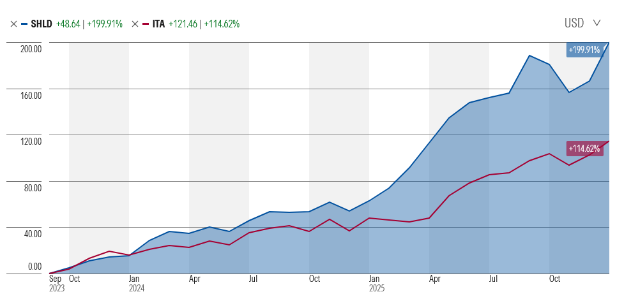
(Chart Courtesy: Morningstar)
SHLD, which follows the Global X Defense Tech Index, surged 74.2% last year as investors priced in expectations of a long-term uptrend in global defense spending. For decades, the U.S., China and Russia where the primary leaders of global military expenditure growth, but the script is being altered for the better underscoring the relevance of this thematic ETF.
In fact, global defense spending could reach $3.6 trillion by 2030, representing a $1.2 trillion increase from the levels seen just two years ago.
SHLD at the Epicenter of Change
Among the boxes thematic ETFs need to check to ensure long-term success are relevance and durability of the theme in question. SHLD accomplishes those objectives. Said another way, aircraft carriers, fighter jets and submarines are still important, but more discreet, tech-infused defense concepts are the future of global militaries.
“The center of gravity in defense is shifting from hardware to software. AI-enabled systems, drones, and digital command networks are moving from experimentation into deployment, reshaping industry economics and widening margin profiles,” notes Tejas Dassai of Global X. “With fundamentals firm and modernization still in early stages, we believe Defense Tech enters 2026 with a constructive setup.”
While the U.S. is the prominent geographic exposure in SHLD, industrial and technology stocks from more than a dozen countries are represented in the ETF, confirming it has leverage to the broad-based theme of rising defense expenditures.
“Across Europe, the Middle East, East Asia, the Americas and the Arctic, political decisions are translating directly into defense budgets and procurement pipelines,” says deVere Group CEO Nigel Green. “Defense stocks are moving into a year where geopolitical reality is shaping fiscal policy in real time.”
The ETF’s European exposures are particularly relevant at a time when the U.S. is scaling back its NATO spending, shifting some of that burden other member states. Europe is stepping as European Union (EU) defense spending could climb to 5% of GDP by 2035.
Why Tech Matters in Defense
There are surface-level reasons why technology is crucial in defense. For all the liberties Hollywood takes, a country doesn’t want its fighter pilots flying four-decade old aircraft in a dogfight against next-generation jets. Indeed, tech’s imprint is indelible on the battlefield and in the behind scenes goings on that advance and protect troops.
For investors, tech is also making its mark on bottom lines. As Dessai points out, defense tech companies generated earnings per share growth of 29% in the third quarter, confirming a robust fundamental picture for SHLD member firms.
“Margin expansion expectations reinforce this shift. Defense Tech operating margins are forecast to expand over 230 basis points (bps) in 2025, with another 120-bps gain expected in 2026,” concludes Dessai. “The expected gains reflect software-driven business models that differ fundamentally from traditional defense, as digital platforms generally carry structurally higher margins, long-lived contracts, and stronger pricing leverage.”
Related: Why Model Portfolio Adoption Is Surging—And Why Young Advisors Have the Most to Gain