
Trending

As you have probably heard, extended heat waves in Europe have pushed temps to over 104°F in some countries and have accounted for 10,000 excess human deaths in June. Unfortunately, there seems to be no end in sight as July is also proving to be a stewing heat trap.
Of course, this has been awful news for farmers, as well. A report by Coceral, the trade organization representing the cereals, oilseeds, rice and olive oil sectors, forecasts that the EU crop will be down 8%, as a result of recent heatwaves. The Energy and Climate Intelligence Unit predicts a loss of “around €2 billion for grains such as wheat, barley and maize alone. This falls to around €1.8 billion after accounting for improved harvest prospects in a few countries, such as Bulgaria, that escaped the worst of the heat. Wider costs of the heatwave, such as lost livestock and vegetable crops, are not included in this estimate.”
Benoît Merlo, a farmer in the Auvergne-Rhône-Alpes region of France, said, “I’ve been working on my farm for ten years to make it more resilient through cover crops, crop rotations and species adapted to hotter and drier conditions. But with temperatures exceeding 38°C for weeks on end, everything is breaking down. I’m expecting yield losses of at least 50 per cent, or even 70 per cent, for certain crops, such as soya. We’re no longer heading for a crash - we’re already there.”
And it isn’t just crops that suffer.
According to the Good Food Institute, Europe, “Heat stress can cause breathing and heart problems, dehydration, weaker immunity, reduced fertility, and death [for farm animals]. During the late June heatwave, extreme heat killed 2.5 million to 3 million broiler chickens in France. Clement Blanchard, a chicken farmer in Pays de la Loire, France’s second largest poultry region, told Reuters he lost about 700 chickens over a few days, compared with one or two per day normally.
“Climate change also increases the likelihood of epidemics affecting farmed animals. On top of heat stress depleting immune systems, rising temperatures and changes to ecosystems create optimal conditions for diseases to spread – and lead to greater antibiotic use in meat and dairy production.” As we know from my previous Food Systems Strategy with Elysabeth article on growing antimicrobial resistance in humansdue in part to excessive antibiotics in factory animals, more antibiotic use in animals due to rising temperatures is another heightened risk for people.
Extreme Heat Kills Crops and Animals. Dead Crops and Dead Animals = Inflation
As we saw with the drought in the Western United States earlier this decade and as noted in an early article on Food Systems Strategy with Elysabeth, entitled, “Can Americans Even Afford A Burger Anymore?”, ground beef hit $6.69 per pound in December 2025 — up 19.3% year-over-year and 72% since 2020 — with the USDA forecasting a further 6.9% wholesale increase in 2026. Further, the U.S. cattle herd fell to a 75-year low of 86.2 million head as years of drought and animal-borne pandemics impacted supply, according to a February 13, 2026, Food Ingredients First article. In addition, if the animals do survive this year’s heat and drought, their production of milk and quality of meat is much less due to stress and being less likely to eat in extreme heat. Again, this adds to food inflation.
Even before this heatwave, the general math for food animals is already bad. Animals are inefficient calorie converters. Cows are 2% energy-efficient which means that only 2% of calories in animal feed inputs are effectively converted to animal meat for food. The remaining 98% of inputs are lost. Pigs are 8.6% efficient, and chickens are 13% efficient. Even with chickens, 87% of inputs are lost. This is why 80% of our agricultural land used for animals only yields 18% of our calories. We use the land to grow the animal feed and then we lose most of it in the conversion. Meanwhile, what is lost in conversion could have been crops grown to feed directly to people.
So, it’s already bad math to give high-protein, high-fiber crops to animals who require massive amounts of land, water, time, and even more crops, when we could simply grow crops to feed directly, and efficiently, to people. With extreme heat and droughts, the bad math keeps getting worse.
Extreme temperatures destroy corn and soy crops, up to 70% according to farmer Merlo above. These crops are used as animal feed and their destruction is going to make this already expensive protein source even more so. The lack of feed and the diminishing number of animals in the system is going to push food inflation for years to come and, hopefully, make us question why we were giving food with protein and fiber to animals instead of people to begin with.
So how can we get extreme temperatures and, consequently, a significant driver of food inflation, under control? Let’s look agriculture’s impact on rising temperatures and what we can do about it.
What Came First: Severe Heat Temps or a Fractured Food System?
Here is a bright light. Our food system is both the cause of (in part) and the solution to (in part) climate change. And making a shift to the food system could help us get extreme temperatures under control. Hmmm, “How’s that?” you say? Let’s take a look.
Our food system creates 30% of the world’s greenhouse gas emissions (GHGs), per the United Nations Environment Programme. Animal agriculture is responsible for 60% of that, or a total of 18% of the global emissions. And why would our animal-protein manufacturing be responsible for such a large chunk of our total greenhouse gas emissions?
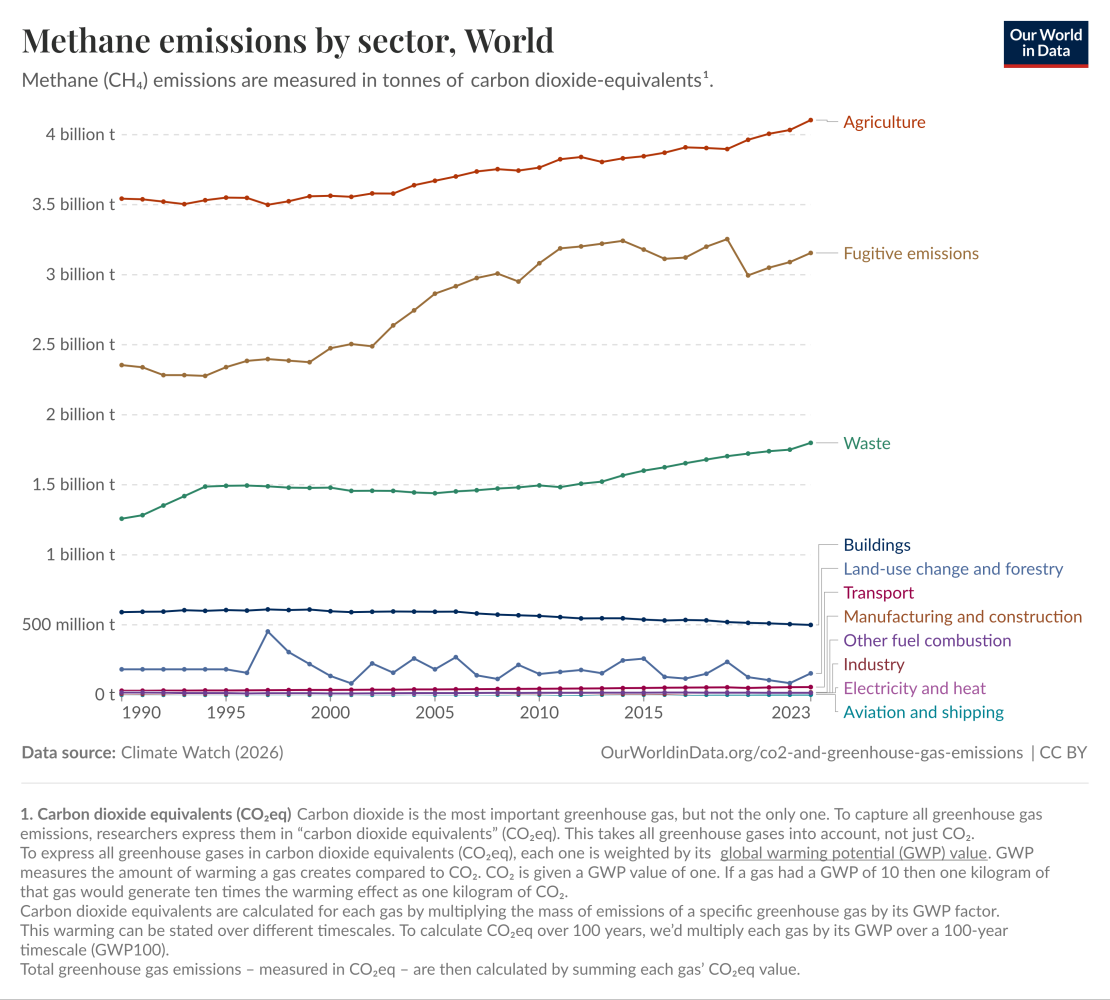
Image from Our World in Data showing that the agriculture sector is the largest emitter of methane.
For starters, animal agriculture is the leading cause of deforestation and biodiversity loss, and is responsible for 41% of the world’s tropical deforestation. Why so much? Remember, as discussed, animals are terrible calorie converters. Cows are 2% energy-efficient which means that only 2% of calories in animal feed inputs are effectively converted to animal products. The remaining 98% of inputs are lost. So we have to give them lots of food/crops for an extended period just to get that 2% of food output. This means cutting down trees to grow crops (no, not for people) to give to animals. Since the animals only give us 2% to 13% back on our investment of crops, we need to cut down more trees to grow more crops to get the output of food necessary. That massive deforestation is a major driver of what is driving excessive temperatures around the world.
Furthermore, animal agriculture is also responsible for 32% of the world’s methane emissions. This is primarily from the supply chain of cows and sheep, as well as pigs, according to the United Nations Environment Programme (UNEP).
In short, with animal protein playing such a large factor in the elements that create higher temperatures, deforestation and methane emission, we won’t significantly improve our ability to reduce temperatures if we don’t address this cow in the room. Tom Lancaster, land, food and farming analyst at the Energy and Climate Intelligence Unit (ECIU) said, “With clear, scientific proof that climate change was to blame for severity of the June heatwave, these losses are just a portent of the future impacts we will see if we don’t reduce greenhouse gas emissions to net zero and bring our climate back into balance.”
So with the imperative of reducing heat temperatures that negatively impact our food system and drive food inflation, how do we go about doing this so that we can mitigate food inflation?

Our World in Data image showing that agriculture is the largest emitter or nitrous oxide .
It’s Spending, Stupid
The most logical step is to address the largest sectors that emit the emissions that drive rising temperatures: agriculture (including waste and deforestation/land-use change for crops), energy, transportation and building materials. This article addresses the largest components of agriculture contributing to rising temperatures, the animal component.
(Spoiler alert: Let’s first be clear about what we are talking about. I am not saying that we get rid of animal agriculture I am saying, look around you. Temperatures are too high and this isn’t working for us. What is the main factor in agriculture, one of the found major drivers of climate change, that is causing this (animals) and how can we address this?)
We can address the animal agriculture portion of the climate change pie by diversifying the protein supply chain so it isn’t so dependent on one very expensive middleman (the animal) that is consuming our natural resources (land/tress for animal crops for feed) such that these resources (land/trees) no longer work for us as carbon sinks, mitigating increasing temperatures. We can reverse that trend by rewilding the land and not using it for animals. Fewer animals also means less methane emissions. Rewilding land requires us to come up with alternatives to supplement the animal protein that would have been produced on that land.
So how can we diversify the protein supply chain so it is less dependent on a resource-heavy middleman and continue to feed the planet?
Invest. Put capital investment (philanthropic, government, and VC) into a diversified protein supply chain, and the technologies that support more efficient farming.
-Invest in plant-based, fermented and cultivated proteins to provide an alternative to the resource-intensive middleman. NASA has already shown interest in funding some of these advancements.
-Invest in hybrid products blending meat with umami vegetables like mushrooms for a meat-tasting burger made with half the meat. This is an easy, win-win solution.
-Invest in farmers to rewild their land and cease graze animals, while also growing more plant proteins.
-Invest in the AI technology to render farming more efficient in our strange new world: vertical farms, methods for reducing food waste such as more cold chain storage, and technologies enabling less pesticide use for healthier and nutritious soil that yields healthier and nutritious food are just a few of the innovations that can move the needle.
-Invest in the Meat and Dairy Giants. Yes, even them. They already have your tax dollars via extensive subsidies ($38 billion US yearly, although in extreme drought years I expect it to be more) to prop up the current system that isn’t working. So stop subsidizing what isn’t working and start funding innovation that will lessen the extreme pressure that our current protein system puts on our climate and, thus, on us.
In short, as the classic banner stated during previous political elections: “It’s spending, stupid.” It’s time to spend big on diversified protein innovation or pay the price of more heatwaves, food insecurity and larger food inflation.
Business as usual in food production is no longer a viable option.
Related: Costco Looks Fully Stocked. Food Security Tells a Different Story.