
Trending

Why would the food system ever change? We walk into Costco and everything looks fine…or is it? As we saw during COVID, the global food system, even in wealthy countries such as the U.S., fell apart quickly.
Let’s take a deeper dive.
Food: A Current Snapshot
Our global food system accounts for 30% of the world’s greenhouse gas emissions. Included in that is food waste, which constitutes 8%, and animal agriculture, which accounts for 18% of the world’s total greenhouse gas emissions. 32% of the world’s methane emissions come primarily from the supply chain of cows and sheep, but also from pigs, according to the United Nations Environment Programme (UNEP). It would be hard to significantly impact climate change without addressing a number as large as 32%, especially since methane is one of the more powerful emissions.
While cow burps are often cited as a source of methane as the jokes commonly note, a substantial portion of these emissions is also due to deforestation required to grow crops for animal feed. These animals need food in addition to other critical resources such as land, water, and time.
Ironically, we often think we cut down trees to grow food filled with protein and fiber for people. But we don’t. We deforest the planet and destroy biodiversity, in part, to grow food for a resource-masticating middleman: animals. We don’t feed them once; we, of course, feed them for their entire lifetimes. This is why animal factories are a leading cause of deforestation and biodiversity loss according to the UNEP: they must continually clear forests to grow food for 80 billion factory animals.
In short, it turns out that we are great at feeding animals, but we are bad at feeding people, particularly as the global population grows by almost 25% to almost 10 billion by 2050, but the natural resources like land and water do not.
Feeding animals instead of people is not just inefficient and a bad business equation (it takes 25 kilograms of feed to get 1 kilogram of cow, increasing the need for deforestation to grow more crops), but this supply chain is also lengthy. This leaves a large environmental footprint. Recently, a New York Times article noted that the environmental cost of beef is $22.05 for a $5.34 meat portion. That is 413%. For cheese it is $3.76 for a $3.74 portion (101%). Chicken is $1.83 to $2.20 (83%). Chickpeas and tofu environmental to portion costs are $.74 to $1.46 (51%) and $.21 to $2.42 (9%), respectively.
As we can see, these destructive, inefficient and long supply chains are an expensive endeavor. The damage from the overall food system, of which animal protein plays a major role, represents approximately $12.7 trillion in externalized costs to the consumer, according to the Food and Agricultural Organization of the United Nations (FAO). This is 10% of global GDP.
In other words, the need to create a more efficient system is huge. And where there is necessity, there is an opportunity to make money (and impact).
Despite this incredibly large footprint on our planet and the equally large investment opportunity to solve this critical dilemma of food security while mitigating natural resource destruction, sustainable food systems transformation driven by innovation currently receives only 2.5%-4.8% to 7.2% of climate funding, according to the Word Bank and Climate Policy Initiative respectively.
So where do we go from here?

Beef emits 49.89 kg of of Greenhouse Gas Emissions per 100 grams of protein per Our World in Data.
The Path Forward
Given the business inefficiencies, the growing concerns regarding producing enough food for a global population using our resource intensive system and the mounting negative impacts from the food system on the planet, blended capital investment (philanthropic, government, and VC) is just beginning to flow into food systems transformation. Family offices, governments, and investors around the world—99% of whom aren’t vegan and have no intention of ever becoming vegan—are looking to make a true impact and understand that protein diversification, complementing (read: not replacing) animal protein, is a powerful way to do so.
- Inexpensive: The World Bank, as noted at COP28, is calling for $450-$650 billion in food systems transformation each year for the next 10-15 years. By contrast, according to Senior Energy Analyst Robert Barnett at Bloomberg Intelligence, novel energy innovation needs $3 trillion a year for the foreseeable future. $650 billion yearly is a lot less than $3 trillion. As a simple example, fermenting proteins (using techniques similar to fermenting beer and other foods such as yeast and tea) isn’t that much of a leap, whereas re-electrifying the grid for EVs is a much larger undertaking. Thus, compared to other green technologies, diversified proteins, along with many other technologies such as better cold storage to address food waste among other issues, are a less expensive innovation.
- Easy(ier): A foundation for much of the technology of complementary proteins (also referred to as diversified proteins) already exists. Yes, the innovation curve in plant-based innovation and fermented proteins is in its infancy, and improvements are constantly occurring. Yes, more innovation is needed for advancements such as precision fermentation for dairy and cultivated meat. However, building off the above point, there is a solid base in the sector from which to grow quickly. This base makes it easier to implement and achieve scale.
- Quick Impact: Inexpensive and easy solutions mean faster impact compared to other green sectors. Since diversified protein innovation means reducing methane, one of the most potent greenhouse gases, the results could be significant and short-term. The Climate Bonds Initiative has measured the impact of investing in diversified proteins as has the Boston Consulting Group, which found that diversified proteins are 3x-40x more impactful at reducing greenhouse gas emissions than other green technologies.
Simply put, we could live without cars if we had to. We can’t live without food. The way we produce protein now is unsustainable with our current natural resources and growing population. This presents an enormous investment opportunity, and investors are waking up to this.
Before we get too excited, what is holding us back?
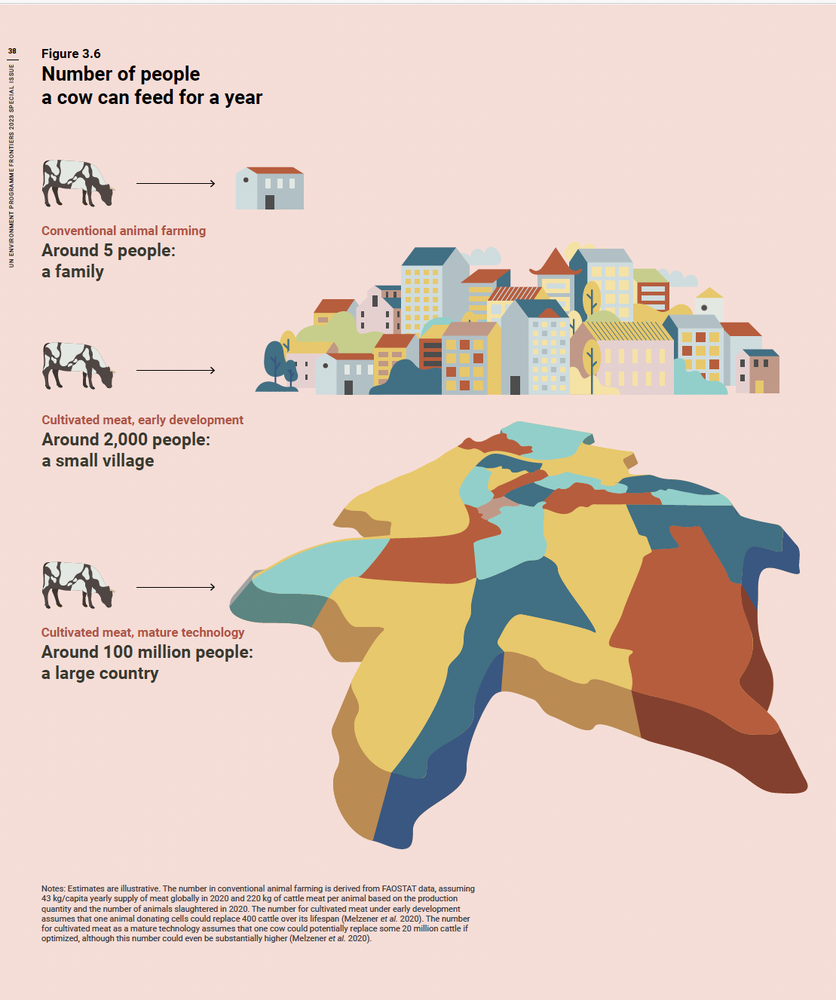
The UN Environment Programme estimate for how much meat cultivated meat can produce at scale compared to what an animal can produce now.
The Biggest Hurdle
If reducing methane emissions and the overall environmental impact of our food sector is so inexpensive, easy, and impactful, why haven’t we done it already? What could divert us from harvesting this low-hanging fruit?
The biggest hurdle isn’t consumers, as is commonly thought. The biggest hurdle is the American meat lobby’s power over politicians and the media. This influence ensures that government funding to novel innovation is slow and misinformation among consumers is rampant. Anecdotally, for example, I was in an interview when someone told me, “Consumers don’t like the taste of Beyond Meat.” I said, “I do, and I know many who do.” He responded, “I do, too, but I read it somewhere.” In short, negative campaigns from the meat lobby had this panelist second-guessing his own tastebuds and experience. Wow, that’s power!
It is important to note that EVs didn’t surge in the market in one day, and meat isn’t going away anytime soon. In other words, no, the world is not going vegan. There’s no need to panic. This isn’t an ‘either or’ situation. Meat will still be around: both 1) regenerative meat—expensive and scarce, mostly feeding the wealthy, and 2) factory meat—inexpensive, subsidized, and what most people eat, even when they think they are eating something labeled ‘humane’. Both will still exist.
However, allowing consumers to rotate in sustainable, complementary protein options and reduce their meat intake with other tasty items will reduce the pressure on the planet and our natural resources. This keeps us moving forward, not backward, in the fight against climate change and feeding the global population. If the meat lobby could be kept at bay, this diversification could happen relatively quickly and easily, providing meaningful change, expanded consumer choice, and maintaining America’s relevancy in food innovation and resiliency, a new priority of the Department of Defense under President Biden, that has since been curtailed.
Assuming we can keep the vested interests on track, what kind of financial opportunity are we looking at exactly?
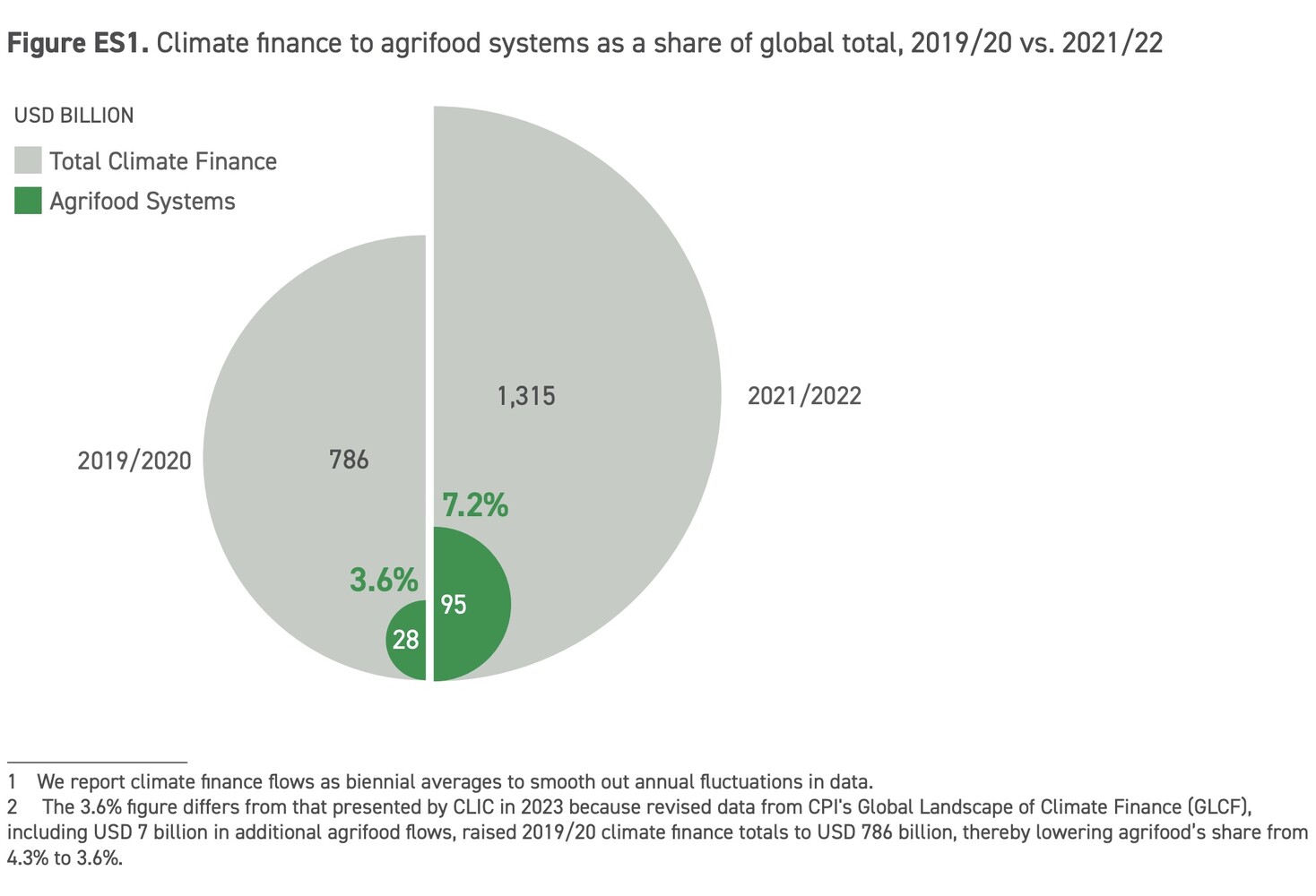
Climate Policy Initiative notes that only 7.2% of climate finance in 2021-2022 went towards agrifood systems.
Show Me the Money
Even better is that this represents an enormous business opportunity and investment case along the entire supply chain: AgTech, bio-technology, regenerative ingredients, flavor and texture innovations and consumer packaged goods. These are all exciting investment opportunities for the food industry and, in time, the public. As more blended capital dollars flow to R&D for complementary proteins ameliorating the entire supply chain and regenerative practices, more of the $9.7 trillion total food and beverage market, not including the supply chain, is addressed. The meat market is $1.65 trillion, 17% of the food and beverage market.
In short, the business opportunity is massive. In my opinion, the meat industry should be jumping at the chance to own and profit from the innovation opportunity around complementary proteins. After all, aren’t they there to make money? So make it.
As a Cargill executive shared with me after the company changed their name from a meat company to a general protein company in anticipation of a food system overhaul (paraphrased), “We don’t know when the food system will shift, but when it does, it will go quickly.”
Mahesh Roy of IIGCC, an investor organization focused on climate change, noted that capital will flow from the private sector into food transformation as it has into the energy sector. As paraphrased: “Keep it simple. Show people the data around the inefficiency of the current food system and they will find the opportunity to make money. Show them the added benefit of impact and the trillions will flow.”
Related: Protein Innovation Could Do for Meat What It Did for Potato Chips