
Trending

Ah, the all holy potato chip! What could ever possibly make that beautiful crisp better than it already is: potato, oil, salt…it’s perfection! Nothing could possibly be more delicious…or could it? What if the chip were baked, instead of fried? What if it were whole grain or had ridges? What if it were in the shape of a square, or the shape of a triangle and was made of blue corn? Wait! What if it no longer came in a bag but came in can with a pop-top lid!?! What if it were made from things like veggies or the sun? (What even is a Sun Chip?) Maybe it has flavors like ‘Flamin’ Hot???’
Indeed, there have been quite a few iterations made of the almighty potato chip. In fact, there is an entire aisle in the grocery store dedicated to its many versions. Yet, the classic potato chip is still thriving. Potato chips are expected to grow from almost $65 billion today to $113 billion by 2034, a CAGR of 7.22%.
It is the best of all worlds: the consumer still has the all-perfect, classic potato chip and they also have a slew of other tasty options. The whole category is up based on the innovation around the original, classic potato chip. The grocery store is happy. The consumer is happy. The chip makers are happy.
Along with more mouths to feed as the population has grown, innovation in chips has only increased demand for all chips. It hasn’t destroyed the original chip. The chip-snack industry has increased to meet demand and both the industry and consumers (waistline issues aside) benefit from more options.
Consumers Like and Benefit from Options; Supply Chain Resiliency is a Bonus
So, what if the meat counter were to expand its options such that the meat counter became more like an entire meat aisle? What innovations would we have in the short-and long-term and what would be the benefits of such an expansion to the industry and consumers? What are the protein possibilities that can help to scale protein production to not only meet increased dietary demand from MAHA, but also the increased demand from middle-income countries globally?
- Factory Meat: Not going anywhere! To be clear, before anyone worries that cheap meat is going to be pushed out, it won’t be. The fast-food burger and grocery store ground meats are here to stay. The impacts on animals and the environment are huge as this sector is currently the leading cause of global deforestation, water eutrophication, and 32% of the world’s methane emissions, but it is also how we currently feed a good portion of the population. Luckily, innovating for more options, such as the ones below, will lessen demand for this option, which will benefit, people, the planet and animal alike.
- Grass-Fed (AKA Regenerative) Meat; While attractive in concept (imagine animals in fields rather than factories and most people take a sigh of relief), it is an expensive option that serves mostly the wealthy. In this instance, giving the animals more land, water, space and time allows them to be healthier and the product, despite it still having high amounts of saturated fat and no fiber, to also be healthier as antibiotics, stressed animals and hormones can be avoided. However, more resources being used (land, water, time, food) also means a more expensive product. It also means that the product can’t scale for global production because it is more resource intensive than factory meat. This means the cost will remain out of reach of many.
- Plant-based Proteins. Often formulated from pea and soy proteins, using plant protein directly for the end product for human consumption, instead of using it as animal feed (requiring crops, water, land, time) to be converted by the animal and then be turned into food for people, is a much more efficient process. It uses less land and water than mono-cropping to feed animals and is a fast-to-plate process rather than the weeks, months or years of waiting for animal meat.
- Fermented Biomass Proteins (with fiber, bonus!) from mycelium-a protein technology already scaling and proving viable, providing both quantity and quality. Using technology akin to fermenting beer, this is a near-future game changer; creating large slabs of meat from microbes. Much like animal meat, it can be seasoned to be delicious.
- Cultivated Meat. This technology has a way to go yet, but what a guaranteed crowd pleaser: the actual meat grown from the cells of animals without the deforestation and water use needed for growing crops for animal feed. Just skip the animal and all its land, water, time and food needs altogether, while gaining a resilient and less pandemic-risky supply chain! Brilliant for the global win-win.
- Hybrid Meat. Rather than jumping to new options right away, maybe the industry moves in baby steps until we lock down the cultivated meat technology. Imagine burgers that are a blend of mushroom and beef, or a blend of fermented microbes and pork, or cultivated meat fat (much easier than cultivating a structured piece of muscle from cells) with soy or pea protein. Here the options are endless.
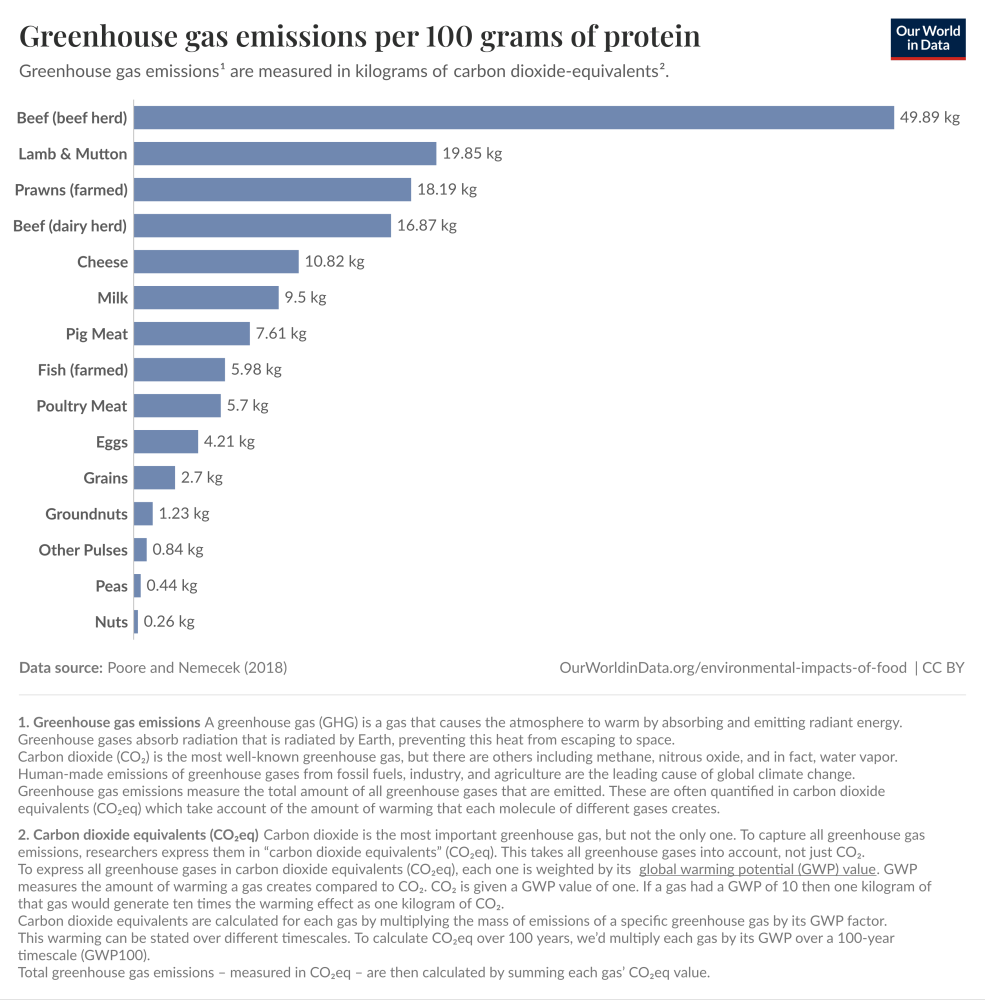
Greenhouse gas emissions per 100g of protein; by Our World In Data.
Don’t Mess With Meat…Unless You Want To Grow Profits Like The Chip Aisle
And so it could be with the meat counter. Factory meat, grass-roaming meat (expensive due to its use of natural resources, but a perfect option for the upper-spending tier), plant-based meats, fermented meats, cultivated meats and hybrid meats will offer more price and meat choices to the consumer, more production and profit options for the meat companies and more growth for the grocery chain.
Equally as exciting is the job growth that can come from innovation growth for all these new options.
If a Diverse Meat Aisle Is Such A Great Idea, Then What’s the Hold Up?
Alas, the hit job from the meat industry on the novel protein sector harkens back to how the oil and car industries killed the electric car in the ‘90s. Even though the meat industry would be, in my opinion, the financial beneficiary of a diversified protein aisle, the industry is resisting change.
This is doubly disappointing because the industry is very powerful and has the ear, through intense lobbying, of policy makers. I believe that they could get governmental support to start making shifts in the food system. So they wouldn’t even have to take on the risk themselves. It is an incredibly privileged position and I wish they would use it: get the subsidies, revamp the system to include more novel protein options and benefit financially from the growth. In the end, the current large food companies have the distribution channels and we can’t ignore that, while I love a good start-up story, the current food industry giants have the highest likelihood of success.
In the end, necessity is the mother of invention and, much like with the electric car, protein innovation will grow and solidify in the global culture because it has to, and most likely the industry titans will be a part of that shift. As discussed in my article, “The Food System is Fragile, Fractured and F-Bombed“, global food insecurity and risks to the food supply chain such as climate change, natural resources depletion and disease are on the rise.
As the population grows to 10 billion from 8 billion by 2050, we can’t keep expanding animal protein because it is too costly in time, land, water and crops resulting in 41% of tropical deforestation, water eutrophication from manure pits and 35% to 40% of the world methane emissions.
From the MIT Technology Review is a little considered but growing problem: “Farms have become larger in the past two decades or so, so there’s much more manure—and that has to be stored somewhere,” says Swati Hegde, the [Alberto’s Dairy] global manager of agricultural methane.
“Typically, cattle and swine farms spray manure into lagoons or tanks, creating a foul-smelling, low-oxygen slurry in which microorganisms known as methanogens thrive. They gobble up hydrogen, carbon dioxide, and other compounds and produce methane as a by-product. Other microbes in the mix produce smaller amounts of nitrous oxide.
“Both are particularly potent greenhouse gases, with as much as 30 to nearly 275 timesthe warming power of carbon dioxide, respectively, over a century.
“The slurry is often spread onto fields to add nutrients to the soil. When it’s done excessively or improperly, this part of the practice can pollute soil or groundwater with drug residues, pathogens like salmonella and E. coli, and nitrates. Nitrates that leach into drinking water have been linked to a variety of human health risks. And those that flow into rivers, lakes, and coastal waters can spawn algae blooms that poison fish, block sunlight, suck up oxygen, or form large coastal dead zones devoid of marine life.”
As noted by the unappetizing reality above, the innovation curve for the current production of animal meat has reached its end. Sure, we can tweak here and there to reduce methane or eutrophication, but we can’t squeeze more from the animals with any fewer inputs than we already do.
The crunch is on to produce more protein, that is more nutritious, in a shorter amount of time using fewer resources while causing less environmental, animal and human damage. Enter novel proteins.
Godspeed.
Related: Insect Protein Could Be a Pandemic Risk We’re Overlooking