
Trending

You already have an attention portfolio. The only question is whether you built it yourself—or whether someone else built it for you.

“I think, therefore I am…..?”
Last week I wrote about what I called the fourth retirement risk: identity. I argued that as the identities of successful men shrink when their careers end, the algorithm fills the vacuum.
This week, I want to focus on another target of the algorithm: our attention. I am convinced that attention is one of our most valuable assets in retirement and in life. Yet it’s one of our least protected.
Imagine you met with a financial advisor who refused to tell you what they were investing in, how they got paid, what risks they were taking, or why they were recommending one investment over another. Or a physician who started prescribing medications before asking about your symptoms, your age, your medical history, your current prescriptions, or other critical health questions. Or an attorney who urged you to sign a stack of legal documents without explaining what you were signing, what rights you were waiving, or what the long-term consequences might be. You’d be out the door in every one of these cases. You need transparency before commitment.
However, this is exactly what most of us do with the algorithm. We hand over our attention every day without asking even the most basic questions:
-
What are its incentives?
-
Is it trying to make me wiser or simply keep me engaged?
-
How does it decide what I see?
-
Does it reward accuracy or emotion?
-
Does it benefit when I’m calm or when I’m outraged?
-
Is it optimizing for my long-term well-being—or for the number of minutes I stay on the platform?
We would never hand our retirement portfolio to an advisor under those conditions, yet millions of us hand over our attention portfolio every morning without a second thought.
The strange part is that this surrender of attention rarely feels like a decision. It feels like relaxation. You sit down to check the news. Forty-five minutes later you’re watching a video explaining why civilization is collapsing. An hour after that, sometimes we’re arguing with someone we’ve never met. Somewhere in there, the hours just disappeared.
Running out the clock on TikTok
I asked a client, Michael, earlier this year what he was doing in retirement. I was trying to get the conversation back on track after a 15-minute diatribe on politics, podcasts, social media, AI, and cable news. (Tom, can you BELIEVE…?). Getting people to talk about themselves usually works to redirect a conversation back to goals, family, money, cash flow, etc.
Not this time. The story ended with him admitting that he hadn’t put an appointment on his calendar in a few weeks and was unable to tell me anything he did the last 2 days.
There isn’t a line in my professional fact finder where I can put Spends all day doomscrolling, or DraftKings owns his soul, or more optimistically, Really likes cat videos.
Descartes said, “I think, therefore I am.” But what does that mean in the age of the algorithm?

“I think, therefore I am…..?”

“I think, therefore I am WHAT I’M THINKING ABOUT?”
If we freely sacrifice our attention to the algorithm, and our attention shapes our thoughts, and our thoughts shape our identities, what are we becoming?
Managing your Attention Portfolio
We spend decades learning how to diversify financial assets. Yet almost nobody teaches us to diversify attention, even as we invest hours and hours of our attention on screens and clicks and comments. The issue isn’t whether you’re spending your attention. The question is who’s collecting the returns.
Think about your Attention Portfolio like your financial portfolio. How do you have it balanced? Imagine one that looks like this:
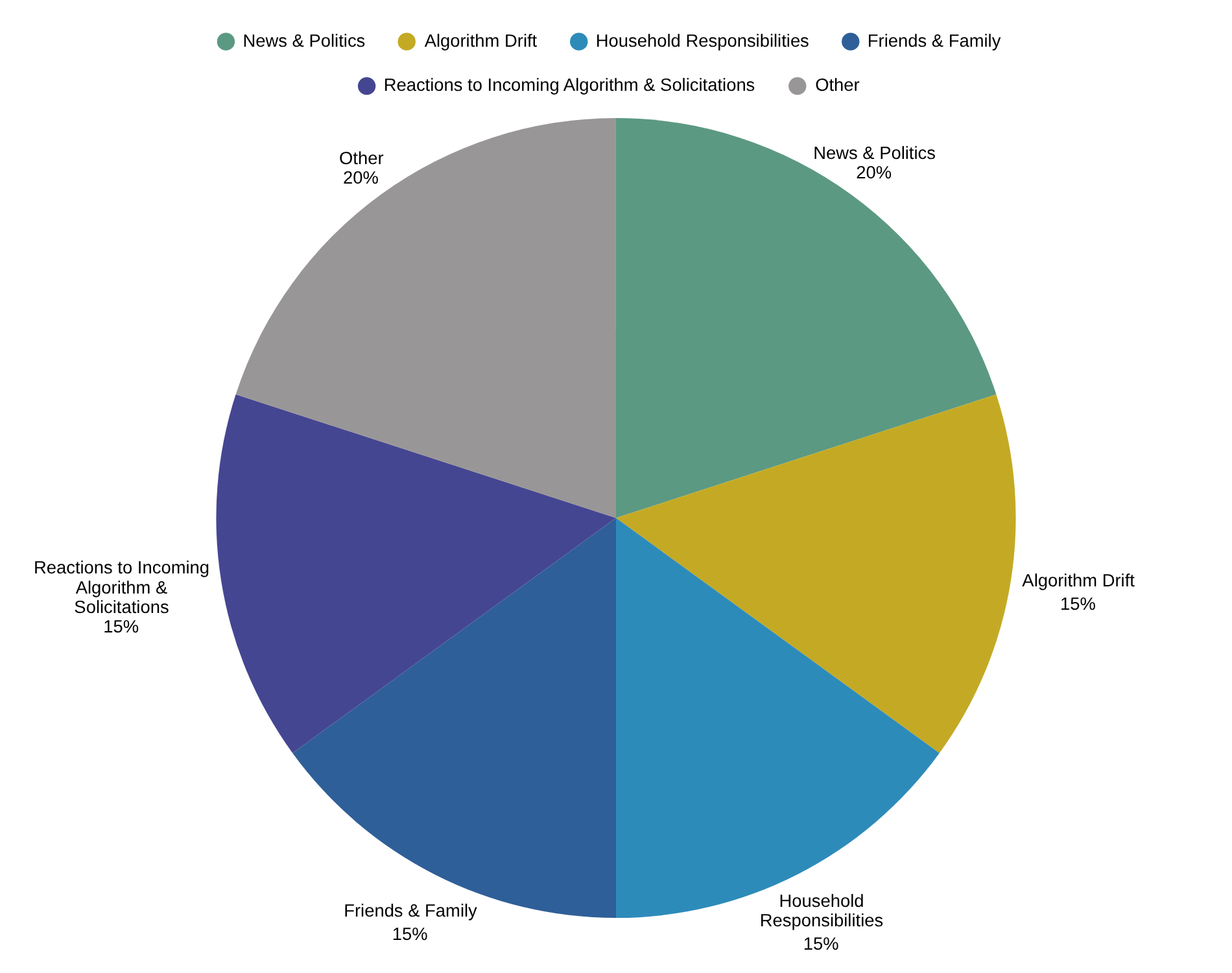
That’s the kind of attention consumption that could leave you unable to remember how you spent the last couple of days. You would want to rebalance, just like an out-of-whack portfolio, maybe closer to:
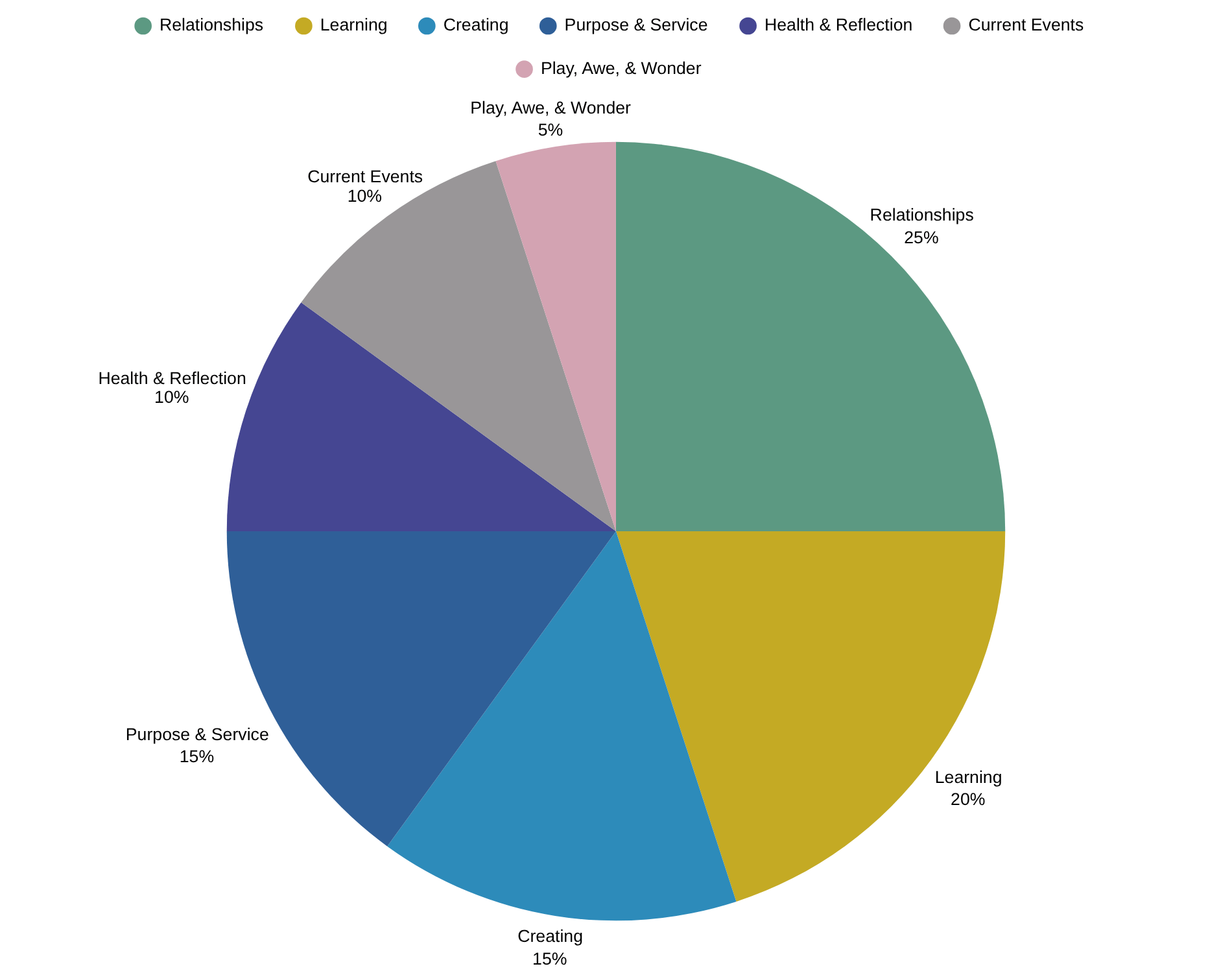
The exact percentages don’t matter. What’s important is doing this exercise so you’re more conscious of how you’re spending your attention.
Maybe we build a wealthy Attention Portfolio by applying the same concepts to 10 strategies:
1. Diversify your attention
Just as you wouldn’t put all of your retirement savings into one stock, don’t put all of your attention into one subject.
If every conversation, podcast, or news story revolves around politics, markets, or whatever is making you react this week, your thinking becomes less resilient. A healthy attention portfolio includes family, learning, creativity, service, friends, health, and yes, staying informed—but not consumed.
2. Invest a little every day
Wealth isn’t built by making one giant investment. It’s built by showing up consistently.
Your mind works the same way. Reading 10 pages, learning one new skill, mentoring someone, or having one human conversation every day will change you far more than cramming information into your brain once a month and drifting the other 29 days.
3. Let curiosity compound
Money compounds over time. So does curiosity.
One interesting book leads to another. One hobby introduces you to new people. One volunteer opportunity creates friendships you never expected. The more you feed your curiosity, the easier it becomes to stay curious.
4. Rebalance periodically
Good investors periodically look at their portfolios and ask, “Has one investment become too large?” Do the same with your attention.
Has cable news become your hobby? Have social media or YouTube become your default pastime? Every few months, step back and ask whether your attention is still going where you actually want it to go.
5. Don’t concentrate your identity in one place
Investors know concentration creates risk. The same is true for identity.
If your entire sense of purpose comes from your job, retirement can feel like losing yourself. If your entire mental world revolves around one issue or one community online, you can leave yourself vulnerable. Branch out and build multiple sources of meaning from the things that interest you.
6. Think long term
Successful investors don’t panic every time the market moves. The same principle applies to attention. Ask yourself, “Will I care about this a year from now?”
Many headlines disappear within days. Time spent with your family, learning a new skill, or helping someone else often pays off for decades.
7. Watch the hidden costs
Every investment has fees. Your attention does too.
Some activities leave you energized, hopeful, or wiser. Others leave you anxious, angry, or exhausted. Before spending another hour on something, ask yourself, “What is this costing me emotionally?”
8. Keep some mental cash on hand
Good investors keep some cash available for opportunities. You should do the same with your attention. I talked about this with Decision Liquidity and the Boredom Retirement Plan.
Not every moment needs to be filled with a screen or a podcast. Leave room for boredom and mental quiet. That’s often where your best ideas appear.
9. Don’t chase every headline
Experienced investors know that constantly chasing the hottest investment usually ends badly. Your attention works the same way.
Every breaking story isn’t worth your emotional energy. The people who think most clearly aren’t the ones consuming the most information—they’re the ones choosing the right information.
10. Review your portfolio
Every investor eventually asks, “How am I doing?” Ask yourself the same question about your attention.
If someone looked at where your attention went this month, what would they conclude? Are you becoming more curious? More generous? More interesting? Or just more reactive? Given how much attention we invest, you should be able to say what you got out of it.
Guard your attention when it’s most vulnerable
A good financial plan accounts for the possibility of bad outcomes. A solid portfolio weathers market uncertainty and turmoil.
Your attention portfolio needs to be prepared for how formidable an opponent the algorithm is. The algorithm becomes remarkably efficient at identifying periods of transition: Young adults. New parents. Recently divorced people. Widows. Retirees.
These transitions can create uncertainty, which makes us uncomfortable, which leads to a search for comfort (reassurance, distraction, commiseration, etc.). These moments can soak up our attention, which the algorithm notices like a shark sensing something in the water.
The algorithm doesn’t know whether you’re lonely because your spouse died, your children moved away, or you simply stopped going to the office every morning. It only notices that you’re available and gets to work serving up content. When you have a planful Attention Portfolio, it becomes easier to navigate that consciously and positively instead of spending hours clicking down rabbit holes.
Thanks for reading Age Against the Machine! Sign up to receive new posts.
Final thought
We spend decades building financial independence so we can finally choose how to spend our time, where to put our energy, our purpose, and our love. The tragedy would be arriving at that freedom only to discover we’ve accidentally or unwittingly outsourced where we put our attention.
Perhaps the next evolution of retirement planning isn’t simply asking whether your money will last. Instead, it’s asking whether your attention to what is truly important will.
Related: Why So Many Successful Men Lose Their Identity in Retirement
Disclosure: Client examples are illustrative only and do not represent the experience of all clients or any guarantee of outcomes. This material is provided for general informational purposes only and does not constitute individualized investment advice. Investing involves risk, including the loss of principal. No investment can guarantee a profit or protect against a loss. Investors should consult with their financial advisor before making investment decisions.