
Trending

It was a light week for economic news, but markets finally encountered some turbulence after an impressive run. Most major U.S. indexes finished the week lower as investors weighed two growing concerns:
-
Will massive AI investments generate the profits companies are promising?
-
Is the renewed conflict in the Middle East leading to a resolution?
The Nasdaq led the decline as technology stocks stumbled following earnings from Alphabet and Tesla, both of which now sit below their respective 200-day moving averages. The broader S&P 500 proved more resilient thanks to strength in sectors like financials and healthcare. The Russell 2000 also pulled back, while mid-cap stocks managed a modest gain, highlighting that investors continue rotating rather than simply heading for the exits.

This might be the prettiest thing I’ve every seen. Chart from Duality Research
The market’s attention has shifted noticeably over the past several weeks. Earlier this year, investors were willing to overlook geopolitical risks and focus almost entirely on strong corporate earnings and AI-driven growth. Earnings are still strong, but growth may no longer be enough for investors without some proof of a return on investment.
Geopolitically, the repeated negotiation failures between the US and Iran have given way to increasingly aggressive strikes and equivalent posturing. As tensions have now risen beyond a war of words again, the risk to global trade and energy logistics is no longer something the market can ignore. Rising oil prices and higher Treasury yields are forcing markets to reconsider whether inflation has truly been defeated.
AI Doubts Creep In
Technology remains the market’s biggest long-term growth story, but the next chapter of this hero’s journey may be full of challenges. Investors are becoming less interested in how much companies are spending on AI and more interested in when those investments will begin producing meaningful profits and cash flow.
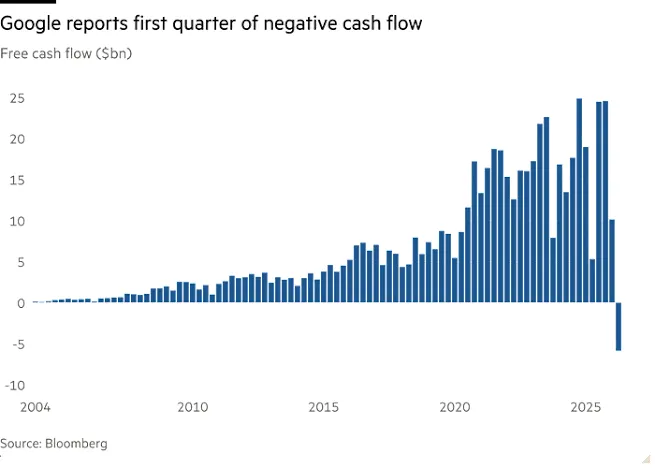
Alphabet’s earnings illustrated that shift perfectly. Strong cloud growth and healthy demand for AI services were overshadowed by another increase in planned capital spending and the first quarter of negative cash flow. Investors reacted by punishing Alphabet with a 6% selloff after hours. That reaction suggests investors are becoming more disciplined, rewarding companies that can demonstrate returns instead of simply spending more at all costs.
Despite the weakness in technology, the broader market has remained relatively resilient. Money rotating into other sectors has helped cushion the S&P 500, even as the index slipped below its 50-day moving average. On a year-to-date basis, earnings per share growth has outpaced the price returns which makes the S&P 500 (and most sectors within) a better value than at the start of the year.

Overall Market breadth also remains healthier than it was late last year, although participation weakened modestly this week, particularly within the tech-heavy Nasdaq.
Inflation Risks Rebound
Renewed tensions involving Iran pushed oil prices sharply higher, raising concerns that energy costs could once again feed broader inflation. Although prices eased on Friday, crude oil prices closed on Thursday at their highest level since June 4th.
Worries quickly spilled into the bond market, sending the 10-year Treasury yield above 4.7% for the first time since January 2025 before also easing by Friday. Higher oil prices do not automatically mean lasting inflation, but the longer energy prices remain elevated, the greater the chance those costs spread throughout the economy.
Economic data was lighter this week but painted a generally resilient picture. Business services activity accelerated as the July S&P Composite PMI reached its strongest reading in eight months. Initial jobless claims unexpectedly fell to their lowest level since 1969. In the housing sector, rising borrowing costs are still weighing on buyer activity.
The data gives the Federal Reserve room to keep interest rates unchanged at the July meeting, although there may be some dissent from the more hawkish members of the committee. Expectations for September have become much less certain. If oil prices remain elevated and inflation pressures broaden, another rate hike could move from a possibility to a probability.
What this means for investors and what’s next
Next week could prove to be one of the most important weeks of the summer for investors. Markets will have a lot to digest, including a Federal Reserve meeting, more inflation data (PCE), policy decisions from the Bank of Japan, and earnings from four of the largest technology companies (Amazon, Apple, Meta, and Microsoft). Numerous semiconductor and memory chip companies will also report.
The Middle East remains the biggest wildcard, and could contribute to volatility in both directions. Any signs of renewed negotiations between the U.S. and Iran could ease oil prices, lower Treasury yields, and provide much-needed support for stocks. Conversely, further military escalation would push energy prices higher, reinforce entrenched inflation concerns, and increase the pressure on both bonds and stocks.
From a technical perspective, the market has lost some momentum, with the S&P 500 slipping below its 50-day moving average and the Nasdaq breaking near-term support. This movement doesn’t necessarily signal the end of the bull market, but it does suggest investors should expect a bumpier ride in the weeks ahead.
Alphabet’s earnings showed that strong revenue growth isn’t enough to paper over excessive capital spending. Keep a close eye on Apple this week, which never played the AI capex game and may continue to reap the rewards.
Unless geopolitical tensions ease or earnings significantly exceed expectations, volatility is likely to remain particularly elevated in the affected industries. If you feel queasy about your portfolio positioning, consider whether you have the stomach to weather short-term volatility in favor of potential longer-term returns. If not, you may need to follow the crowd in a rotation trade away from AI.
Related: How SpaceX's Lock-up Schedule Could Fuel Months of Volatility