
Trending

Give non-professional market participants some credit. They remain engaged with equities even as the S&P 500 is off nearly 2% year-to-date.
Retail investor activity hit an all-time high nearly two months ago and remains stout even as domestic stocks disappoint. February brought an extension of that trend. Although the S&P 500 dipped 1.4% last month, data confirm retail investors remained net buyers of stocks.
Advisors may be thinking “no big deal.” Trends like this come and go and the perception remains that retail investors often get it wrong. However, there are demographic implications advisors should not ignore, including the fact that’s been older market participants that as of late have been the most devoted dip buyers.
That may surprise plenty of advisors and other market observers because conventional wisdom dictates that it’s Gen Zers and millennials that widely embrace equity market risk while their older counterparts dial it back when markets decline. Data confirm otherwise and it may be equally or more surprising to learn which older demographic is leaning into stocks even as the asset class falters.
Gen X Swinging for the Fences
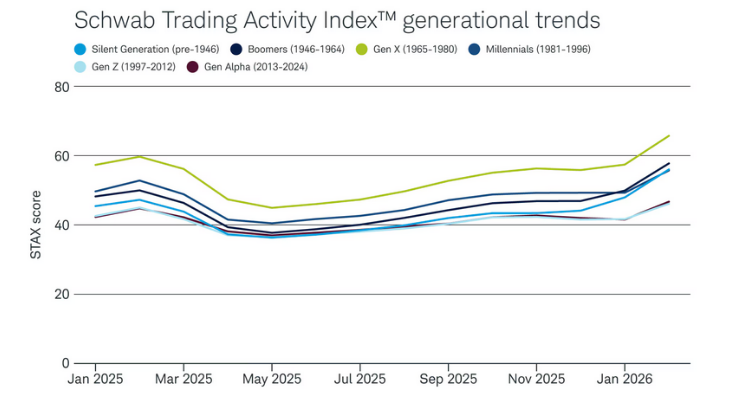
The Schwab Trading Activity Index™ (STAX), which tracks that firm’s clients equity holdings and trading activity to get a handle on broader sentiment, surged 15% last month with much of that increase attributable to Gen X.
“Gen X investors, born between 1965 and 1980, led the charge over the proverbial wall of worry. While Gen X has consistently posted the highest STAX score among all generations since Schwab began tracking generational data in June 2024, their February STAX score of 65.71 marked a record high,” according to the brokerage firm.
In fact, the Schwab data indicate that the firm’s Gen X clients were more bullish last month than their younger millennial counterparts. Gen X was also more aggressive than the groups below millennials.
“Gen Z's STAX score rose 10.6% month over month to 45.36, while Gen Alpha's score rose 12.4% to 45.36,” adds Schwab. “Younger generations have been coping with higher unemployment rates amid a labor market slowdown, which may have played into their more bearish sentiment in February. The U.S. unemployment rate for those aged 16 to 24 rose to 9.5% in February, according to the Bureau of Labor Statistics, compared to just 4.2% for the prime-age workforce (ages 25 to 54) and 3.3% for individuals 55 and older.”
Why It Matters to Advisors
Advisors should already be cultivating relationships with Gen X. The great wealth transfer dictates as much as does client retention when current baby boomer clients pass on.
Wealth managers should also be inquisitive as to level of risk-taking by Gen X clients in discretionary accounts. Are they taking on too much risk because they feel behind on retirement savings? Are they doing it in hopes of funding a major purchase? Relevant inquisitions to be sure, but it’s also worth remembering Gen X has seen a lot when it comes to market history.
“Many of these investors have lived and eventually profited through market downturns tied to the dot-com and global financial crisis bear markets. Staying the course and looking for oversold opportunities has been a hallmark of their investing strategies,” notes Joe Mazzola, head trading and derivatives strategist at Schwab.
Related: Options Income ETFs Matter. So Does Being Selective.