

Trending

This year is at the halfway mark and it’s safe to say it’s been a challenging one, though not necessarily to an alarming extent. With that in mind, there’s plenty of good news for advisors.
As highlighted in a new study by Natixis Investment Managers, advisors reported assets under management (AUM) growth of 12.5% over the past year. That percentage is expected to moderate a bit over the coming year, but the long-term expectations remain encouraging.
“While advisors expect continued growth, their average 12-month outlook moderates to 10.7% as 64% say many clients want to hold more cash due to geopolitical uncertainty,” according to Natixis. “Longer term, advisors’ average growth outlook rises to 11.2% over the next three years, suggesting confidence that they can navigate the structural changes reshaping the business of advice.”
That sanguine outlook is in place even as advisors acknowledge they’re demographic and technological challenges emerging.
Speaking of Technology…
Advisors are already aware that technology is an essential part of their practices, but data confirm it behooves advisors to stay abreast of tech trends and be quick to embrace tech as a foundation of growth, not reluctant to arrive at that conclusion. Not surprisingly, technology is also viewed as a potential competitive threat to the wealth management industry.
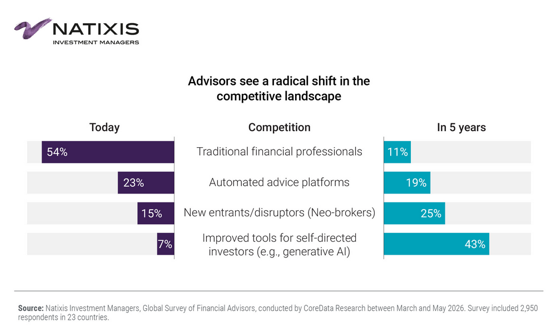
(Image: Natixis)
Artificial intelligence (AI) is also top of mind for advisors. Interestingly, the Natixis survey indicates wealth managers view AI as both a possible threat and an avenue for bolstering their practices while improving service to clients.
“Advisors are also looking for ways to use AI to strengthen their businesses. Two-thirds (66%) say AI has the potential to drive market growth for the next two decades, 70% say it can free up more time to spend with clients, and 76% say advisors who adopt AI will have a competitive advantage,” according to the study. “Still, 58% say integrating AI into workflows has been more difficult than expected, and 65% say investors take unnecessary risks when turning to AI for advice.”
Demographic Challenges Front-and-Center
As has been widely documented, the wealth management industry faces demographic challenges on multiple fronts. First, the great wealth transfer isn’t always what it’s cracked up to be if beneficiaries of current clients leave when those clients pass on.
Second, the industry is grappling with an inadequate replacement rate. Many advisors are retiring, but “new blood” isn’t replacing them on a one-for-one basis. Some advisors see opportunity in these challenges. Presumably, advisors are capitalists and they believe they can benefit from the wave of retirements hitting the industry because demand for wealth management services, particularly led by humans, is growing.
“Nearly eight in ten U.S. advisors (78%) say the wave of advisor retirements is a significant opportunity to grow their business, even as 65% say it will widen the advice gap. U.S. advisors also appear more confident than their global peers in navigating the transition, with only 37% saying they are struggling to hire young advisors to bridge the aging advisor gap, compared with 51% globally,” concludes Natixis.
Related; 90% of Clients Embrace Model Portfolios—But Advisors Still Face One Big Challenge