

Trending

As of the end of July, US-listed exchange traded products (ETPs), mainly ETFs, controlled north of $11.5 trillion in assets under management, according to ETFGI data.
A staggering sum to be sure and one that’s supported in significant part by advisor adoption and retail investors. However, an asset class doesn’t get to $11.5 trillion without the help of institutional investors. As is the case with other market participants, high-level pros like the transparency and tradability of ETFs, the tax advantages associated with these products, democratization of asset classes, low fees or some combination of all four of those traits.
In the U.S., the ETF industry is just over three decades old, which is still youthful in financial services terms. That implies ample room for issuers and investors to change with the times and there’s evidence that’s occurring. It also implies there’s a long runway for adoption among professional investors –the scenario that’s playing out today.
State Street’s 2024 ETF Impact Survey shows two-thirds of institutional investors use ETFs “exclusively” or “extensively” and that percentage is significantly higher in other developed markets such as Australia, Japan and multiple European countries.
Pros See Various ETF Benefits
Sophisticated market participants have a variety of reasons for using ETFs. Alone, that implies favorable adoption and assets under management trends continue, but it’s also worth drilling down on why institutional investors embrace ETFs.
Thirty percent told State Street they use ETFs to effectively manage risk while a nearly comparable percentage view ETFs as tools for buffering against volatility and avenues for increasing cybersecurity measures.
“Risk and uncertainty are constants in institutional investing. Today investors are more focused than ever on tools that offer stability in the face of disruption,” notes State Street.
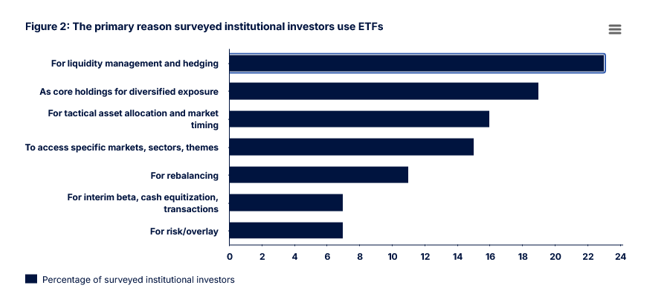
(Chart Courtesy: State Street Investment Management)
ETF liquidity, which is sourced in primary and secondary markets, is another major reason why institutional investors user ETFs. “Secondary market” implies there are two markets – primary and secondary. The latter is crucial in identifying and supporting ETF liquidity, particularly when selling pressure intensifies.
“ETFs provide multiple layers of liquidity—including both primary market creation/redemption mechanisms and deep secondary market trading—making them flexible and cost-efficient tools for institutional portfolios, especially when executing sizable trades,” according to State Street.
Costs, Diversification Meaningful, Too
ETFs have long been hailed for cost efficiencies and, in some cases, the ability to provide diversification. Those attributes are often viewed as positives to advisors and do-it-yourself investors, but high-level market participants are increasingly awakening to the fact that the median ETF expense ratio is 0.44%, or less than half the 0.92% found on open-end mutual funds.
Endowments, hedge fund, insurance companies, pensions and other institutional investors are also flocking to ETFs to harness the diversification benefits of cryptocurrency and gold and protection sourced from outcome-driven products.
“ETFs are increasingly providing relatively easy, liquid, and cost-efficient exposure to once harder-to-reach opportunities,” concludes State Street. “For institutions looking to future-proof portfolios, ETFs potentially offer a powerful way to embrace a more modern, multi-dimensional approach to risk management.”
Related: Surprising Perks With Gifting Appreciated Stocks to Heirs