
Trending

Organizations don’t stall because they lack insight. They stall because they mistake insight for the answer. There’s this expectation that insight should/will arrive already translated into a decision.
Shocking news: It doesn’t. And it shouldn’t.
Insight is evidence. Nothing more. Nothing less. And treating it as an answer is how leaders outsource judgment and delay action.
To that point, Voice of the Customer and Voice of the Employee programs are inputs that deliver data and evidence, i.e., patterns, signals, friction, unmet needs. What they don’t deliver is a decision. (Honestly, insight doesn’t just happen either; there’s work to be done to uncover that insight.)
Yet many leaders wait for insight to arrive fully translated into a solution, complete with priorities, funding logic, and risk mitigation. When that translation never comes, action quietly dies in the space between knowing and doing.
That gap is not a CX problem; it’s really a leadership problem. Organizations rarely fail to act because they can’t; they fail to act because they don’t have to.
The False Promise of “Actionable Insight”
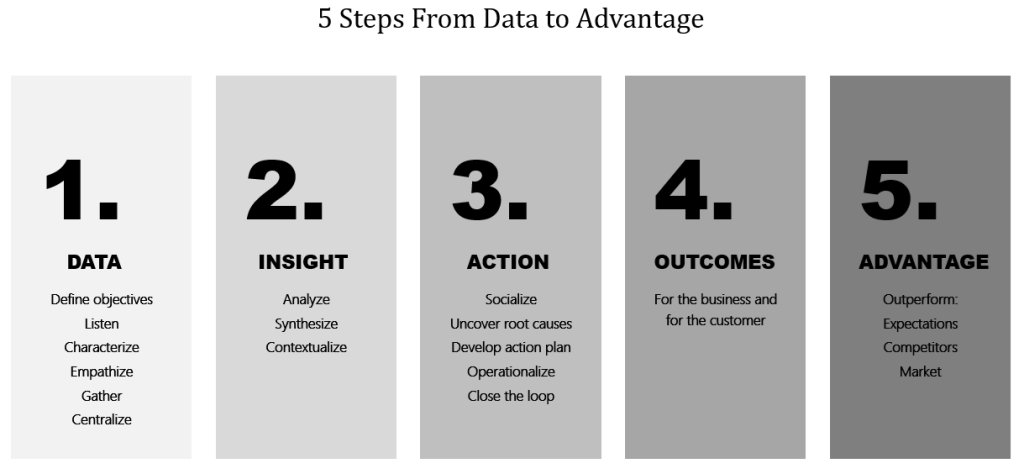
We talk endlessly about actionable insight, as if insight itself should somehow tell us exactly what to do next. Honestly, that framing is misleading. I’ve written and spoken for years about Insight to Advantage (and Data to Advantage – see the graphic below). It looks like this, in a nutshell:
Data → Insight → Decision → Action → Advantage
Just remember, insight doesn’t:
- Just magically appear (I should add another step before insight: Analysis)
- Make trade-offs for you
- Resolve competing priorities
- Account for resource constraints
- Weigh risk, timing, or impact
Those are leadership responsibilities.
When organizations expect insights to arrive pre-packaged with answers, they unintentionally signal that decision-making is optional. The result is familiar: more analysis, more dashboards, more debate, and less movement.
Why Organizations Get Stuck in the In-Between
The gap between insight and action is not a failure of data or empathy. It’s a failure of decision discipline. (Remember, decision discipline doesn’t mean saying “Yes” to every insight. It’s about refusing to leave insight unanswered. Inaction without explanation is the real failure.)
Common symptoms include:
- Unclear ownership once insight is surfaced
- No defined decision rights
- No expectations for response
- No consequence for delay or inaction
So insight piles up, admired but inert. In these environments, CX teams are asked to explain, reframe, justify, and persuade – when their real role should be to surface evidence and clarify opportunity, not to lobby for action. (Your governance committees must take on that role.)
When CX is expected to deliver decisions, it signals that leadership has outsourced judgment.
The Role of CX: Evidence, Clarity, and Urgency
At its best, CX does three things exceptionally well:
- Surfaces patterns and friction in lived experiences
- Clarifies urgency and potential impact
- Frames opportunities in a way leaders can engage with
That’s already substantial value. But CX does not/should not own decisions. It also doesn’t control budgets, policies, trade-offs, or risk. When CX is expected to “carry insight across the finish line,” organizations blur accountability and set everyone up to fail. (You know this, right? You’ve been there done that.)
Leadership’s Real Job: Turning Evidence into Movement
Leaders don’t just decide. They must design the conditions under which decisions happen, including:
- Clear ownership for acting on insight
- Explicit decision rights
- Expectations for response, not just for review
- Permission to act with incomplete information
- Visible follow-through
In mature organizations, insight doesn’t need to be pushed. It enters a system that already knows what to do with it. That’s the difference between insight being interesting and insight being consequential.
Organizational Maturity Isn’t “Meeting in the Middle”
You’ll often hear that organizational maturity shows up in how well insight and action “meet in the middle.” That sounds reasonable, but it’s incomplete. True maturity is revealed by whether insight creates obligation:
- Does someone own the response?
- Is a decision required?
- Is that decision communicated back?
If CX has to chase leaders, repackage insights, or advocate endlessly for movement, maturity is still aspirational.
The Golden Thread at Work
This is where the Golden Thread either holds or snaps.
When insight is treated as evidence that demands leadership judgment, the connection between values, decisions, and outcomes stays intact. When insight is treated as an answer – or worse, as optional input – the Thread frays, strategy drifts, culture weakens, and the experience suffers.
Insight doesn’t drive change on its own. Leaders must drive it.
In Closing
Stop asking insights to do the work of leaders. Evidence informs. Leaders decide. Organizations move or stall based on whether those roles are clear and enforced.
Insight is evidence. Evidence demands interpretation. Interpretation demands decision.
In mature organizations, insight doesn’t sit in dashboards waiting to be admired. It creates obligation. Someone owns the response. A decision is made. Movement follows, even if the answer is “not now.” CX does not have to lobby for action, and employees do not have to wonder whether speaking up matters. (Remember, I wrote about this in my post about building a culture of listening and action.)
This is where the Golden Thread becomes visible. When culture, employee experience, and customer experience are truly connected, insight flows through the organization with intent. Leaders understand how listening links to priorities, how decisions shape behaviors, and how behaviors produce outcomes. Listening without action breaks the Thread. Action grounded in evidence strengthens it.
Until leaders treat insight as the starting line rather than the finish line, organizations will keep listening loudly and moving quietly. And employees and customers will notice.
Nothing is more terrible than activity without insight. ~ Thomas Carlyle [or vice versa!]
Related: People-Centric or Profit-Centric? In 2026, Culture Decides the Winner