
Trending

Written by: Adam Blumberg, CFP
Concentration is often how significant wealth is created. The planning challenge is deciding how much of your future should continue to depend on one asset.
For many founders, early employees, and digital asset investors, wealth did not come from owning a little bit of everything.
It came from knowing one business, technology, network, or investment unusually well. It came from accepting uncertainty, maintaining conviction, and remaining invested long enough for the thesis to work.
That concentration may be the reason the wealth exists.
Then the circumstances change. A private company becomes valuable. Employer stock appreciates. A token launches. An early investment grows into the largest part of the balance sheet.
At that point, the same asset that created the wealth can begin to affect nearly every other financial decision.
A concentrated position is not inherently a mistake. The problem begins when one asset is expected to create the wealth, preserve it, fund every goal, cover every tax obligation, and support the family indefinitely.
The objective does not necessarily have to change from owning the asset to selling it.
It does, however, have to expand from accumulating wealth to coordinating wealth.
Concentration Is Often the Engine of Wealth Creation
A concentrated position exists when a meaningful portion of your net worth is connected to one asset, one company, or one asset class.
That concentration can arise in many ways.
A founder may have most of their wealth tied to a private business or shares in a newly public company. An early employee may accumulate stock options or restricted stock units before an IPO. A crypto founder or contributor may receive a substantial token allocation. An investor may hold a large position in Bitcoin, ETH, NVIDIA, or another asset that appreciated far beyond the original investment.
In many of these cases, the concentration was entirely rational.
You understood the opportunity. You believed in the business or technology. You accepted the risks. You stayed involved through periods when the outcome was far from certain.
Traditional diversification advice can feel disconnected from that experience. When someone immediately recommends selling the position that created the wealth, it may sound less like planning and more like abandoning the conviction that made the outcome possible.
Good concentrated-wealth planning should not begin by dismissing that conviction.
It should begin by recognizing that the financial consequences of the position have changed.
When Does Concentration Become a Planning Problem?
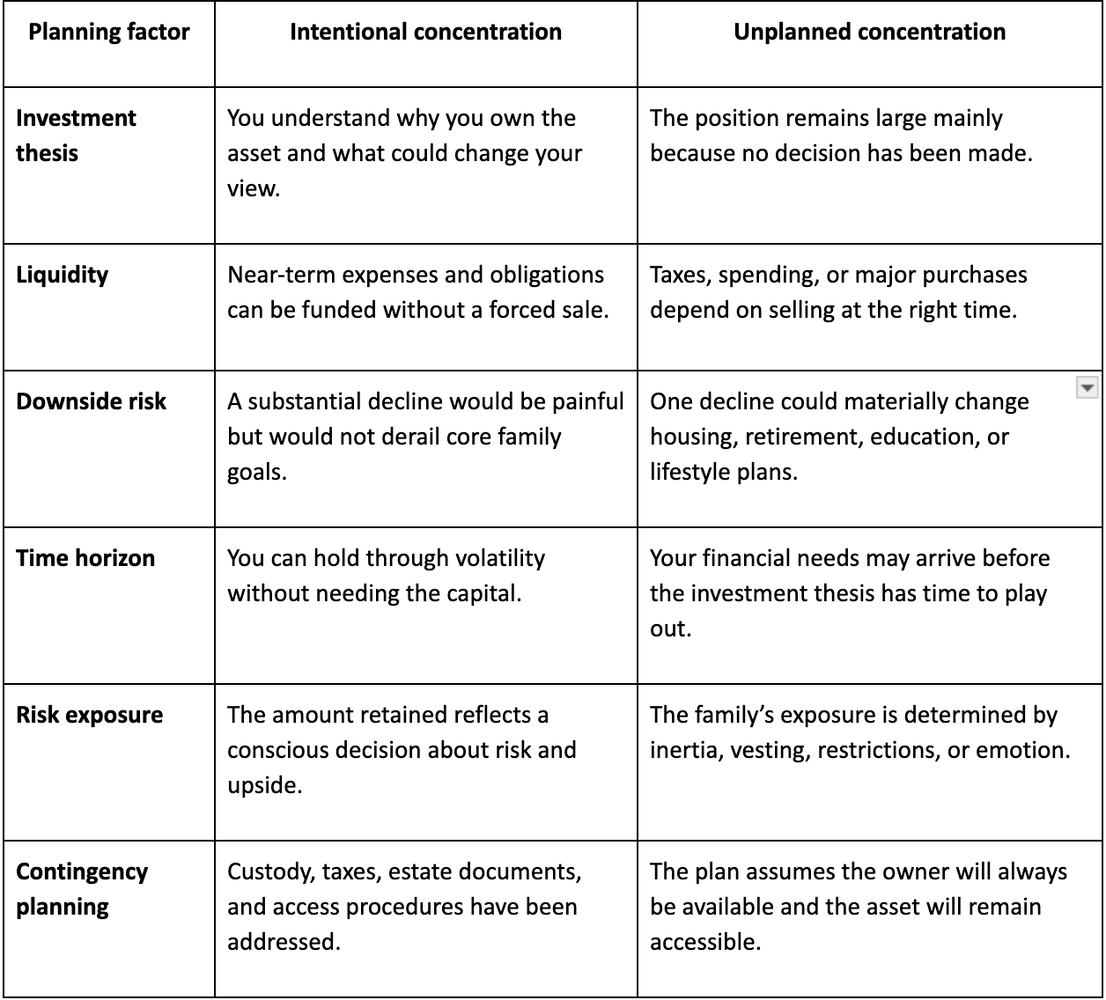
The percentage of your net worth held in one asset matters, but it does not answer the entire question.
Two people can hold equally concentrated positions and face very different risks.
One may have substantial income from another source, several years of liquid reserves, modest spending needs, and no upcoming financial obligations. The other may depend on the concentrated asset to purchase a home, pay taxes, exercise options, fund education, and support regular family expenses.
The position may look the same on paper. Its effect on each family is completely different.
That is why concentration should not be measured only as a percentage of a portfolio. It should also be measured in terms of financial dependency.
The more jobs one asset is expected to perform, the more vulnerable the plan becomes to one unfavorable outcome.
Measure Risk in Family Terms
The basic investment question is whether the asset can decline.
The more useful planning question is what that decline would change in your life.
Could your family still purchase the home you have been considering? Would education funding, retirement, charitable giving, or regular spending remain intact? Would you have enough liquidity to meet a tax obligation? Would a severe downturn force you to sell at the worst possible time simply to generate cash?
These questions do not assume that the asset will fail. They acknowledge that even an excellent long-term investment can experience volatility, illiquidity, legal restrictions, operational problems, or an extended period of underperformance.
For digital assets, the risk may extend beyond market price. Custody failures, compromised keys, smart-contract vulnerabilities, or inadequate continuity planning can make an otherwise valuable position difficult or impossible to access.
For founders and employees, exposure may extend beyond the shares themselves. Income, benefits, career prospects, and personal net worth may all depend on the same company.
The goal is not to predict every possible adverse event.
It is to determine which events your financial plan could survive without sacrificing the priorities the wealth is intended to support.
Diversification Does Not Have to Mean Selling Everything
Many founders, executives, and crypto investors hear the word “diversification” and assume the recommendation will be to sell most of the position and move the proceeds into a conventional portfolio.
That is NOT the only way to manage concentration.
A thoughtful strategy should account for your investment thesis, time horizon, tax position, other income, family circumstances, future cash needs, and willingness to accept volatility.
Depending on those factors, planning might involve creating a dedicated cash reserve, gradually selling part of the position, improving custody, hedging selected risks, developing another source of income, or evaluating whether prudent borrowing could provide temporary liquidity.
Every choice involves tradeoffs.
Selling may create taxes and reduce future participation in the asset. Hedging has costs and can limit upside. Income strategies may introduce additional complexity. Borrowing adds leverage and could create forced-liquidation risk. Holding the entire position leaves more of the family’s future dependent on one outcome.
There is rarely a strategy that eliminates every risk while preserving every potential benefit.
The objective is to choose the tradeoffs deliberately instead of allowing a tax deadline, market drawdown, trading restriction, or cash emergency to make the decision for you.
Keep the Conviction. Reduce the Dependency.
Concentrated-wealth planning does not have to begin with the question, “How much should I sell?”
A better starting point may be:
What does this asset need to accomplish, and which parts of my life should no longer depend on it?
Perhaps you want to retain meaningful exposure because you continue to believe in the asset’s long-term potential. That may be entirely reasonable.
At the same time, you may decide that the next home purchase, several years of family spending, an upcoming tax obligation, or a child’s education should not depend on the asset’s price at one specific moment.
That distinction can preserve the investment thesis while reducing the possibility that short-term circumstances force a long-term investor into a bad decision.
In other words, the goal is not necessarily to eliminate concentration. It is to separate the risks you are intentionally choosing from the risks you are carrying by default.
Coordinating Wealth Requires More Than an Investment Recommendation
Once one asset becomes a significant part of the family’s financial life, the planning work extends beyond portfolio management.
Liquidity, taxes, cash flow, custody, estate planning, insurance, asset protection, and family goals begin to interact.
A decision in one area can affect several others.
Selling shares may create liquidity but also generate taxes. Borrowing may delay a sale but introduce leverage. An estate-planning strategy may change how an asset is owned or transferred. A custody arrangement may protect against one risk while creating new operational responsibilities. A tax-efficient decision may still be a poor decision if it prevents the family from accomplishing an important goal.
That is why the objective should be coordination rather than isolated optimization.
The best tax outcome is not always the best family outcome. The highest expected return is not always the most resilient financial plan. The most sophisticated strategy is not necessarily the best strategy if you don’t understand it or can’t maintain it during a difficult market.
Make the Wealth Serve the Life
The purpose of planning is not to erase the asset that created your wealth.
It is to prevent every other part of your financial life from depending on that asset behaving perfectly.
A substantial gain should create choices. It should not create constant anxiety over the next earnings call, market drawdown, vesting date, or token unlock.
With coordinated planning, a concentrated position can remain an important part of your investment thesis while also supporting the people, goals, and opportunities that matter most.
The question is not simply whether you should continue to own the asset.
The question is whether the rest of your financial life has been designed to coexist with it.
Related: AI Bubble or Investing Revolution? Evidence Points Both Ways