
Trending

Aging without the Hallmark nonsense
For most people, A Christmas Carol is a beloved holiday fable about generosity and redemption. But strip away the snow, carols, and sentimentality, and you’ll find something deeper: a structured intervention for an adult to help him confront three blind spots that shaped the arc of a life.
Dickens’s ghosts reflect how we became who we are, how we misunderstand where we are now, and how many futures we accidentally walk into because we never bothered to look ahead. The ghosts aren’t supernatural. They’re lenses for holiday reflection. And if you’re serious about aging well—physically, financially, psychologically—you need to make peace with all three.
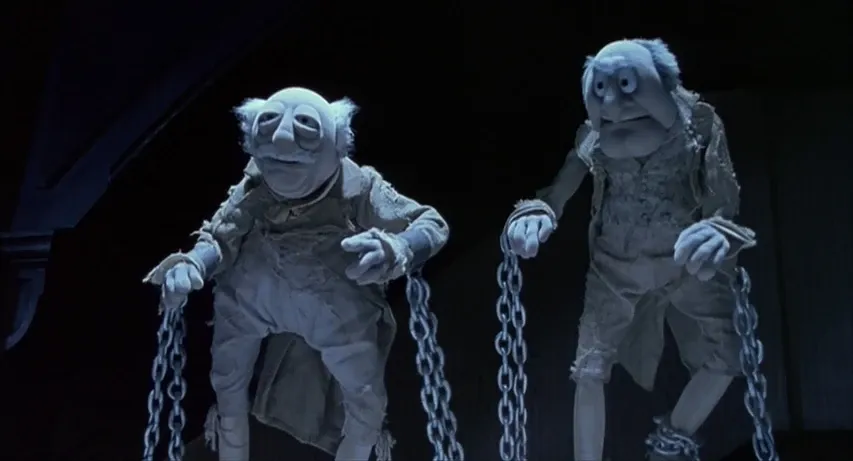
“‘I wear the chain I forged in life,’ replied the Ghost. ‘I made it link by link, and yard by yard; I girded it on of my own free will, and of my own free will I wore it.”—Marley’s ghost in A Christmas Carol (aka Marley & Marley in the Muppets version)
The Ghost of Christmas Past: How younger you still powers current you
The Ghost of Christmas Past doesn’t show Scrooge his childhood to evoke sympathy. It reveals the past to show Scrooge the events and choices that shaped his current life and emotional state.
One of the most dangerous myths in adulthood is that we “outgrow” our younger selves. Instead, research shows that we carry our younger identities forward, often unexamined, often uninvited, like legacy software quietly running the operating system.
The expectations of youth become the default habits of adulthood
As we grow up, we absorb a host of lessons, observations, and expectations about:
-
What success looks like
-
How hard we’re supposed to work
-
What our relationship with money should be (Tool? Scorecard? Security? Measure of personal worth?)
-
What our hierarchy should be for work, rest, and play
These expectations seed early habits that became behaviors like:
-
We don’t talk about money.
-
The future is uncertain, so why try to plan?
-
Today’s needs outweigh tomorrow’s worries or possibilities.
I see this in my professional capacity regularly.
A client named Joey came in years ago, close to retirement and loudly proud of his career successes, which he attributed to his thoughtful discipline in all areas of his life. He trained daily, rarely missed work, and hadn’t taken a real vacation in years. He had accumulated significant wealth through diligent savings and astute planning and questioned the value of paying for financial advice when he, through at least one measure, was thoroughly capable of managing his wealth. He had spreadsheeted his financial accumulation monthly for the last two decades as evidence of his prowess.
He also had accumulated two ex-wives and three estranged children along with one “scumbag” ex-business partner.
Now that he was entering a new phase of his life, I asked Joey what the new “job of his money” would be given that his life would no longer revolve around accumulating wealth. It was clear, however, that Joey still thought in terms of accumulating money for its own sake.
I pivoted to his personal relationships with a question I use to shape this kind of discussion: “Who is your 3AM emergency call?” Joey short-circuited. Without answering, he quickly wrapped up the meeting and thanked me for my time, rushing out of the conference room. He didn’t say it, but I sensed the bah-humbug in his exit.
About 18 months later, he surprised me by reaching out again. Like Scrooge, he had reflected on the “job of the money” and the broken relationships around him.
“I realized that optimizing my career and finances worked for a while but then became counterproductive. I grew up in a household where arguments were stifled, grudges were held, rest was equated with laziness, and security came only from productivity,” he told me.
Now he was ready to change.
I felt for Joey. His habits weren’t categorically wrong, but many of them certainly were expired. His reflections show how we can put our own Ghost of Christmas Past to work to explore a key question: Which expectations or habits were adaptive then but corrosive now?
The Ghost of Christmas Present: You are aging with other people
The Jolly Spirit of Christmas Present shows Scrooge the holiday beyond his miserly line of sight. He’s not living through the holiday alone, but simultaneously with many as the spirit transports Scrooge to festive celebrations among the rich and poor alike. They visit Bob Cratchit’s modest house and witness the uncertain outlook of the frail Tiny Tim. Before the spirit drops Scrooge off back at his house, there is my favorite creepy reveal: the two destitute children hidden beneath the Ghost’s green robe, Ignorance and Want.
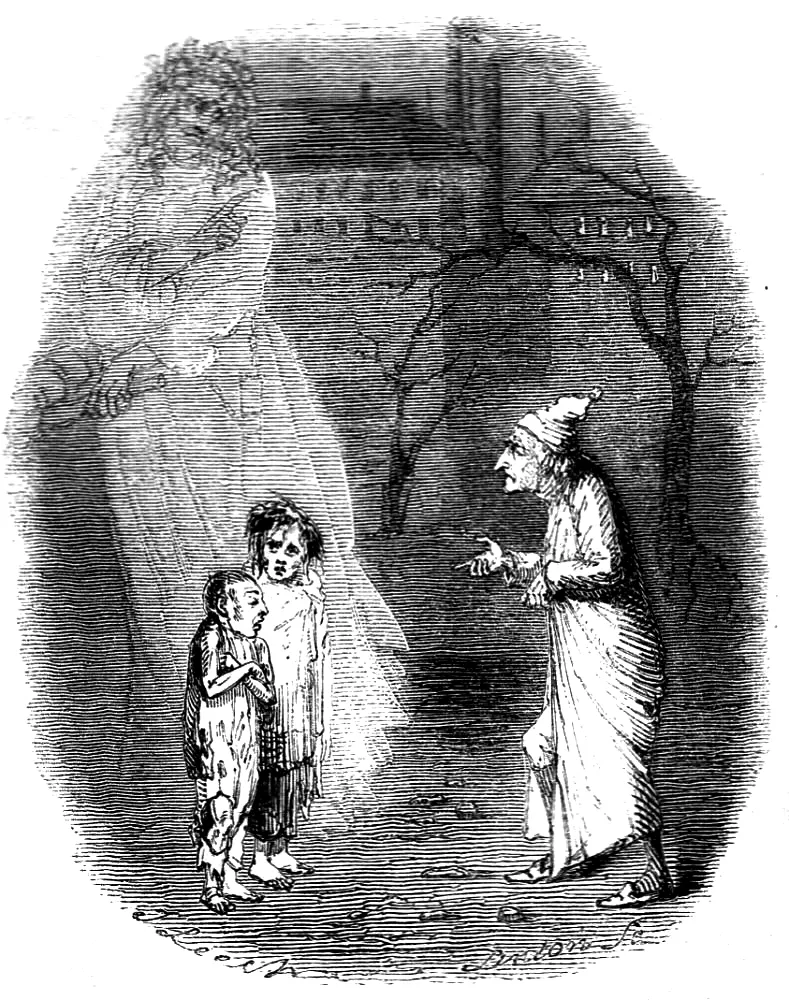
“This boy is Ignorance. This girl is Want. Beware them both, and all of their degree, but most of all beware this boy, for on his brow I see that written which is Doom, unless the writing be erased.”—A Christmas Carol
This part of Dickens’s tale illustrates one of the strangest things about midlife: how often people assess life introspectively (man, I’m going bald) or externally (my kids are growing up too fast, my parents are becoming more dependent). In both cases, we track our own biomarkers, our own finances, our own goals—and forget that aging is a group experience, not a solo sport.
Let your Ghost of Christmas Present remind you that your life does not occur in a vacuum, but is embedded in time with others. At any given moment, you are aging alongside:
-
Parents who are becoming fragile.
-
Children who are forming their own templates / expectations / habits.
-
Friends whose health and wealth trajectories are diverging.
-
Colleagues aging faster or slower than you.
The responsibility you didn’t ask for
Furthermore, whether you like it or not, you might right now be:
-
Someone else’s role model
-
Someone else’s safety net
-
Someone else’s cautionary tale
The Ghost of the Present forces a harder realization: You are now part of the environment shaping other people’s aging while you are being shaped by the same environment.
Because we are all aging at the same time—often doing it “alone together”—shortages in housing and healthcare and related services will not arrive as abstract policy problems, but as lived consequences. And like Ignorance and Want, they will mostly remain hidden until it is too late.
Here’s a simple exercise that illustrates the point. When projecting out into the future about retirement, estate planning or whatnot, it’s typical to plot a client’s age along with the scenario. It can be a bit of a reveal when you plot the projected ages of the rest of their family in the analysis as well.
A 60-something couple I work with is convinced that they will live to their late 90s. When I showed them that their kids would then be in their 70s, they were floored. Potential grandkids could at that point be mid-career. The realization significantly changed their outlook on how to steward family wealth over the next few decades.
The Ghost of Christmas Future: You don’t have one future
“It was shrouded in a deep black garment… save one outstretched hand.”
The final spirit in Dickens’s story does not speak; it points. Scrooge is shown a corpse he doesn’t want to identify and ultimately a tombstone with his name on it. Scrooge takes a very hard look at his future self and realizes he does not want to go down this bleak path.
Scrooge got lucky
Of course, this night of revelations convinces Scrooge to change his ways, and A Christmas Carol reminds us that the future is not set in stone. You have multiple future versions of yourself, all competing for your current decisions.
For those of us not in a Dickensian fable, our revelations may not be so clear. The Ghost of Christmas Future isn’t going to show up and point directly to the endpoint of our chosen path. However, there are often small signs or quieter signals in your life that point to a need to course correct to avoid unwelcome futures.
Few of these “unpreferred” futures arrive all at once. They compound slowly and almost invisibly before showing up suddenly like a holiday apparition.
You are already choosing
Every day, we encounter these microchoices that can lead to a dark, forgotten grave or the family gathered at Bob Cratchit’s home. Choices that can help us achieve the future self we desire and work toward, not the one we fear and stumble into.
Choices such as:
-
More community vs more isolation
-
Better health vs more fragility
-
Greater autonomy vs. increased dependence
-
More curiosity vs. stubborn rigidity
-
More resilience vs. grudging resignation
Putting the ghosts to work (instead of letting them haunt you)
Here’s the jacket copy for this holiday tale of past, present, and future:
From the past:
Identify which inherited habits are worth keeping—and which should be returned or exchanged for ones that will better serve you in future years.
From the present:
Recognize that your aging process is intertwined with others. Look beyond your self-interest and build a future of community and healthy relationships with those around you.
From the future:
Stop imagining one destiny. Start managing probabilities. Take the enlightenment of the past and present to make deliberate choices that lead to your best future.
Here is what Scrooge says at the end of A Christmas Carol:
“I will honour Christmas in my heart, and try to keep it all the year. I will live in the Past, the Present, and the Future. The Spirits of all Three shall strive within me. I will not shut out the lessons that they teach.”
Most people drift into older age with excellent intentions and terrible systems. Ebenezer Scrooge realizes this in his final statement. He has the intention of honoring Christmas, but realizes that goal requires daily effort.
So here is your call to action: Let your ghosts guide you instead of haunt you. That’s how you’ll end up merry and bright.
Related: Snuffing Out the Shame of Being Scammed: Your Secret Holiday Mission