
Trending

The last time Treasury yields were this high, Shrek 2 was dominating the global box office, and Usher's Confessions was the album of the year. We were also embroiled in a Middle East war that was supposed to have ended already.
U.S. markets faced a difficult combination of crosscurrents this week. Treasury yields surged to multi-decade highs while economic data pointed to stronger growth. This is not a recessionary narrative, but the medicine the economy may need to take to eliminate high yields and high inflation could create one. The 10-year Treasury briefly topped 5.2%, while the 30-year moved above 5.5%, triggering story after story (after story, after story...) about impending doom.
Inflation concerns, strong economic activity, and additional Fed rate hikes pushed bond prices lower (and therefore yields higher). Major US stock indices proved surprisingly resilient, although the strength was concentrated primarily at the top. Beneath the surface, the number of companies above their 200-day moving average dropped again, a bad sign for overall market health.
A lack of conviction is showing up in investor sentiment. Last week’s AAII sentiment survey showed the worst Bull-Bear spread since May 2025. This week showed an improved mix, but we’re far closer to the bearish high than the bullish one. Caution is deeply embedded in this market environment until fresh news can shift attitudes in a more optimistic direction.
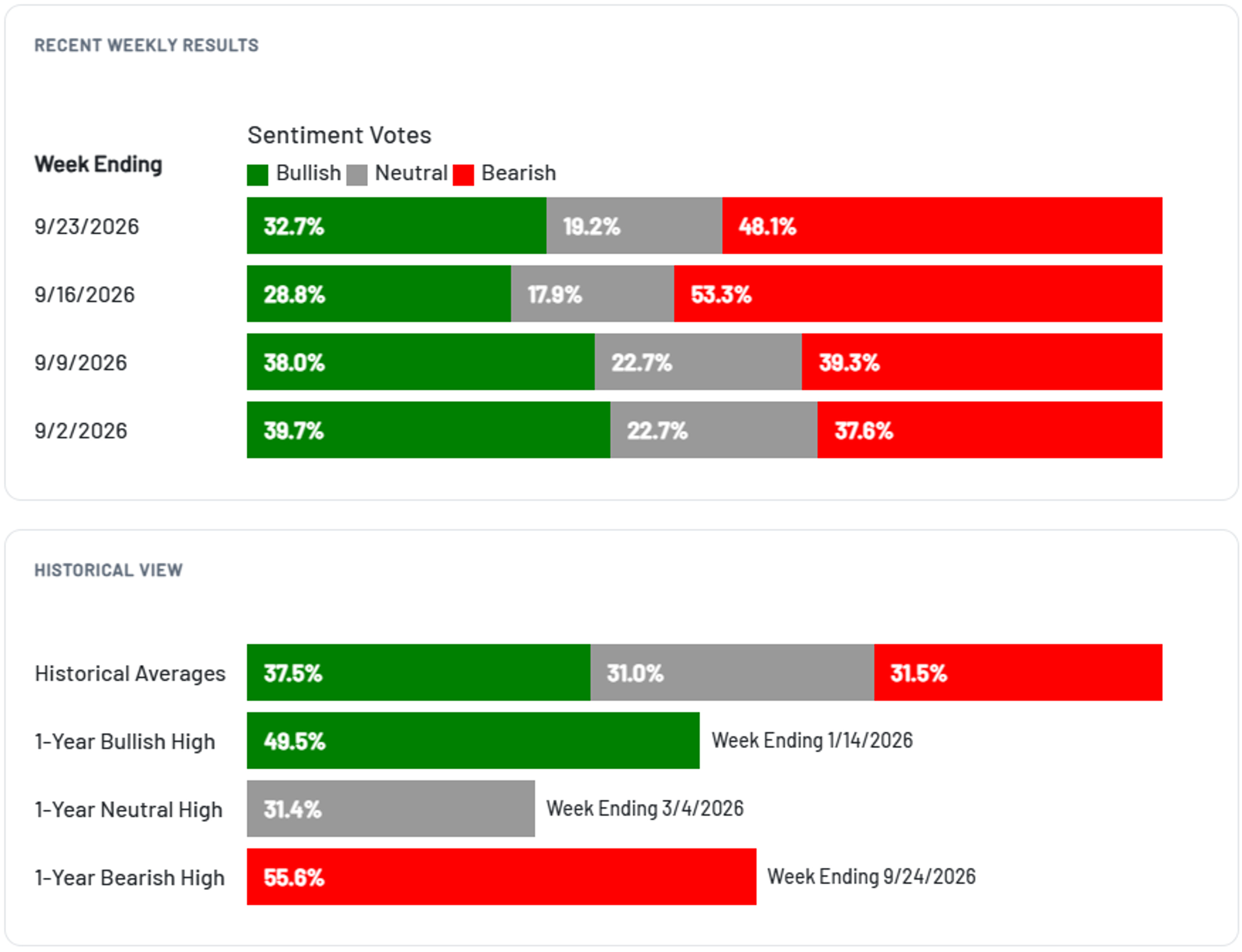
Source: AAII Sentiment Survey
The bond sell-off reflects more than a simple inflation story. Core PCE inflation remains at 3.3%, well above the Fed’s 2% target, but inflation has been an issue for years now and bonds yields have only recently spiked higher. The current geopolitical tensions and higher energy prices are the factors lifting yields higher. The correlation between 10-year Treasury yields and oil is at a 35-year high, per Mandy Xu at CBOE. The prior high was the beginning of the 1990 Gulf War.
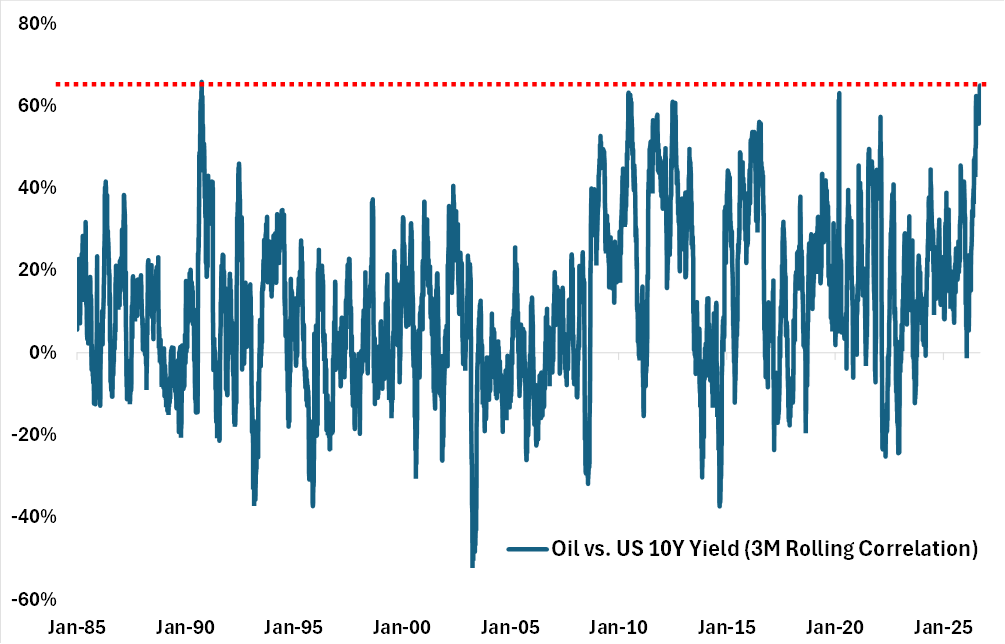
Source: CBOE
If the White House can ink a sustainable truce with Iran that eliminates the risk of further energy market disruptions, a lot of issues plaguing the global economy will start to melt away. To be clear, lasting damage has been done that will not be fixed overnight, but we’ve already seen oil prices respond quickly to potential deals. A real one could be the antidote to stem rising yields, even if it doesn’t immediately return them to the pre-conflict levels.
The Fed’s work is never done
The U.S. economy is showing signs of acceleration in spite of yield and energy price headwinds, with September’s composite PMI rising to 58.4. This is the highest level in more than five years. The combination of stronger growth and sticky inflation is making the Fed’s job more complicated. The central bank raised rates by 25 basis points in September and signaled at least one more increase before the end of the year in the accompanying Summary of Economic Projections.
Markets are pricing in four hikes over the next year, and a sustainably higher average fed funds rate over the next decade. This points to expectations that the neutral rate, a point where the Federal Reserve interest rate policy neither stimulates nor constrains the economy, could be rising. Extraordinary AI spending and large government deficits may lead to both stronger growth and higher inflation for many years.
If this is in fact the case, this shift could mean that the Fed is underestimating the necessary hikes over the next year and overestimating how soon they will be able to begin cutting again. A higher neutral rate is a structural element within the economy and not a symptom of temporary supply or demand shocks that will abate in time. We cannot observe the neutral rate directly, but the market is behaving as though the era of low interest rates is permanently behind us.
Take a deep breadth
For investors, higher yields are creating more attractive opportunities in fixed income, particularly for more conservative investors who can benefit from higher income and want to limit long duration risk. Higher rates also create added pressure on stocks by increasing the minimum rate of return investors demand and tightening overall financial conditions.
Higher rates will also create more separation between companies. Larger and more financially stable companies will be able to best navigate higher rate environments, while smaller companies who have smaller or worse balance sheets, and must pay up to borrow will suffer more. This is bearing out in the falling percentage of S&P 500 members trading above their 50-day and 200-day moving averages. The Nasdaq and Russell 2000 breadth also deteriorated further over the course of the week.
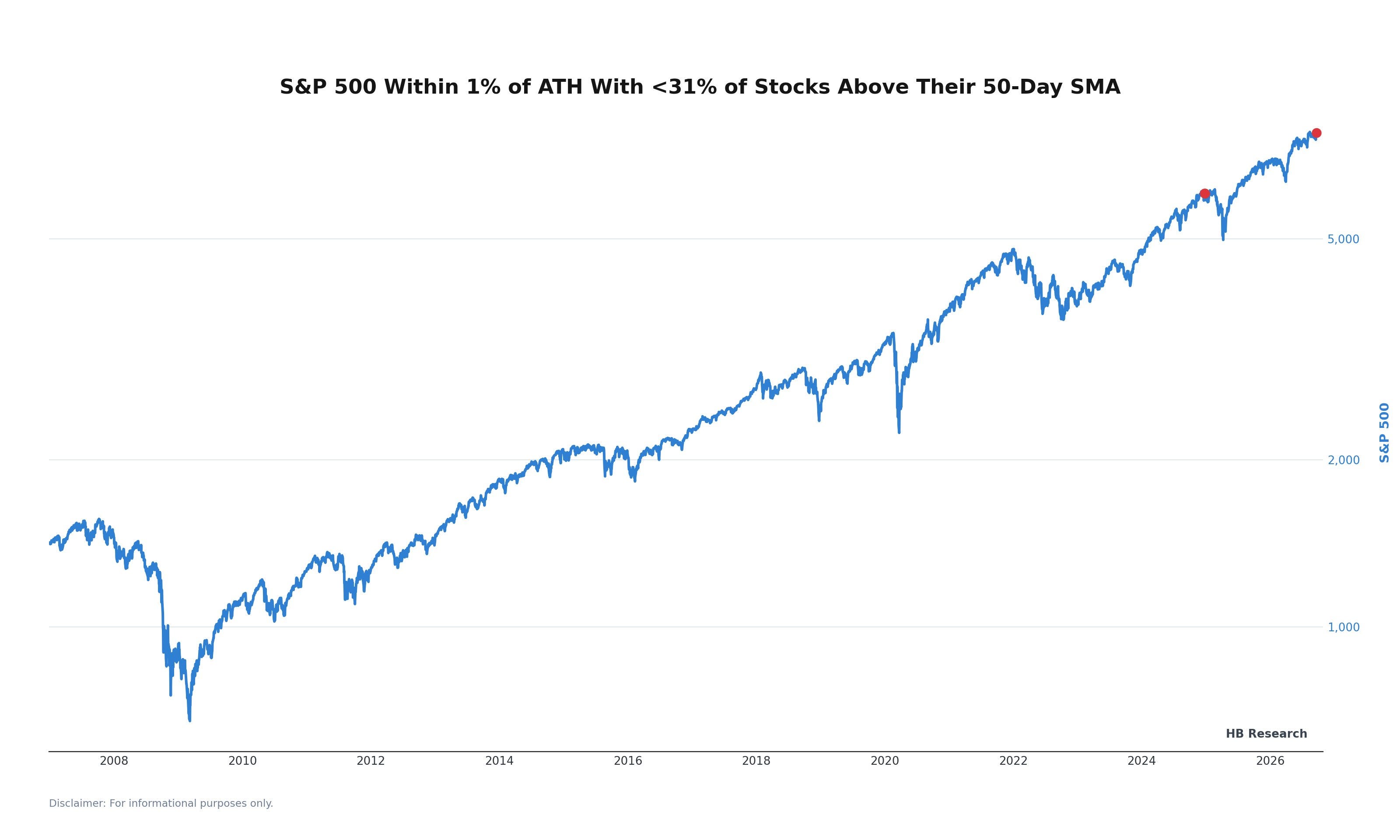
Source: HB Research vis Daily Chartbook
The major indexes are still remarkably close to all-time highs even while fewer stocks participate, meaning large-cap and mega-cap technology stocks are doing most of the heavy lifting.
What this means for investors and what’s next
Next week’s key catalysts are Micron’s quarterly earnings and Friday’s employment report. Another strong jobs number or a rise in wage growth potentially puts additional upward pressure on Treasury yields. For those in the labor market, rising payrolls have not translated to an easier hiring environment, one of the major complaints feeding the poor consumer and worker sentiment.
Any stabilization or a pullback in yields could give stocks some breathing room as September ends and the next earnings season begins. Q4 is usually a strong season for stock performance, and if Q3 earnings produce the expected results, markets won’t look back.
FactSet reported that analysts are increasing earnings per share estimates for the second straight quarter, which demonstrates unusually strong expectations. Upward revisions are concentrated in only a few sectors, but the overall impact raises consensus S&P 500 EPS by +1.2% vs. an average historical revision of -1.7% at this stage in the quarter.
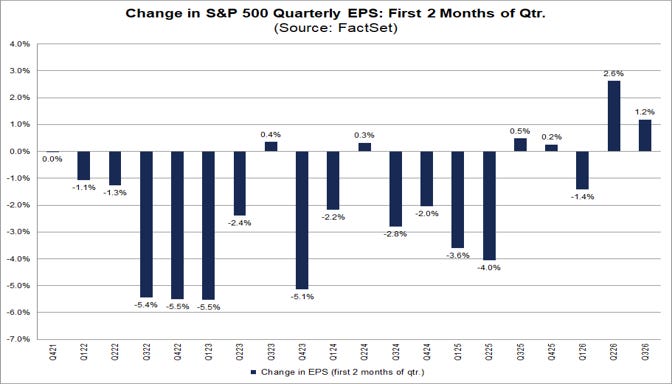
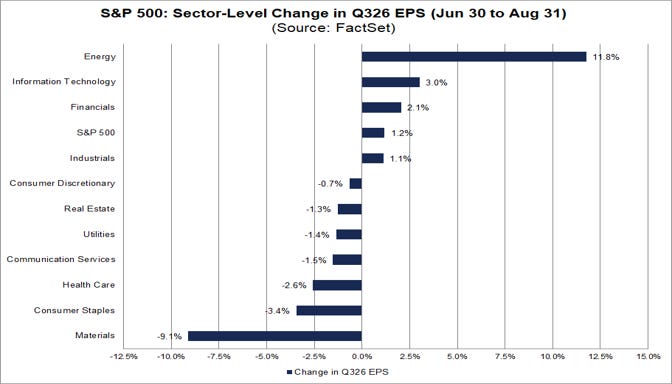
Source: FactSet
For investors, the message is that higher rates may be becoming a more durable feature of the market, making both fixed-income income opportunities and equity-market breadth worth watching closely. As you’re on the hunt for investment opportunities, the companies that are proving their ability to grow are likely to be the ones who continue to do so in the future. Don’t overthink it. Stick with what is working.