
Trending

Written by: Stephen Duench, CFA® | AGF
We believe alternative sources of yield, including premiums from derivatives, are now essential tools for mining additional equity income in portfolios.
Being a dividend investor has not been easy of late. Momentum has been the order of the day, and many income-generating stocks have underperformed while low-yield, high-growth tech stocks have clearly taken precedent as the lynchpins of the current bull market. Yet there’s also no denying that being largely left behind by the tsunami of tech enthusiasm—which, by the way, has shown signs of peaking—has made many of these same names that much more attractive. And when you combine tempting valuations with tightening credit spreads as central banks ease and potentially growing investor demand for yield in equity markets, it begins to look like a trifecta of positive forces may be forming around dividend stocks heading into 2026.
That’s not to say dividend stocks are guaranteed to rebound next year, but with the right approach and a bit of outside-the-box thinking, we believe there are plenty of opportunities for income investors to find what they’re looking for.
Scratching Beneath the Surface for High-Yielding Opportunities
One of the consequences of the global rally in stocks this year is the impact it’s had on the overall dividend yield of equity markets. Of course, this is mostly a math problem. As share prices increase, dividend yields fall, all else being equal. Yet there’s no doubt this correlation has been exacerbated by the fact that much of the price appreciation in equity markets has been concentrated in a small minority of high-growth and low-yielding Artificial Intelligence (AI)-related technology stocks.
With the right approach and a bit of outside-the-box thinking, we believe there are plenty of opportunities for income investors to find what they’re looking for.
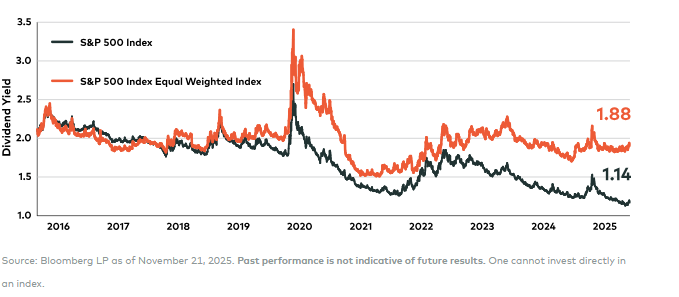
Then again, this isn’t necessarily a bad thing—especially for dividend investors who are willing to scratch the surface and actively search for opportunities. Given the ongoing narrowness of equity returns in 2025, there are now many forgotten areas of the market that haven’t participated fully in the rally and continue to provide relatively high yields. In fact, the S&P 500 Equal Weighted index bears this out. Its dividend yield is significantly higher than the S&P 500 index precisely because it gives more weight to some of the higher-yielding names that have been left behind in the bull market.
Paying Dividends: S&P 500 Index versus S&P 500 Equal Weighted Index
Factoring “Quality at a Reasonable Price” into the Equation
Among the various characteristics often associated with dividend growth stocks, none may be more attractive right now than their potential to deliver “ quality at a reasonable price” and the underlying metrics that typically indicate quality. Indeed, based on our quantitative models, S&P 500 Index companies with the highest free cash flow margins are more oversold versus the broader market than they’ve been in years, yet these are precisely the types of companies that also tend to have the best ability to pay, support and grow their dividends over time.
On the other hand, even the most active investors—those of us scratching the surface for the best dividend opportunities—must admit there’s only so much yield you can derive from the equities universe these days. After all, yields are simply lower than they’ve been for a long time. As such, we believe alternative sources of yield, including premiums from derivatives, are now essential tools for mining additional income in portfolios.
So how do those tools work? One approach is to write or sell a put option, which is a contract whereby an investor gets paid a fee (i.e., a premium) in agreement to buy an underlying stock at a pre-determined strike price if the contract is exercised by the buyer. The strategy is obviously not without risk, but the potential to generate a higher premium seems attractive right now—particularly for underperforming dividend growth stocks that an investor may have a strong conviction in owning longer-term should they be obligated to buy as part of the put writing agreement.
In part, this is a function of volatility, not only as it relates to specific dividend growers that have been forgotten, but also in relation to more idiosyncratic bouts of volatility that impact equity markets more broadly. Either way, we believe the opportunity to derive income from derivatives is an increasingly important one heading into 2026.
Related: Transform Your Customer Service: Essential Steps Every Company Should Take