
Trending

Social Media: Gaining Influence but Not Inspiring Trust
“How Much Do You Feel You Can Trust Financial Advice Available on Social Media?”
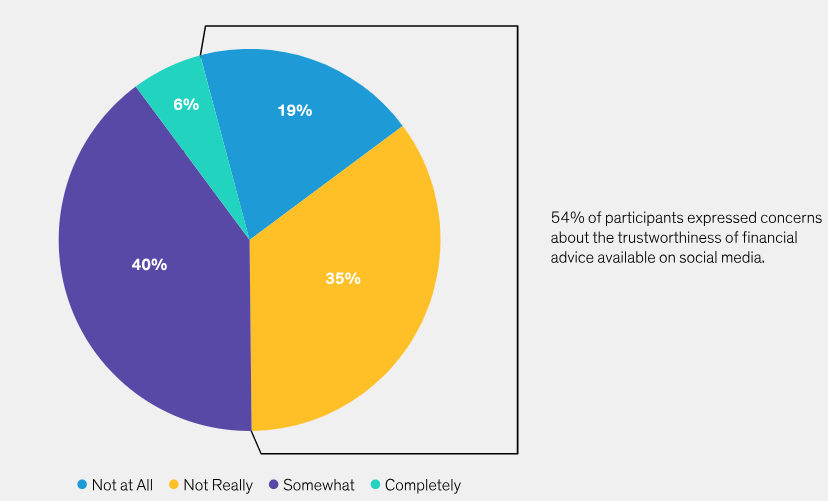
Source: AllianceBernstein (AB), Inside the Minds of Plan Participants, 2025
Social media is a primary news source for many Americans; Pew Research reports that more than half of adults get some of their news from social media.
But social media may have a credibility problem when it comes to financial advice.
AB’s 16th-annual Inside the Minds of Plan Participants survey of 1,200 current and former defined contribution (DC) plan participants finds that social media consumption is up 10% from a year ago. Nonetheless, just 6% of respondents completely trust social-media financial advice. Conversely, 54% say they don’t trust it, in varying degrees.
This underscores a credibility void that DC plan sponsors are well positioned to fill through both financial education and investing insights. Sponsors could also learn a thing or two from social media’s creative approach to reaching investors.
Financial education remains a challenge for many participants. That’s evidenced by the roughly one-third of survey respondents who believe they can spend 10% of their savings annually in retirement and never run out of money. DC plan sponsors can help plug these knowledge gaps with financial education and wellness programs.
Employers can also highlight the features of some DC plans, such as target-date funds and guaranteed-income products. For example, respondents say their most pressing retirement need is a steady source of income. Yet only 36% are confident or very confident that they’ll have a comfortable retirement. Guaranteed-income benefits provide lifetime income and, in some cases, complete control over investments.
That doesn’t mean plan sponsors can’t learn a thing or two from social media’s mobile-friendly platforms and bite-size messages. These communication approaches could offer new ways to reach participants by promoting financial education, wellness and DC plan features.
Ultimately, DC plan sponsors may have more influence than they realize.
Related: Is Market Concentration Rigging Your Portfolio? What Passive and Active Investors Need to Know