
Trending

Like The Open Championship, markets don't stay in one place forever. Leadership rotates. This week, capital didn't leave the market; it simply found a new fairway. If upcoming earnings confirm growth is broadening beyond the AI trade, this week's rotation may ultimately be a healthy step in a more durable bull market!
The Data
The week’s inflation reports offered encouraging news. Both the Consumer Price Index (CPI) and Producer Price Index (PPI) suggested inflationary pressures eased after three consecutive months of higher readings driven by the higher oil prices following the Iran conflict.
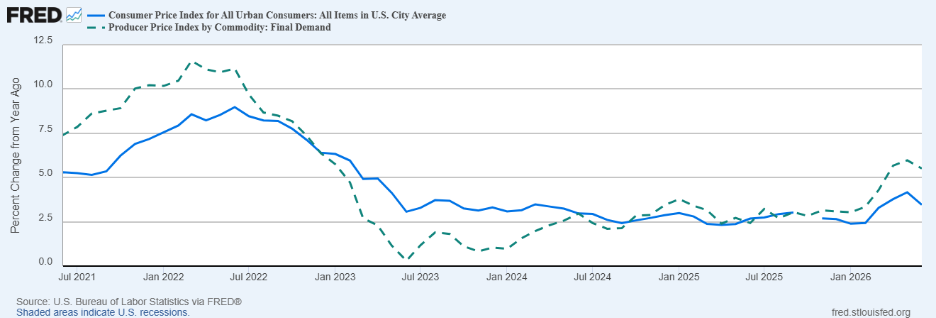
Meanwhile, new Fed chair Warsh delivered his first testimony in front of the House and Senate. As we've discussed previously, the Fed remains in a difficult position. While inflation data improved, policymakers are unlikely to react to what may prove to be temporary swings in energy prices. Warsh's measured tone and task force creation suggests the Fed will remain patient in waiting for clearer trend inflation data.
The Rota
After leading markets higher for much of the year, the AI trade took a breather this week. News of a new, competitive open-source AI model from China renewed questions about future AI spending, competition, and whether valuations can be justified by future earnings. Yet the broader market told a different story. Consider sector performance for the week. While US technology stocks at the center of the AI trade were down nearly 5%, six of the other ten sectors ended the week higher:

Further, equal-weight indexes outperformed their capitalization-weighted counterparts, and market participation broadened as gains spread beyond technology. In many respects, this is something forecasters have hoped to see: a market supported by a wider range of companies rather than a handful of AI leaders.
Earnings Season
The next stop on the rota is earnings season. With inflation showing signs of moderation, quarterly results and management guidance will determine where markets go next. While only about 12% of S&P 500 companies have reported, reporting activity accelerates next week, with companies representing nearly 20% of the index's market capitalization scheduled to announce results. Analysts expect S&P 500 earnings to grow 23.6% from a year ago, one of the strongest quarterly growth rates since 2021. Those expectations leave little room for disappointment. Beyond headline earnings, market participants will be listening closely for commentary on consumer demand, capital spending, pricing power, and whether AI investments are beginning to translate into tangible returns.
Sources: Federal Reserve Bank of St. Louis, YCharts
Related: The Warsh Fed Has Arrived: 5 Changes Investors Should Be Watching