
Trending

Plenty of ink has been spilled on why clients fire advisors with those ranging from lack of communication, hard sales pitches and confusion over fees. Less attention is paid to why prospects hire advisors and even less time is devoted to why they don’t.
However, understanding why many do-it-yourself (DIY) investors stay in that camp is instructive for advisors because it can help them convert more of that crowd than they previously though possible. It’s not a time-consuming endeavor, but it’s a worthy nonetheless. That’s particularly true when considering YouGov data indicating that just 32% of Americans currently work with a fiduciary.
Take out the 28% that aren’t interested and the 4% that aren’t aware of the services offered by financial and there’s an opportunity-rich field of formerly advised investors (14%) and those that aren’t yet working with professionals, but are interested in doing so (22%).
On the bright side, getting some of the folks in the “interested” camp to “join the party” isn’t a tall task because the reasons they’re there are easy to understand.
Control and Money
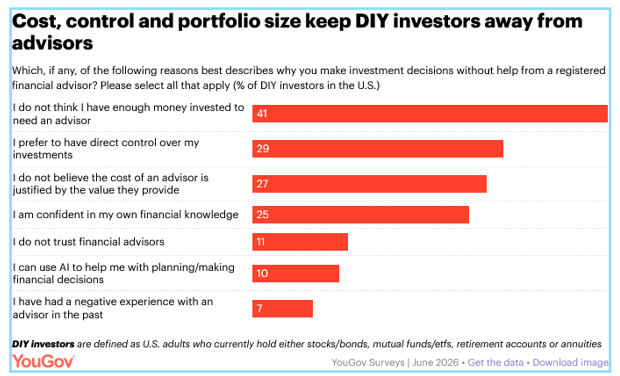
As the YouGov survey points out, two of the biggest reasons DIY investors don’t get over the hump and into an advisor’s office are the perceived specter of large minimum assets needed and fear of relinquishing control of their money.
“The leading reason DIY investors give for not using a financial advisor is that they do not think they have enough money invested to need one. Some 41% select this reason, making it the most common barrier by a clear margin,” according to the research firm. “Control is another major factor. Nearly three in ten DIY investors (29%) say they prefer to have direct control over their investments.”
Starting with the latter category, just as there are plenty of advisors that got into the business because they enjoy analyzing and researching investments, a lot of DIYers feel the same way. Some of them simply want to continue managing their money and it’s their right to feel to that way. However, those that are put off by perceived financial constraints represent a more pliable clientele.
By some estimates, just 53% of advisors require asset minimums, meaning nearly half do not. That means the percentage in the “no” category need to do a better job of articulating flat annual fees, hourly rates, or project-based fees because when the accommodating nature of those structures is effectively presented, it can be a catalyst for earning new business.
(Image Courtesy: YouGov)
Where DIY Investors Are Turning
To their credit, a fair amount of DIY investors are just “winging it.” Twenty percent told YouGov they rely on resources obtained from their employer or workplace retirement-plan provider. Roughly the same amount are reading earnings reports and other investor relations material or consuming sell-side reports and other forms of research.
That doesn’t diminish the opportunity set for advisors with the DIY crowd. Actually, the opportunity here is compelling because so many, perhaps too many, unadvised investors are consuming information from questionable sources.
“Some 17% say they use a broker or brokerage platform for investment information — the same share that cite social media posts or influencers,” observes YouGov. “Online forums and communities such as Reddit or Discord are used by 15% of DIY investors, the same share that turn to financial TV channels. AI tools, agents or chatbots are already used by 14%, putting them level with books or educational courses, newspapers or newspaper websites, and podcasts.”
Related: The Surprising Truth About AI and Financial Advisors: Clients Want Both