
Trending

Written by: Chris Carnazzo | Your Money Cues
"You Are Not a F#@kup."
Those are the first words in the introduction to The ADHD Field Guide for Adults, by Cate Osborn, Erik Gude, and Rennie Dyball. They hit like a gut punch for the people who've dealt with this condition.
They've heard the opposite their entire lives. From teachers, parents, partners, and even the voice in their head, on a loop. The Field Guide describes what that is like day to day:

-
Knowing what needs doing and still not being able to start.
-
Losing hours to a task that should take minutes.
-
Forgetting the thing they swore they'd remember an hour ago.
It's not a character flaw, just a brain that's wired differently.
The Financial Impact of ADHD
One of the most cited studies on ADHD and financial outcomes comes from a team led by William E. Pelham III. Researchers followed children with ADHD who had attended a summer treatment program and compared their financial outcomes in adulthood with a control group of peers without ADHD.
By age 30, the differences were substantial:
-
Average income was 37% lower.
-
Average savings were 66% lower.
-
About one-third were still living with their parents.
-
Projected over a lifetime, the estimated earnings gap approached $1.25 million.
Those findings deserve attention, but they also deserve context. The study followed a relatively narrow group: primarily Caucasian boys from a single county in western Pennsylvania who had all been formally diagnosed and treated through the same program.
In other words, it captured children whose families recognized the symptoms, sought care, and had access to treatment. It does not include people who went undiagnosed or developed their own coping strategies.

The authors acknowledge these limitations and caution against assuming these outcomes apply to every person with ADHD. Nor is the average participant necessarily representative of the clients sitting across the table from a financial planner.
Someone who has accumulated significant assets may have developed effective systems, chosen work that fits their strengths, or built other supports that helped them succeed despite the challenges of ADHD.
Every Client Is Different
Dr. Stephen Shore, a professor of special education at Adelphi University and an autism advocate, is known for saying,
"If you've met one person with autism, you've met one person with autism."
The same principle applies to ADHD. There is no single profile.
Some adults with ADHD struggle to hold a job. Others become entrepreneurs, executives, physicians, or attorneys. Some accumulate significant wealth. Success doesn't mean the ADHD disappeared. More often, it means they've found work that fits the way their brain operates or built systems that compensate for the parts that don't.

That distinction matters for financial planners. The clients most likely to seek professional advice may not resemble the participants in studies showing poorer financial outcomes.
Their finances may be well organized. Their careers may be thriving. They may not even meet the diagnostic criteria they did as children, because ADHD often presents differently in adulthood.
What you can't see is the effort holding everything together. A client who appears calm, organized, and successful may still rely on elaborate routines, reminders, accountability systems, or a spouse who quietly fills in the gaps. None of that shows up on a balance sheet.
Working with these clients instead of against them starts with a reframe. Some of them call it neurospicy. It isn't a clinical term, and it's never something an advisor should call a client. From an outsider it can land as derogatory.
It is a self-owned label, one that takes the sting out of a word like disorder. Different wiring, not damage. Not better, not worse, just different.
That's why the goal isn't to identify who has ADHD. It's to build a planning process that works for clients whose brains don't all solve problems the same way.
Rejection Sensitive Dysphoria (RSD)
Dr. Christine Hargrove, an expert on ADHD and financial therapy, describes one way a planner can unintentionally lose a neurodivergent client before the conversation has really begun. She is a clinical assistant professor at the University of Georgia, assistant director of its Love and Money Center, and president-elect of the Financial Therapy Association. She spoke to the FPA's Neurodivergent Founder's Circle about rejection sensitive dysphoria (RSD), an intense emotional response to rejection, criticism, or failure, whether perceived or actual.
According to Hargrove, it often appears in a moment most planners would never think twice about.

"I see RSD show up a ton when you look at a transaction sheet. Like, it's just about the fastest thing that shows up."
The planner is simply reviewing the numbers. The client is watching the planner's face.
A raised eyebrow. A pause before the next question. A request for clarification. None of those signals are intended as criticism, but they can easily be interpreted that way.
Once that happens, the client may become defensive, withdraw from the conversation, or quietly avoid the planning process altogether. The planner may never realize anything changed.
The Curb-Cut Effect
Learning to recognize that kind of sensitivity isn't easy. The effort doesn't just help neurodivergent clients, though. It makes you better with everyone. Angela Glover Blackwell, writing in the Stanford Social Innovation Review, calls this the curb-cut effect.
Curb cuts, the small ramps built into street corners, were fought for by wheelchair users, as the podcast 99% Invisible has documented.
Today they're used by parents pushing strollers, travelers rolling luggage, delivery workers, and anyone who appreciates an easier path. An accommodation designed for one group ended up improving life for everyone.
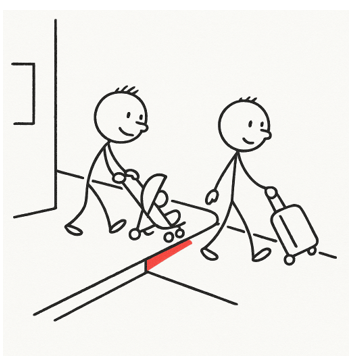
I've seen the same principle in my own family.
When my son was first flagged for developmental delays, his teachers didn't wait for a formal diagnosis before offering support. They saw enough to know he would benefit from additional structure, one-on-one attention, and more intentional scaffolding. Their reasoning stayed with me. Even if he ultimately hadn't been on the spectrum, those supports would still have helped him learn.
Financial planning works the same way. You don't need to diagnose anyone to build a process that reduces unnecessary friction.
-
Know and control your own nonverbal cues.
-
Slow down before reacting to a spending decision.
-
Explain why you're asking a difficult question.
-
Break large action items into smaller, manageable steps.
-
Assume that a missed task may reflect overwhelm rather than indifference.
If those accommodations matter to the most sensitive client in the room, they'll almost certainly make the experience better for everyone else, too.
Related: Researchers Find a Predictable Pattern of Emotions Throughout the Financial Planning Process
References
Blackwell, A. G. (2017). The curb-cut effect. Stanford Social Innovation Review, 15(1), 28–33. https://doi.org/10.48558/yvms-cc96
Hargrove, C. (n.d.). Emotions, money & ADHD [Webinar]. FPA Neurodivergent Founder's Circle.
Mars, R. (Host). (2018, May 23). Curb cuts (No. 308) [Audio podcast episode]. In *99% Invisible*. Radiotopia.
Osborn, C., Gude, E., & Dyball, R. (2026). The ADHD field guide for adults. Function.
Pelham, W. E., III, Page, T. F., Altszuler, A. R., Gnagy, E. M., Molina, B. S. G., & Pelham, W. E., Jr. (2020). The long-term financial outcome of children diagnosed with ADHD. Journal of Consulting and Clinical Psychology, 88(2), 160–171. https://doi.org/10.1037/ccp0000461