
Trending

Take my word for it because I’m on my second dog – both have been black Labradors – pet ownership is not inexpensive, but it’s often fun and rewarding. And if you don’t believe me about the financial aspect, consider what the American Kennel Club (AKC) has to say on the matter. The organization says the average annual cost of dog ownership is $2,500.
It’s not a huge amount, but it’s not peanuts, either, and it is large enough that advisors ought to ask clients, particularly retirees, if they are pet owners. Seriously, this is a conversation that should take place because a Nationwide Retirement Institute Survey indicates that 62% of future retirees are or will be pet owners in retirement with nearly half planning on bringing a dog into the mix.
There are a variety of reason why advisor/pet owner client conversation should take place, not the least of which is life’s tendency to throw us curveballs. Said another way, in an unexpected negative scenario, a retiree’s pet may be left homeless if the owner unexpectedly passes away.
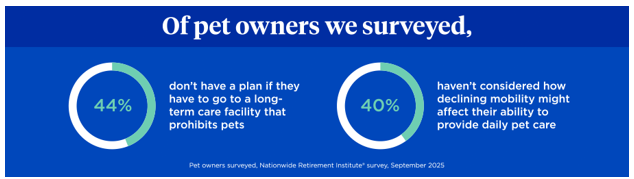
(Image Courtesy: Nationwide)
Clients View Pets as Life Enhancers
Clients are smart and they should be treated as such. With that in mind, it’s not a stretch to assume that many are hip to the fact – forgive the dog owner bias here – that owning a dog has been proven to add years to one’s lifespans. That’s likely attributable to the walks and getting more vitamin D from being outside.
A Nationwide survey of pet owners survey confirms that these folks view pets as life enhancers. Ninety-five percent said their pets are positively affect their lives while 82% said their brings them joy. Nearly two-thirds said their pets boost their mental health. And not to toot my own, but I’m onto something with the life expectancy bit.
“Pet owners also tend to exercise more frequently than non-pet owners, averaging 4 days of exercise per week versus 3.5 days,” notes Nationwide. “That correlates to positive indicators of cardiovascular health, like lower blood pressure.”
Err on the side of caution and assume that many of your clients know some or all of the benefits of pet ownership and are capitalizing on those perks. As such, pet financial planning is a real topic and one that should be discussed.
Clients + Pets = Opportunity
Not surprisingly, there’s a financial planning gap as it relates to pets and advisors shouldn’t scoff at that notion because it represents opportunity for them.
“While many Americans understand the need to create a comprehensive financial plan for themselves in retirement, many people may overlook a key consideration—their pets,” adds Nationwide. “This planning gap presents an opportunity for you as a financial professional to make sure pets are included in your clients’ retirement strategies.”
Starting points for related discussions pet ownership cost forecasts, pet insurance and making a plan for the pet assuming a worst-case scenario comes to pass.
“From a financial planning perspective, your clients’ pets represent an often-overlooked priority,” concludes Nationwide. “By proactively addressing pet-related contingencies—financial, logistical, and legal—you can help your clients ensure that their retirement is secure for both themselves and their beloved animal companions.”
Related: The ETF Fee War Just Got Cheaper: Schwab Cuts Costs Again