
Trending

Written by: Chris Carnazzo | Your Money Cues

Plutchik's wheel of emotions. Diagram by Machine Elf 1735, via Wikimedia Commons (public domain).
I recently wrote about new research that found a surprisingly predictable emotional pattern in financial planning. But another part of the study caught my attention: how the researchers categorized those emotions.
Squishy feelings are difficult to quantify. The two Australian researchers needed to turn the emotional moments in 1,236 recorded client meetings into data they could count. So they borrowed a framework from psychology: Plutchik's wheel of emotions.
Plutchik's Wheel of Emotions
Psychologist Robert Plutchik spent four decades developing a theory of emotion. He built the wheel to bring order to a field that had not agreed on its basic terms.
Plutchik viewed emotions as products of evolution: responses that helped humans and other animals survive.
- Fear prompts flight.
- Anger warns others away.
- Disgust helps prevent poisoning.
If emotions serve specific functions, he reasoned, the basic ones should be limited in number, shared across species and organized in a consistent way.
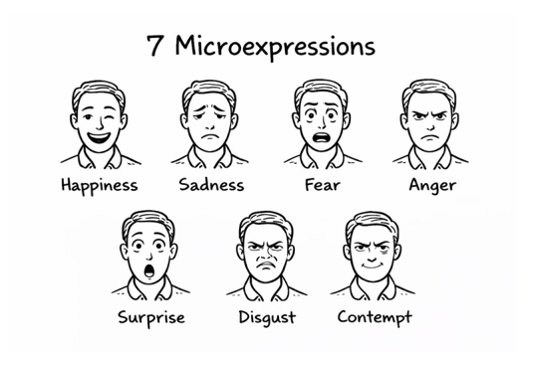
Paul Ekman's seven universal emotions.
Since Descartes, philosophers and psychologists have proposed lists ranging from three to 11. Paul Ekman built his from faces and landed on seven. Plutchik built his from behavior and landed on eight. Every one of those lists includes fear, anger and sadness. But no one ever agreed on a number, and Plutchik admitted there was “no unequivocal way” to settle on one.
He began with behavior. He identified patterns of action that recur across species, then matched each one with an emotion. That produced eight basic emotions, arranged in four opposing pairs:

Three features follow from the arrangement:
1. Similar emotions are neighbors.
Emotions that share facial expressions, body language and behavioral tendencies sit next to one another. They blend into each other instead of standing as separate states. Fear sits beside surprise; joy beside trust.
2. Opposite emotions face each other.
Emotions that pull us toward conflicting actions sit 180 degrees apart, like complementary colors on a color wheel. These pairs represent competing responses: approach vs. retreat, accept vs. reject, engage vs. attack.
3. Every emotion varies in intensity.
Each primary emotion exists along a continuum. Move toward the center of the wheel and the emotion gets more intense, more likely to drive behavior. Move outward and it softens.
- Annoyance → Anger → Rage
- Serenity → Joy → Ecstasy
Adjacent emotions blend into more complex states, which Plutchik called primary dyads. The wheel places these blends between neighboring petals.
- Joy + Trust = Love
- Like mixing red + blue = purple.
How the Researchers Used It
The Australian researchers, Ben Neilson and Michelle Lobartolo, analyzed 1,236 transcribed financial planning appointments. They were collected over four years and drawn at random from a broader pool of practice cases.
The researchers coded the emotion in each one. Then they tied every expression to the stage where it appeared: discovery and fact finding, strategy development and presentation, implementation and ongoing review.
At discovery, the first stage, three emotions dominated:

- Anxiety, in roughly 38 percent of coded expressions. The most common emotion at discovery, by a wide margin.
- Vulnerability, 22 percent. Admissions of dependence, of not understanding, of embarrassment.
- Uncertainty, 18 percent. Clients struggling to name a goal.
Most of it surfaced in the first ten minutes, while clients walked through their financial history and past mistakes. The researchers recorded the phrasing. “I should have done this years ago.” “I'm terrible with money.”
They logged the cues carrying it, too:
- From the client: lowered voice pitch, apologetic phrasing, constant self-justification.
- From the adviser: active listening, empathetic mirroring, affirming language. These moved the emotional tone toward relief and curiosity.
The authors called the next finding unexpected:
- Anxiety and vulnerability, when the adviser acknowledged them out loud, became precursors to trust.
- Advisers who normalized a client's experience reached the strategy stage faster.
One thing was confusing, though. They said they'd use Plutchik's wheel, but then didn't really use the terms from it. Read the results and you find anxiety, relief, confidence, confusion, hesitation and reassurance doing nearly all the work. Six of Plutchik's eight primaries barely appear.

Anxiety is not a primary emotion on Plutchik's map. It is a blend.
Anxiety = anticipation + fear
I've written before about warmth before competence, that people decide whether to trust you before they decide whether you're any good at your job. This study comes at the same idea from the other side.

Trust was the most common of Plutchik's eight primaries, with 98 instances. The researchers describe it not as something clients arrive with, but as something that accumulates across sustained positive interactions.
The wheel gives trust one wedge out of eight, equal billing with surprise and disgust. The data ranks it as the destination.
That is why cues matter. The first ten minutes are when a client is most anxious and least able to say so. Those minutes run almost entirely on signals: the lowered voice, the apology, the self-justification.
Read them, and you can acknowledge what is happening, which is what builds trust. Miss them, and there is nothing to build on.

Why I Like It
People don't come into a financial planning meeting expecting to talk about their feelings. Many struggle to describe what they're experiencing. Others don't have the vocabulary.
The wheel gives clients a shared language they can point to instead of hunting for the perfect words.
Daniel J. Siegel, the UCLA psychiatrist, calls this “name it to tame it.” Putting a label on an emotion helps reduce its intensity and makes it easier to think clearly instead of reacting.
That helps almost anyone. It helps most for clients who struggle to name what they are feeling, a difficulty researchers call alexithymia. About half of autistic adults experience it. One study of adults with ADHD put the figure at 41 percent.
The wheel is not a measuring instrument. What it is, is a picture that gives people words for something they came in unable to say. That is what I like about it.