
Trending

Written by: Arun Sai | Pictet Asset Management
Few questions are occupying investors more than the impact of AI on employment. Much of this debate has been framed through the lens of labour substitution: as AI performs a growing number of tasks previously undertaken by humans, labour demand must inevitably decline.
While labour substitution is a credible concern, it focuses only one side of the equation. Lower-cost intelligence can also stimulate new demand, expand existing markets, enable new products and services, lower barriers to entrepreneurship and reshape the nature of work itself. These demand-side effects are often underemphasised despite being central to how previous general-purpose technologies affected employment.
We argue that assessing AI’s labour market impact requires considering both labour substitution and what we call Jevons’ Job Market or AI’s rebound effect, whereby lower-cost intelligence expands economic activity and creates new demand for labour, even as it automates existing tasks.
The evidence so far
The best current evidence does not support a simple claim that broad AI diffusion must cause economy-wide mass unemployment. Across official reviews, firm-level studies, field experiments and early macro labour market evidence, the most robust near-term finding is reallocation rather than aggregate collapse. Some tasks are automated and some occupations face pressure, but the dominant observed effects so far are higher productivity and changing skill demand. Net labour market effects remain relatively modest and highly heterogeneous.
1. Productivity gains
Productivity gains are already evident in customer support, software development, and consulting. A randomised field experiment involving around 5000 developers across firms found a 26% increase in completed tasks. In a consulting study1 of around 800 knowledge workers found that access to GPT-4 contributed to them completing tasks 25% faster while also delivering solutions of significantly improved quality. While there are several such instances of evidence for a productivity pickup at a task level, at the macro level, productivity growth may lag technological improvements if organisational redesign and workflow changes fail to keep pace.
2. Firm-level substitution
Some firms are already shifting hiring from non-AI roles towards AI-related roles. A study2 of online vacancies in the US shows that AI-exposed establishments increased AI-related vacancies and reduced hiring in non-AI positions, while at the occupation and industry level, employment and wage effects were still not detectable.
3. Innovation channels already producing results
AI-adopting firms already appear to innovate more effectively, resulting in stronger sales growth and higher employment growth. Albeit early days, studies3 suggest that our core proposition of AI adoption leading to larger total addressable markets and higher output is empirically plausible.
4. Labour market normalisation
Some recent labour market dynamics may reflect the normalisation of post-Covid distortions, including the payback from ‘labour hoarding’. A recent Goldman Sachs study4 concludes that normalisation of previous over-hiring is four times as important in explaining weak tech hiring since 2022 than AI-related effects. A separate study5 presents an interesting finding that any apparent link between AI exposure and junior hiring disappears if adjusted for remote working – with work-from-home worsening the trade-off for hiring fresh graduates versus more experienced hires who can operate independently from day one.
In other words, while the US labour market is indeed in a ‘no-hiring no-firing’ holding pattern, we see little evidence to suggest that this is a result of AI adoption.
Jevons job market: AI’s rebound effect
Job destruction from automation and higher productivity overlooks an important economic mechanism: the rebound effect, analogous to the ideas popularly associated with Jevons’ paradox.
AI reduces the cost of intelligence. Agents lower the marginal cost of cognitive work in much the same way that steam engines lowered the cost of mechanical power and electricity lowered the cost of distributed energy. When something becomes cheaper, economic actors consume more of it.
The labour market analogue is what we refer to as Jevons’ Job Market. Rather than simply replacing labour, cheaper intelligence should expand demand for intelligence, enlarge existing markets and make entirely new products and services economically viable. This can support employment through four broad channels.
1. Task reallocation
AI automates routine and institutionalised knowledge-based tasks, allowing workers to shift towards judgement, creativity, negotiation and client interaction. The IMF finds that in the US, an increase of 1 percentage point in the share of job postings with new skills is associated with an average wage gain of 2.3 percent and an employment gain of 1.3 percent6. If anything this could even shift hiring in favour of AI-literate youth with employers seeking to complement existing skillsets.
2. Productivity-led demand expansion
AI lowers costs and improves quality. Productivity gains alone do not necessarily reduce employment: lower costs can expand demand directly, support higher output or redirect spending towards complementary goods and services, sustaining labour demand even when fewer workers are needed for each unit of activity. The introduction of ATMs provides a useful historical parallel. ATMs automated routine teller tasks and reduced staffing needs per branch, but lower operating costs supported branch expansion and teller employment held up for many years. A more sustained decline required a fundamental redesign of the service itself, as digital and mobile banking began to substitute for the branch rather than simply automate tasks within it.
3. TAM expansion and new products and services
AI efficiency gains enable new offerings and product innovation. Lower experimentation costs and faster R&D shorten innovation cycles. AI may also make products and services economically viable for customer segments that were previously uneconomic to serve. Every SME could afford a consultant. Students could receive personalised tutoring.
4. Lower barriers to entrepreneurship
Lower entry barriers make it easier to start new businesses and widen market access for founders with limited resources shifting the balance between capital and skill shifts further in favour of skill. There is early evidence to support this from the US census data that shows a surge in one-person new business formation from early 2025 coinciding with the widespread availability of agentic coding capability following the launch of MCP and Claude Code.
More firm creation and higher business dynamism should lead to a Schumpeterian creative destruction on steroids.
AI’s labour market impact: substitution and rebound effects
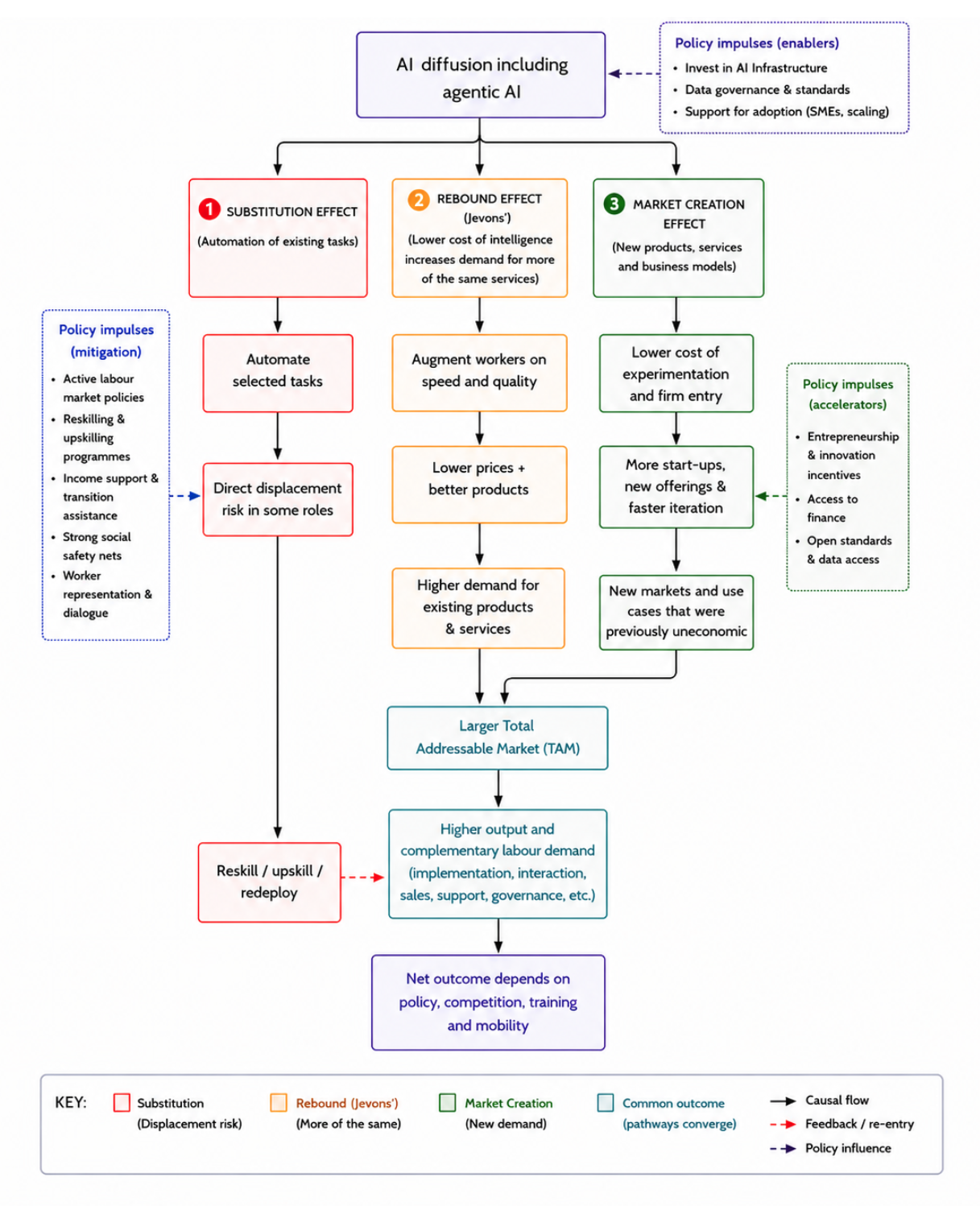
Source: Pictet Asset Management, structure adapted from Acemoglu & Restrepo (2019, 2022)
Viewed through this framework, widespread job loss is not a given. Net job creation is plausible, although not automatic. It depends on complementary factors such as job redesign, skill formation, worker mobility, competition policy, SME diffusion and policies that incentivise augmentation over replacement. Importantly, any net employment gains are an aggregate outcome rather than a claim that every occupation or worker benefits equally.
Challenges
1. Uneven impact
High-exposure, low-complementarity occupations remain most vulnerable to displacement. Empirical analysis in a 2026 IMF paper shows that for occupations that are highly exposed to AI, but with limited scope for complementarity employment levels are 3.6 percent lower in regions with greater demand for AI-related skills than in other regions five years after the appearance of these skills 6.
Complementarity captures whether AI is more likely to augment a worker or substitute for them, reflecting the importance of human judgement, accountability, and the consequences of errors. Consider the legal profession: AI may assist judges with legal research and drafting, but society is unlikely to delegate judicial decision-making to AI. By contrast, many routine clerical and administrative tasks are far more readily automated. The greatest displacement risk therefore lies in occupations with high exposure and low complementarity, such as customer service, clerical support, data processing and other routine, codifiable cognitive roles.
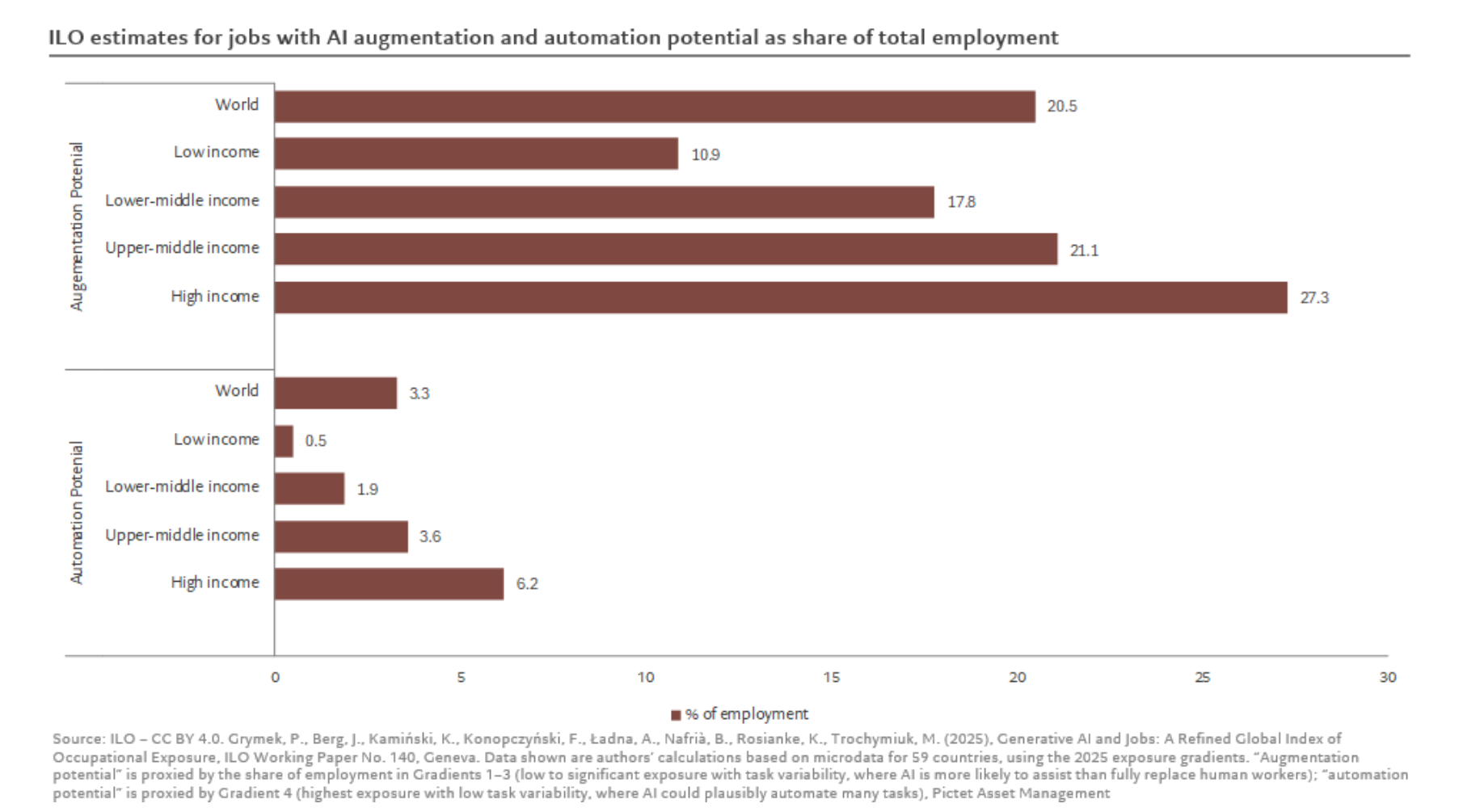
The ILO estimates global employment exposure to GenAI at 24% and one in three in high-income economies but considering task variability as well reduces their estimate of directly automatable jobs to just over 3 percent globally and roughly twice as much in high income economies7. However, interestingly broken down by gender, jobs at risk of automation are more than twice as high among women than men adding another layer for complexity for societal implications.
2. Weaker training pathways
Junior roles are exposed sooner to automation of judgement and agency. The 2026 Global AI Jobs Barometer from pwc highlights that the most AI-exposed entry level jobs are now seven times more likely to require traditionally senior skills than the least AI-exposed ones8. Compounding matters is the increased use of AI in creative fields which makes honing creativity of new entrants more challenging. Firms and institutions will need to rebuild training mechanisms rather than simply focussing on efficiency gains.
Policy levers
Net positive job creation from AI will not happen in a policy vacuum. A proactive, multi-pronged policy mix is required.
1. Capability formation
An AI literacy push is crucial. Education curricula and teaching methods need to adapt rapidly, combining AI competence with stronger human complementary skills. AI is no longer a specialist field. This increases policy makers’ urgency to strengthen STEM skills and culture.
2. Labour market adjustment
Policies aimed at reducing frictional unemployment such as portable benefits and wage insurance conditional on retraining are paramount. Governments should also design and implement incentives for firms to prioritise augmentation over automation, establish guardrails that promote transparency of AI use while recognising societal and ethical implications.
3. Wider diffusion
AI adoption barriers need to be identified and addressed. Supporting diffusion across SMEs, lagging regions and the public sector is central to broad-based job creation rather than isolated pockets of super-growth. An innovation-centric industrial policy including improved entrepreneurs’ access to capital is key to ensuring that some of the displaced workers are able to create firms and in turn more employment opportunities
For investors, the implication is that the extent of AI impacting jobs through labour substitution is an incomplete framework for assessing its economic impact. Equally important is AI’s capacity to expand markets, accelerate innovation, lower barriers to entrepreneurship and create new demand for labour. The firms, sectors and economies best placed to capture these demand-side effects may ultimately generate more durable value than those focused solely on labour cost reduction. Looking at AI through both lenses provides a more complete framework for understanding the long-term implications of AI for employment, productivity and economic growth.
Related: Agentic AI Could Rewrite Every Rule of Commerce
References
(1) Navigating the Jagged Technological Frontier
https://papers.ssrn.com/sol3/papers.cfm?abstract_id=4573321
(2) shapingwork.mit.edu
https://shapingwork.mit.edu/wp-content/uploads/2023/10/Paper_Artificial-Intelligence-and-Jobs-Evidence-from-Online-Vacancies.pdf
(3) Artificial intelligence, firm growth, and product innovation - ScienceDirect
https://www.sciencedirect.com/science/article/pii/S0304405X2300185X
(4) Goldman Sachs, Global Economics Analyst: Disentangling Tech Hiring Headwinds: Higher Rates, Overhiring, and AI, July 2026
(5) The Broken Ladder: AI, Remote Work, and Early-Career Hiring (Lambert and Schindler, 2026)
https://papers.ssrn.com/sol3/papers.cfm?abstract_id=6787638
(6) Bridging Skill Gaps for the Future: New Jobs Creation in the AI Age
https://www.imf.org/-/media/files/publications/sdn/2026/english/sdnea2026001.pdf
(7)Generative AI and jobs: A 2025 update
Generative AI and jobs: A 2025 update
(8) AI Jobs Barometer | PwC
2026 Global AI Jobs Barometer