
Trending

The August Retirement Fear Index declined for the first time—but the structural worries facing affluent families remain firmly in place.
For the first time since we launched the Retirement Fear Index, the temperature of retirement anxiety has cooled.
Just a little.
The August 2026 reading came in at 120.7, down from July’s peak of 121.7. Retirement fear is still running 20.7% above our baseline of 100, but the decline breaks a steady upward trend that began late last year.
Think of it as the first cool evening after a long stretch of hot summer weather. You notice the difference. You may sleep a little better.
But you don’t put the air conditioner away.
For financial advisors, the important August story is not simply that retirement fears declined. It is where they declined—and where they did not.
The more cyclical fears surrounding inflation and everyday costs eased. The structural fears involving Social Security, healthcare, long-term care and longevity held firm.
That distinction matters when you are working with high-net-worth clients. Affluent retirees may be better equipped to absorb higher grocery bills or another increase in utility costs. But wealth does not remove uncertainty about living to 95, paying for several years of care, supporting adult children or watching one spouse eventually manage the family finances alone.
Money may soften some retirement fears. It rarely eliminates them.
The cyclical fears cooled
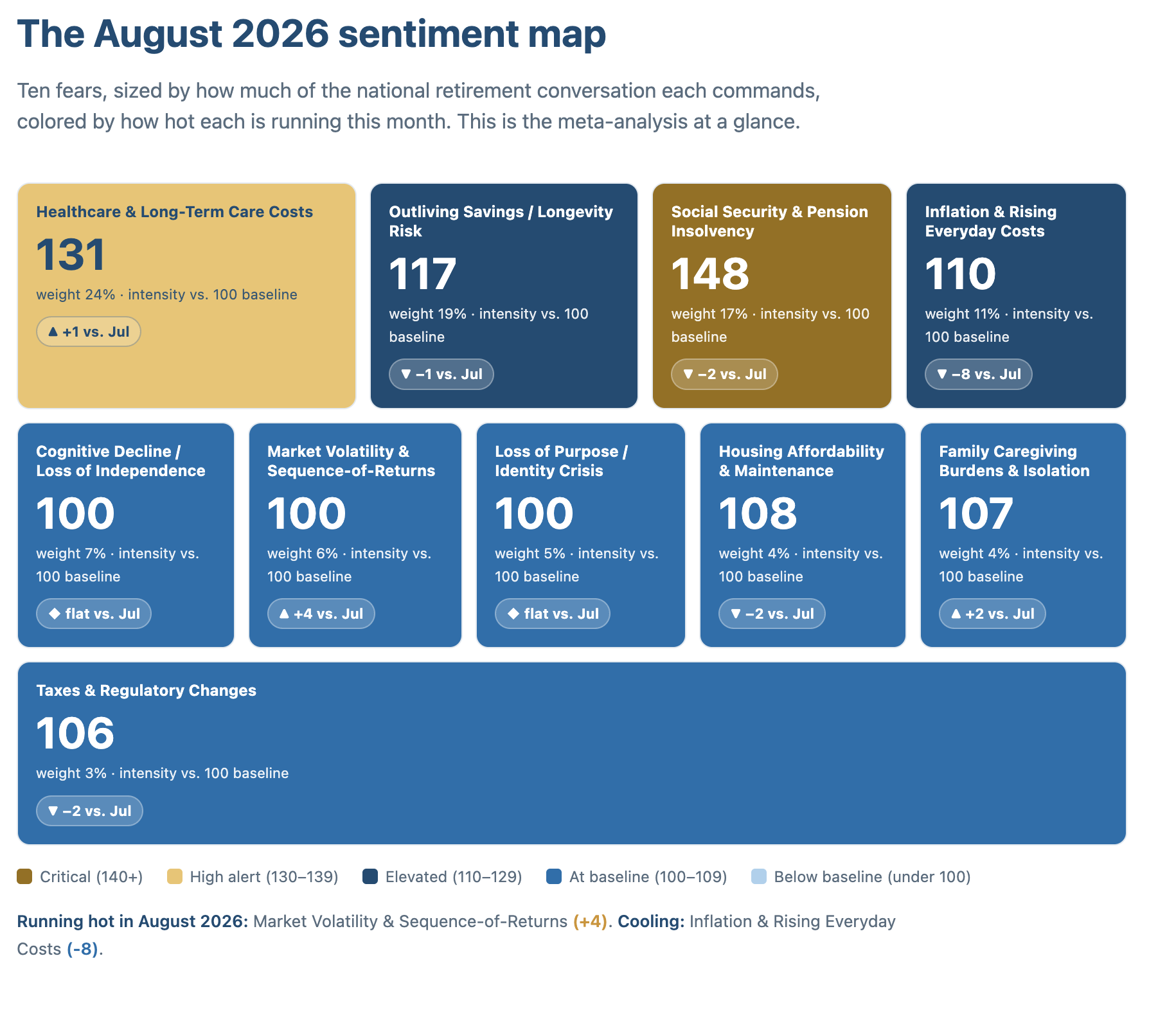
Inflation and Everyday Costs registered the largest decline in August, falling eight intensity points from 118 to 110.
That reflects a meaningful change in the latest economic data. Headline inflation slowed from 4.2% in May to 3.5% in June. Core inflation eased from 2.9% to 2.6%, while the energy index fell 5.7% during the month—the largest monthly decline since April 2020.
Retirees tend to feel these changes quickly.
A lower gasoline bill, slower grocery-price increases or a smaller utility bill can provide immediate breathing room to someone living on a fixed income. Even for affluent clients, a slowdown in everyday expenses can create a sense that the financial environment is becoming more predictable.
Consumer attitudes improved as well. The University of Michigan Consumer Sentiment Index jumped 11.5% in July to 55.2, its highest level in five months. Year-ahead inflation expectations eased from 4.6% to 4.2%, while long-term expectations settled at 3.3%.
These are what I call cyclical fears. They are connected to inflation, energy costs, interest rates, market swings and the broader direction of the economy.
They can rise quickly. A series of expensive grocery trips, a market correction or another increase in borrowing costs can make clients wonder whether their retirement plans still work.
They can also retreat when economic conditions improve.
That is what we saw in August. (LinkedIn)
The structural fears held firm
The fears that barely moved were the ones tied to the long-term architecture of retirement.
Social Security and Pension Insolvency remained the highest-intensity fear in the Index at 148.
Healthcare and Long-Term Care rose slightly to 131.
Outliving Savings held at 117.
Those concerns are not likely to disappear after one favorable inflation report or a few good months in the stock market.
The 2026 Social Security Trustees Report still projects depletion of the Old-Age and Survivors Insurance Trust Fund in the fourth quarter of 2032. Unless Congress acts, incoming revenue would cover only a portion of scheduled benefits.
That does not mean Social Security will disappear. But the possibility of reduced benefits matters to people who expect it to provide the foundation of their retirement income.
It matters to wealthy families, too. A HNW household may not depend on Social Security for basic living expenses, but clients still build cash-flow projections, tax strategies and legacy plans around expected benefits. A reduction may not break the plan, but it could change the plan.
Healthcare is even harder to compartmentalize.
The latest CareScout Cost of Care data showed the national median cost of an assisted-living community rising 5% to $6,200 per month, or $74,400 a year.
For a couple, the possibility that one spouse could need care for several years can alter the entire retirement equation. It may affect where they live, how much they give to children, when they transfer assets, whether they purchase a second home and how confidently they spend.
Then there is the savings gap.
Vanguard’s latest retirement-plan research reported a median 401(k) balance of $44,115. That number includes workers at different ages and career stages, but it still shows how little room for error many households have as retirement approaches.
A modest balance may have to support a retirement lasting 25 or 30 years, alongside inflation, taxes, healthcare expenses and the chance that one spouse will live much longer than the other.
Even wealthy retirees are not exempt from longevity risk. Their concern may be less about paying the monthly bills and more about maintaining multiple homes, helping family members, funding charitable commitments or preserving assets for the next generation.
Those are structural issues. They require more than a better month in the economic data.
Market volatility moved in the other direction
August also showed why retirement sentiment rarely moves in a straight line.
While inflation fears declined, Market Volatility and Sequence Risk rose four intensity points following the Federal Reserve’s July 29 meeting.
The Fed held interest rates steady, but three officials dissented because they preferred another increase. That introduced a fresh concern that rates could remain higher for longer—or rise again if inflation proves stubborn.
For retirees taking withdrawals from investment accounts, volatility is more than an emotional issue.
Poor returns during the first several years of retirement, combined with ongoing withdrawals, can weaken a portfolio much more than the same decline later in retirement. That is the essence of sequence-of-returns risk.
Just three months ago, market volatility was running below the Index baseline. Now it is moving higher again.
One fear cooled. Another took its place.
This is where an advisor’s steady presence matters. Clients do not need their plans rebuilt after every Federal Reserve meeting. They need help distinguishing between a change in the headlines and a change in their long-term financial capacity.
Caregiving is also reshaping retirement
Family Caregiving and Isolation rose two points in August following new findings from the Employee Benefit Research Institute.
EBRI found that caregivers were less confident than non-caregivers about several aspects of retirement. They were also more likely to report that their expenses were higher than expected and that their retirement lifestyle did not match what they had imagined.
That finding should concern more than caregivers.
Many retirement plans quietly assume that an adult child or spouse will be available to provide care. Fewer plans account for the financial, emotional and career costs that responsibility may impose on the caregiver.
This is especially relevant in affluent families, where money can create the illusion that every care problem can be outsourced.
It cannot.
A family may be able to hire home health aides, care managers and household help. Someone still has to coordinate the care, make medical decisions, manage changing family expectations and recognize when a parent is no longer safe living alone.
Caregiving is a family matter. It is also a retirement-planning issue.
A small amount of fear can be useful
We often treat fear as something that needs to be eliminated.
Unchecked fear can certainly cause damage. It can lead investors to sell during a market decline, hold too much cash, postpone retirement indefinitely or deny themselves reasonable spending after decades of saving.
But some retirement fears serve a purpose.
Concern about outliving savings may prompt a client to stress-test a financial plan.
Concern about cognitive decline may lead to an updated power of attorney or a conversation with an adult child.
Concern about long-term care may encourage a family to compare insurance, home-care and assisted-living options before a crisis occurs.
Fear becomes more useful when it becomes specific.
“I’m afraid of retirement” is difficult to address.
“I’m concerned that one of us may need long-term care, and we have never discussed how we would pay for it” is a planning issue.
The advisor’s job is not to convince clients that nothing bad will happen. It is to help them separate useful warnings from runaway anxiety.
Retirement is also a chance to change the menu
Retirement planning sometimes reminds me of preparing a large family barbecue.
For years, you may have cooked the same food for the same people in the same way. Everyone knows what will be served. Everyone knows where to sit. There is comfort in that routine.
Then retirement arrives and suddenly you have a much bigger grill—and much more time to decide what belongs on it.
You can keep serving the old favorites. You can also experiment.
Try a different recipe. Invite someone new. Visit a farmers market in a town you have never explored. Hand the tongs to someone else. Accept that one dish may not turn out exactly as planned.
Retirement gives clients an opportunity to reflect, hit the reset button and explore new people, places and experiences. Yet many affluent retirees remain so focused on avoiding mistakes that they never give themselves permission to try anything new.
A sound financial plan should protect the future. It should also create room for curiosity.
Advisors can ask whether clients are using their financial freedom to build a larger life—or merely preserving the life they already had.
Five family money conversation starters
Retirement fears often grow in silence. The following questions can help advisors move family discussions beyond portfolio performance and into the decisions that may eventually affect everyone.
1. “What are each of us most worried could happen?”
Ask spouses to answer separately before comparing responses. One may fear running out of money. The other may fear losing independence, becoming a burden or being forced to leave the family home.
The answers may reveal that the couple has been preparing for different versions of retirement.
2. “What would we want our children to know during a health crisis?”
This can open a discussion about powers of attorney, healthcare proxies, account access, long-term-care preferences and where important documents are stored.
It also gives adult children permission to ask questions before an emergency.
3. “How much help do we expect to give—or receive—within the family?”
HNW clients may intend to help children buy homes, pay grandchildren’s tuition or support aging relatives. Those commitments need to be considered alongside the clients’ own longevity and care needs.
Families should also discuss whether parents expect adult children to provide hands-on care later.
4. “What would make this retirement feel successful, beyond investment returns?”
Clients may answer with travel, time with grandchildren, better health, community involvement, creative work or the freedom to live in more than one place.
This question helps connect financial decisions to the life the money is supposed to support.
5. “Which worries are based on evidence—and which may be inherited stories?”
A client who watched a parent run out of money may remain afraid to spend despite having substantial resources. Another may resist long-term-care planning because the family has always handled such matters privately.
The fear is real even when the financial threat is not. Naming the story behind it can help clients respond more thoughtfully.
The first cooling—but not an all-clear
The August decline in the Retirement Fear Index is encouraging.
Inflation fears eased. Consumer sentiment improved. Some of the immediate financial pressure on retirees appears to be moderating.
But Social Security, healthcare, longevity and caregiving remain deeply embedded concerns.
For advisors, the lesson is not to tell clients to stop worrying. It is to help them worry more selectively.
Cyclical fears deserve attention, but they should not force a client to rebuild a 30-year plan after every economic report.
Structural fears deserve a deliberate response: realistic longevity assumptions, healthcare planning, family conversations, stronger legal documents and a clear understanding of who will step in when help is needed.
Healthy fear can function as feedback.
Listen to it. Determine whether it reflects a passing headline, an old family story or a genuine weakness in the plan.
Then give it something useful to do.