
Trending

Written By: David Trainer Question: Why are there so many ETFs? Answer: ETF providers tend to make lots of money on each ETF so they create more products to sell.
The large number of ETFs has little to do with serving your best interests. Below are three red flags you can use to avoid the worst ETFs:
1. Inadequate Liquidity
This issue is the easiest issue to avoid, and our advice is simple. Avoid all ETFs with less than $100 million in assets. Low levels of liquidity can lead to a discrepancy between the price of the ETF and the underlying value of the securities it holds. Plus, low asset levels tend to mean lower volume in the ETF and larger bid-ask spreads.2. High Fees
ETFs should be cheap, but not all of them are. The first step here is to know what is cheap and expensive.To ensure you are paying at or below average fees, invest only in ETFs with total annual costs below 0.44%, which is the average total annual cost of the 459 U.S. equity Style ETFs we cover. The weighted average is lower at 0.14%, which highlights how investors tend to put their money in ETFs with low fees.Figure 1 shows FLAG Forensic Accounting Long-Short ETF (FLAG) is the most expensive style ETF and State Street SPDR Portfolio Large Cap ETF (SPLG) is the least expensive. AdvisorShares (FWDI, FWDD) provides two of the most expensive ETFs while State Street (SPLG, SPTM) and Schwab (SCHX, ITOT) ETFs are among the cheapest. Figure 1: 5 Most and Least Expensive Style ETFs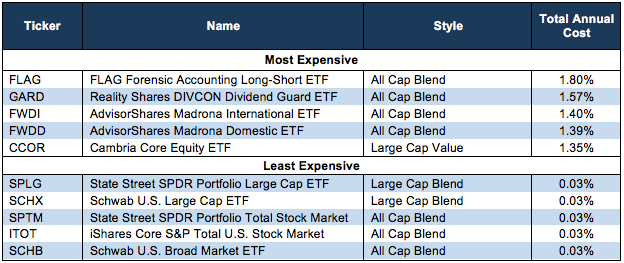 Image Source: New Constructs, LLCSources: New Constructs, LLC and company filingsInvestors need not pay high fees for quality holdings. [1] State Street SPDR Portfolio Large Cap ETF (SPLG) is the best ranked style ETF in Figure 1. SPLG’s Neutral Portfolio Management rating and 0.03% total annual cost earns it an Attractive rating. [2] Alpha Architect U.S. Quantitative Value ETF (QVAL) is the best ranked style ETF overall. QVAL’s Very Attractive Portfolio Management rating and 0.88% total annual cost earns it a Very Attractive rating.On the other hand, Vanguard Mid Cap Growth Index Fund (VOT) holds poor stocks and earns our Unattractive rating, yet has low total annual costs of 0.08%. No matter how cheap an ETF, if it holds bad stocks, its performance will be bad. The quality of an ETFs holdings matters more than its price.
3. Poor Holdings
Avoiding poor holdings is by far the hardest part of avoid bad ETFs, but it is also the most important because an ETFs performance is determined more by its holdings than its costs. Figure 2 shows the ETFs within each style with the worst holdings or portfolio management ratings. Figure 2: Style ETFs with the Worst Holdings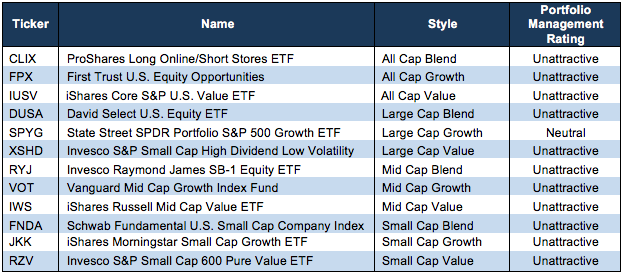 Image Source: New Constructs, LLCSources: New Constructs, LLC and company filingsiShares (IUSV, IWS, JKK) and Invesco (XSHD, RYJ, RZV) appear more often than any other providers in Figure 2, which means that they offer the most ETFs with the worst holdings.ProShares Long Online/Short Stores ETF (CLIX) is the worst rated ETF in Figure 2. iShares Morningstar Small Cap Growth ETF (JKK) also earns a Very Unattractive predictive overall rating, which means not only do they hold poor stocks, they charge high total annual costs.Our overall ratings on ETFs are on our stock ratings of their holdings and the total annual costs of investing in the ETF.Related: Could This Be 2008 All Over Again?