
Trending

Bonds Take the Spotlight: Stocks stumbled as 30-year Treasury yields hit their highest level since 2007.
This week’s edition:
Summary
- Why long-term yields keep rising
- The economy is still holding up
- What this means for investors
- What’s next
- Quick word for income investors
After a strong run that pushed U.S. stocks to record highs, the market took a breather. The Nasdaq and Russell 2000 declined 2.05% and 1.65%, taking the brunt of the reversal. While both the S&P 500 and the Dow held up better, falling only 1.1% and 0.85%, the broad message was clear: rising Treasury yields are no bueno. While the Treasury’s intervention on Wednesday offered a brief reprieve, yields rebounded, and oil prices rose, sending both stocks and bonds lower again by the week’s end.
The biggest concern is not the Federal Reserve’s short-term policy rate right now, although that will swing back around by the September meeting. The issue is the cost of borrowing further out on the yield curve. The 30-year Treasury yield reached its highest level since 2007 in time to celebrate the US crossing another debt milestone ($40 trillion if you hadn’t heard). Higher long-term yields can raise borrowing costs across the economy and put pressure on stock valuations.
The Treasury Department made a surprise announcement on Wednesday that it would double the size of planned long-term Treasury buybacks from $2B to $4B beginning in September. The 30-year yield fell 0.1 percentage points that day. It was the largest one-day decline in more than a year, but the move quickly reversed, leaving yields no better off by the end of the week. The buyback program may improve market liquidity and provide a useful signal, but it does little to address the underlying forces pushing yields higher.
X wasn’t too impressed.

Why long-term yields keep rising
There are various forces working against the Treasury market, which is making this a particularly challenging environment.
Technology companies are borrowing heavily to finance AI infrastructure builds, which fueled a 27% increase in corporate bond issuance through July. This is crowding out government debt absorption. Ballooning government deficits and the increased Treasury issuance have to compete for investor dollars, and this naturally pushes up yields.
The current geopolitical tension and ongoing trade uncertainty layer on added pressure. Oil prices climbed as the openness of the Strait of Hormuz remained in question and pushed Brent crude near $93 per barrel by the end of the week. Higher energy prices could reignite immediate inflation concerns, even though expectations for inflation over the next five and 10 years remain contained.
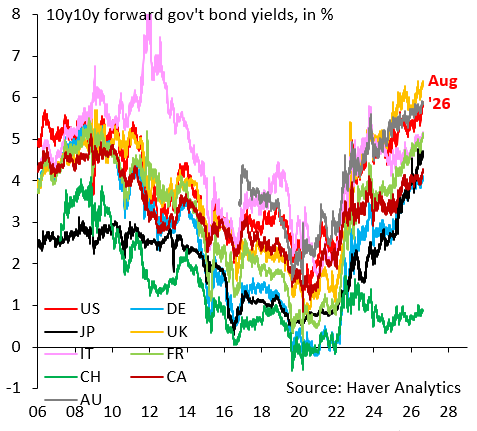
The trend is not limited to the United States. Long-term government bond yields in the US, Japan, Italy, Australia, Germany, the UK, France, and Canada have also moved toward multiyear highs. That suggests investors may be demanding more compensation to hold long-term debt globally, reflecting concerns about government borrowing and inflation.
Source: Robin Brooks
The New York Fed's model suggests that the added premium investors demand to hold longer-term bonds has increased in recent years. Historically, it is relatively contained, but yields are starkly higher than what we experienced between the 2010s and early 2020s. That recency bias is accentuating the panicky consumer and economic response. Global interest rates are unlikely to revert back to the 2010s levels given the elevated concerns.
The economy is still holding up
Higher borrowing costs are weighing on the interest-rate-sensitive parts of the economy. Housing remains a glaring weak spot, with home sales, housing starts, and builder sentiment all dragging. Adjacent industries that align with the housing market, like home improvement stores, furniture retailers, and especially mortgage lenders, are also struggling because of it.
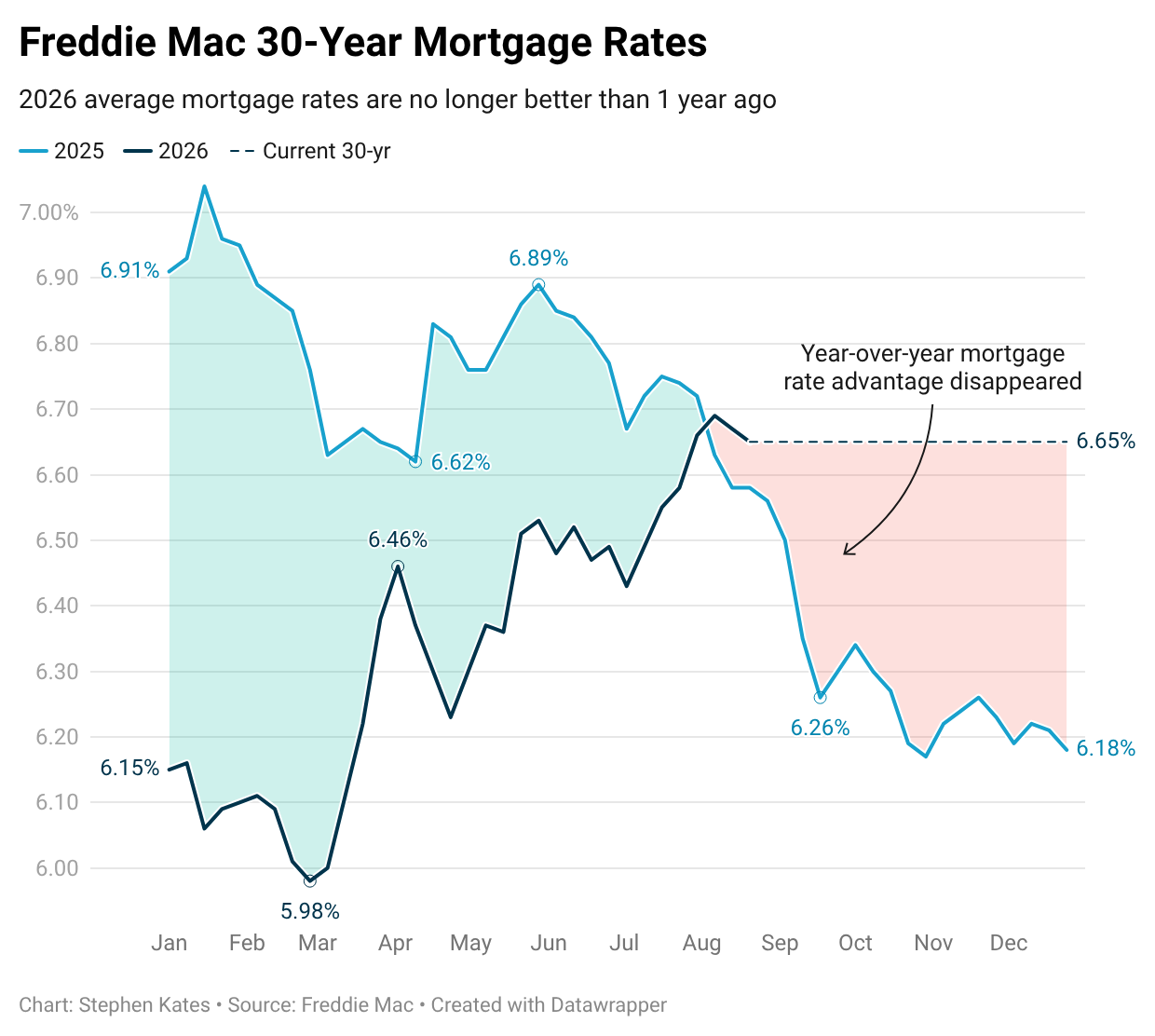
The average 30-year mortgage rate has risen to the point that it is now above its level from a year ago, reversing what little affordability gains buyers received over the past year.
The broader economy continues to show resilience, mainly on the back of AI infrastructure and durable consumer spending. Household spending was solid in Q2, with inflation-adjusted personal consumption rising to a 3.2% annualized rate.
The preliminary S&P Global Composite PMI jumped to 56.0 in August, the highest reading since April 2022. The results were promising, with services businesses leading, but manufacturing also stayed in expansion territory. Importantly, employment growth is continuing, and business confidence showed improvement, two areas that will need to hold up amid waning labor force expansion.
Corporate earnings provided the key support for the recent leg higher for the stock market. Earnings strength is extending beyond the mega-cap technology companies, with small- and mid-cap earnings expected to grow by more than 20%.
What this means for investors and what’s next
The near-term outlook for stocks is modestly cautious. Geopolitical uncertainty and renewed pressure on Treasury yields will create potential headwinds. The strong foundation of earnings is why the recent pullback doesn’t necessarily signal a change in the broader market trends. However, the yield-related jitters shouldn’t be overlooked and could deepen in the short term. The concern over deficits, inflation, and dollar weakness will be front-and-center in the mid-term election news cycle, which could exacerbate market stress when there is wall-to-wall coverage.
But you have to pick your battles here. If you went long 30-year treasuries on Wednesday hoping to make a quick buck, go gamble somewhere else. Trying to take short-term positions in any market is going to be tough given the administration’s propensity for surprise intervention announcements that may or may not land.
Strong economic activity and broad-based earnings growth offer better incentives to focus on the long-term trends and look beyond immediate volatility. The key question is whether earnings growth can continue to run. Pressure created by higher borrowing costs is growing, particularly for companies relying heavily on debt to fund AI-related capital spending. Broadcom was the latest company to announce a major debt deal, and it won’t be the last.
Related: A 5% Bond Yield Isn’t a Crisis. It’s a Return to Normal