
Trending

June was another banner month for ETF inflows with the year-to-date tally reaching $1 trillion in the first half of the year, positioning 2026 to easily top the flows record set last year.
“US-listed ETFs had $196 billion inflows in June, pushing Q2 flows to $560 billion—a new record for any quarter and three-month period,” notes Matthew Bartolini of State Street Investment Management. “Inflows now total over $1 trillion for the year, and full-year inflows are forecast to be well over $2 trillion—beating 2025’s record $1.5 trillion.”
It takes a village – advisors, professionals and retail investors – to drive inflows of $1 trillion in just six months, but in the essence of keeping it real, the bulk of that tally is attributable to institutional investors. That’s no surprising as endowments, healthcare service groups, insurance providers, pension plans and unions, among others, have long been ETF devotees.
The Coalition Greenwich 2026 North American Institutional ETF Study confirms as much. Importantly, the survey confirms there’s plenty of room for further institutional adoption of ETFs because a scant percentage of these investors say won’t be using ETFs in the future.

(Image: Coalition Greenwich)
Big Investors’ Big Embrace of ETFs
One of the nifty things about ETFs is that the asset class has legitimate appeal to both the biggest and smallest fish in the investing ocean. At the professional level, some of the most prolific adopters of ETFs are the largest institutions.
As Coalition Greenwich points out, 56% of institutions of managing $5.1 billion to $10 billion are already using ETFs and that grows to 62% in the $10 billion-plus category. Nearly a quarter of the institution managing at least $10 billion that aren’t using ETFs today are considering doing so.
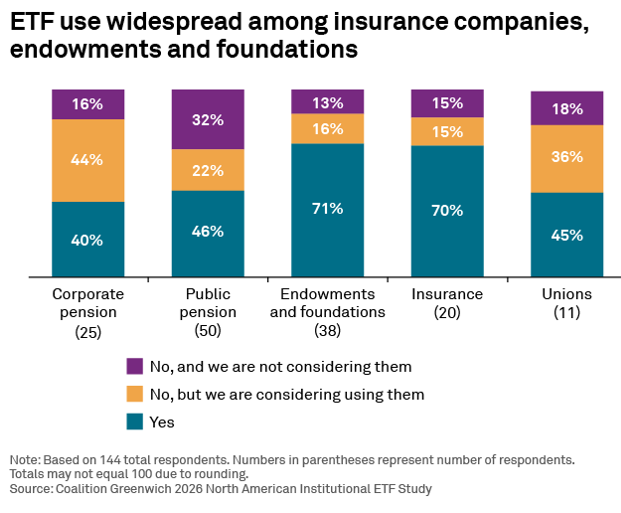
“More than 70% of North American insurance companies and endowments and foundations are using ETFs in their investment portfolios,” according to the research firm.
Future sources of ETF growth at the institutional could well be corporate and public pension managers and unions because those groups trail their endowment and insurance peers in terms of current ETF adoption.
(Image: Coalition Greenwich)
Potentially portending a long-term uptick in institutional adoption of ETFs is the versatility offered by the asset class – something some institutions are already capitalizing on.
“Institutions are using ETFs to replace a wide range of investment vehicles, including index mutual funds, institutional separately managed accounts (SMAs), active mutual funds, and individual stocks,” according to the study. “Insurance companies have been by far the most active in replacing other alternatives with ETFs. Meanwhile, 40% of corporate pension funds are using ETFs to replace SMA/UMAs.”
Why Institutions Love ETFs
Obviously, a major college endowment or insurance carrier is dealing with assets far in excess of even the largest wealth management firms and certainly retail investors, but the institutions’ reasons for embracing ETFs are remarkably similar to those of advisors and do-it-yourself investors.
Eighty-one percent of institutional investors deploying fixed income ETFs say they like the liquidity with 69% saying the same of equity ETFs. An average of 55.5% across bond and equity ETFs say ease of use is important while nearly half enjoy the low costs offered by ETFs. Those are also among the catalysts for advisor and retail adoption of ETFs.
“Accordingly, institutions are adopting ETFs as a key vehicle to seek index exposures. Nearly two-thirds (63%) of institutions say they use ETFs in an effort to obtain strategic long-term exposures—usually as part of passive allocations in core-satellite portfolio constructions—making this the most common reason that North American institutions use ETFs,” concludes Coalition Greenwich. “Given that usage, the continued growth of passive strategies in institutional portfolios may help to drive future increases in ETF adoption and allocations.”
Related: Retail Investors Are Driving the ETF Boom—And It's Only Just Beginning