

Trending
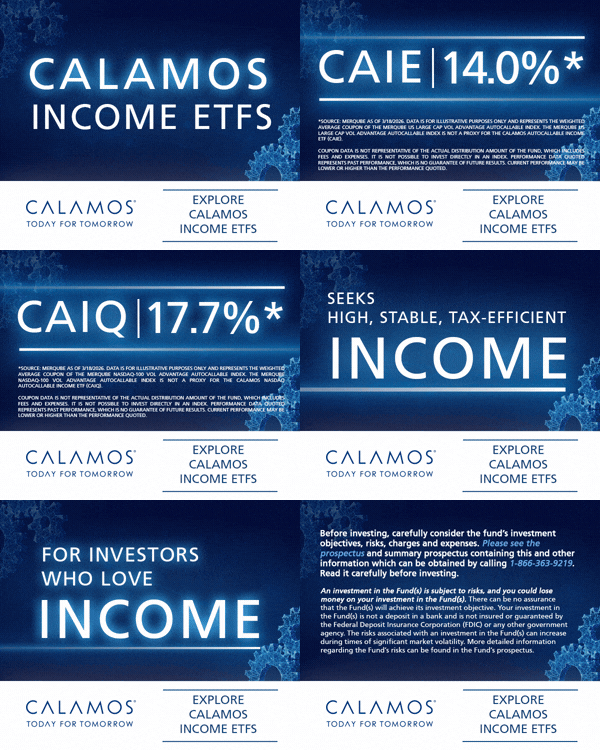
Matt Kaufman, Global Head of ETFs at Calamos, returns with big news: CAIE has earned two major industry honors—the SRP Americas Most Innovative Product Award and Structured Product Intelligence’s Deal of the Year—rare recognition for an ETF in a category traditionally dominated by structured notes. Kaufman says the awards validate the core idea behind CAIE: bringing a complex autocallable note strategy into a simple, transparent, liquid ETF format that advisors already trust.
He introduces CAIQ as the natural next step—a NASDAQ-focused autocallable ETF built on the same laddered weekly issuance, volatility-targeted index design, and J.P. Morgan swap partnership that have powered CAIE’s success. The key enhancement is a tighter 30% downside barrier, allowing for a higher expected coupon while maintaining historical durability. Kaufman positions CAIQ as a complement to CAIE, mirroring how advisors pair NASDAQ and S&P exposures in traditional equity allocations. With CAIE now past $300M and demand accelerating, he expects more innovation ahead from Calamos in the autocallable ETF space.
Resources: Calamos
Related: Matt Kaufman, Head of ETFs, Talks Calamos Autocallable Income ETF (CAIE)
Transcript:
[00:00:00] Doug Heikkinen: This is Advisorpedia's Power Your Advice podcast and I'm Doug Heikkinen.
[00:00:08] Doug Heikkinen: Today we welcome back Matt Kaufman, Global Head of ETFs at Calamos. Hi Matt.
[00:00:13] Matt Kaufman: Hey Doug. How are you?
[00:00:15] Doug Heikkinen: I'm great. . .
[00:00:44] Matt Kaufman: Yeah, thanks Doug. Appreciate you bringing both of those awards up. Historically, those have gone to structured products. So, incredible honor. I think it's validating to the idea and construct of CAIE, the Autocallable Income ETF, to have democratized, not just an outcome based strategy, but an actual structured note strategy that's working very well in the market and bringing that into the ETF marketplace.
Doing it in a way that is simple, transparent, it's liquid, tax efficient, all the things that advisors have come to like about ETFs. And now bringing the structured note marketplace into that. I think it's, again, incredibly validating and it's an honor to have won both of those.
[00:01:30] Doug Heikkinen: It sure is.
You're now launching a follow on offering, CAIQ, which is a NASDAQ based autocallable strategy. What drove the decision to create a NASDAQ specific autocallable ETF, and how does it complement CAIE?
[00:01:46] Matt Kaufman: Yeah. The NASDAQ 100 represents a natural evolution of the autocallable platform. Just like investors have historically chosen between S&P 500 and NASDAQ 100 exposure in their equity allocations, we're now providing that same fundamental choice in autocallable income strategies.
The demand was really immediate and clear. Within weeks of launch of CAIE, advisors were asking, "when is the NASDAQ version coming?" They understood that different clients have different perspectives, different preferences. Some want that broad market exposure. Some are looking for that tech exposure. The NASDAQ 100, specifically having heavy tech exposure. So we're seeing a lot of demand for that NASDAQ version.
In the structured note world, there's a lot of autocallable notes tied to the MerQube US Large-Cap Vol Advantage Index. There are also a lot of autocalls tied to the NASDAQ version, the US Tech version. So we're bringing that to market. It's a natural evolution to, and follow on offering for our initial CAIE.
[00:02:57] Doug Heikkinen: For advisors who want to know a little bit deeper into the deep differences between CAIQ and CAIE, just beyond the underlying index, can you talk about those and are there structural improvements or lessons learned from CAIE's success?
[00:03:14] Matt Kaufman: Oh, sure. I don't think we've learned any lessons where we wouldn't improve upon that.
The CAIE is working tremendously well. That core innovation remains the same. It remains consistent. We are using that same laddered structure with 52 weekly vintages. It's the same partnership with J.P. Morgan as the swap counterparty, MerQube's proven index methodology. But what we are refining is just the execution through the NASDAQ version.
So we're taking a lot of what we have done with CAIE and now just applying it to the NASDAQ 100. So investors can get both of those worlds. The one small difference is the barrier level. The barrier level for the coupon and principle on CAIE are at minus 40% or their 60% principle coupon and then principle maturity barriers.
For the NASDAQ version, we are moving that up to 30% downside coupon barrier and downside protection forward. Your principle barrier there. So we've moved the barrier up by 10% and if you look at the index that this is all based on, historically there was no principle lost going back to 2005.
So you're able to move that barrier up. Get a higher coupon, and then historically at the index level, you would've saw no breaches along the way. Some interesting innovation there.
[00:04:45] Doug Heikkinen: The NASDAQ has different volatility characteristics than the S&P 500. How does this impact the autocallable structure and potential income generation for CAIQ?
[00:04:57] Matt Kaufman: I think this is where MerQube's index technology can really shine. The reference indexes that both of these ETFs are tied to have a volatility target. So the volatility target is 35%. That is the target vol for the reference index of each autocallable. Traditionally, people would move toward the NASDAQ because it has a little bit higher of a volatility.
Well if you've stabilized the volatility of both around the same level, then that you can surmise to think that the coupon you would generate would largely be consistent. So that is another reason. To get that natural step up in coupon level, you'd want to move that barrier up slightly in order to improve or increase the coupon level.
But I think the beauty here is that the structure is remarkably consistent. So the real differentiation isn't necessarily in the yield that you're able to generate, but it's just giving advisors and investors the ability to express a view on technology leadership through NASDAQ while maintaining this high stable income and the protection that comes from autocallables versus that broad market exposure with the original offering.
[00:06:09] Doug Heikkinen: Yeah. And with that tech concentration in the NASDAQ, how does CAIQ handle sector risk while maintaining the autocallable income benefits?
[00:06:18] Matt Kaufman: Yeah. Advisors are choosing CAIQ, they want to make an intentional allocation to technology to growth companies.
We are seeing that specifically in the market today, AI is growing ex exponentially fast. A lot of people want that type of exposure. What we're providing is a way to access that exposure, but in an autocallable format, which is designed to deliver you high stable coupons with differentiated and diversified maturity risk, diversified timing risk.
So you can get that autocallable exposure that you're used to in the structured note world, but in a much more diversified way.
[00:06:59] Doug Heikkinen: Yeah. Advisors are loving CAIE. So how are you positioning CAIQ for advisors who already use CAIE? Is this a replacement, a compliment, or serving different client needs?
[00:07:11] Matt Kaufman: This is complimentary. We're seeing advisors think about this just like they do traditional equity allocations. Some clients warrant an S&P 500 approach. Others may benefit from that NASDAQ exposure, and a lot of times people use both. We're seeing this play out in the covered call ETF space, a large derivative income space in the US. And in the structured note world, it's largely similar. Derivative income dominates there, but it's through the autocallable.
So a lot of use cases there where a lot of people are looking for that S&P exposure and some are looking for the NASDAQ exposure, but both can compliment each other extremely well. I think the key here is that both products share the same operational DNA, the same monthly distribution schedule, the same tax efficient treatment expectations, the same intraday liquidity, so it just makes it very seamless for advisors to use both within their practice.
[00:08:11] Doug Heikkinen: What's the expected coupon range for CAIQ and how might it differ from CAIE given the NASDAQ's volatility profile?
[00:08:20] Matt Kaufman: Yeah, our expectations is that the coupon range for the NASDAQ version will be slightly higher than the S&P 500 or the US large cap version. And that is largely because we've stepped up the barrier and historically looking at the laddered NASDAQ index, historically, it allows you to step up that barrier, achieve a nice high stable coupon in a case where you never would have breached the coupon or the principle barrier. And so we're seeing a little bit higher of a coupon range. As soon as we are out and live and make that first distribution, that will be confirmed. But we are seeing that a little bit higher than on the original product.
[00:09:02] Doug Heikkinen: So what's next for the autocallable space?
[00:09:05] Matt Kaufman: Good question. We've proven that the model works. CAIE has recently crossed $300 million in assets. We've won recognition from the structured products industry. It's extremely validating. But if you look at the real story, it's a multi hundred billion dollar structured products market that's just waiting for ETF disruption.
So we're exploring a lot of strategies here. I think you, you're gonna see a lot from Calamos in the future. There's a lot more to do here, but right now we're focused on CAIE, CAIQ. Those are two great products, first to market products that we're really excited about.
[00:09:46] Doug Heikkinen: Matt, thanks so much for being with us and congratulations with all the success.
[00:09:50] Matt Kaufman: Oh, appreciate it. Thank you.
[00:09:52] Doug Heikkinen: For more information about Calamos, please visit them at Calamos.com. We are on all social media platforms @Advisorpedia. Please give us a follow. For our producer Tory Miller and everyone at Advisorpedia. Thank you so much for listening.