
Trending

Many financial advisors are turning to ETFs that blend income with Nasdaq equity exposure. The reasoning behind this shift is straightforward. Should the Nasdaq-100 market’s returns fall back to earth, these blended ETFs could still fortify a portfolio with regular income.
Inversely, if equity markets continue to perform well, this type of strategy can offer simultaneous uncapped capital appreciation and portfolio yield. Combined with the tax efficiency of the ETF wrapper, these funds have proven to be efficient investment options.
Nevertheless, advisors should do their research before taking on these ETFs. Each strategy can offer different sector and asset class exposures, and many come with significant trade-offs.
How CANQ Uses Bonds to Stand Apart
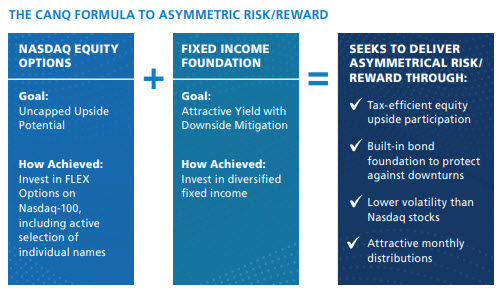
One actively managed fund with an alternative take on the dual-layer approach is the Calamos Nasdaq® Equity & Income ETF (CANQ). This fund offers equity exposure to the Nasdaq-100 through options and direct investment in individual stocks. However, CANQ’s secret sauce is how it generates income.
Many ETFs that promise equity exposure with income do so primarily through covered call strategies that generate yield by selling call options for premium income. While this tactic delivers income, it does so at the expense of limiting upside potential and fully exposing investors to downside risk.
By contrast, CANQ buys calls for unlimited upside exposure rather than selling them to generate income. The fund uses a fixed-income portfolio to generate income and provide more downside resistance.
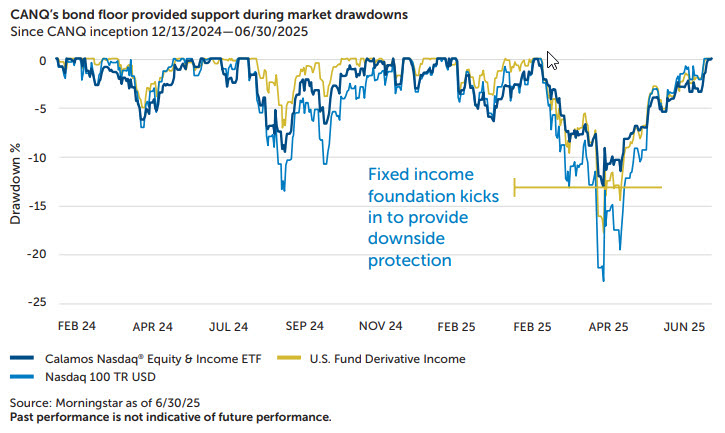
Considering the frothy performance of the US equity market, CANQ’s bond allocation may be more valuable than ever. The chart below shows how the fund resisted several Nasdaq-100 drawdowns.
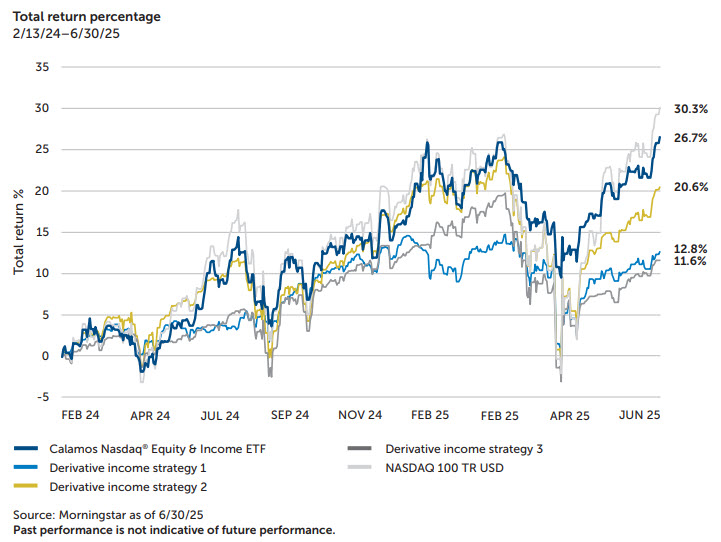
Powered by the strength of its bond returns, CANQ is performing well in the equity income ETF space. The chart below bears this out, showing CANQ and the top three strategies in the Derivative Income Morningstar category.
In addition, strong yield opportunities accompany this long-term portfolio growth. As of July 31, 2025, CANQ has a 30-day SEC yield of 4.64%.
For more on CANQ, visit www.calamos.com/canq or speak with a specialist at 866.363.9219.
Related: CPSL Offers Full Access to Calamos Monthly S&P 500 ETFs
Before investing, carefully consider the fund's investment objectives, risks, charges and expenses. Please see the prospectus and summary prospectus containing this and other information which can be obtained by calling 1-866-363-9219. Read it carefully before investing.
An investment in the Fund(s) is subject to risks, and you could lose money on your investment in the Fund(s). There can be no assurance that the Fund(s) will achieve its investment objective. Your investment in the Fund(s) is not a deposit in a bank and is not insured or guaranteed by the Federal Deposit Insurance Corporation (FDIC) or any other government agency. The risks associated with an investment in the Fund(s) can increase during times of significant market volatility. The Fund(s) also has specific principal risks, which are described below. More detailed information regarding these risks can be found in the Fund's prospectus.
Risks of investing in the Calamos Nasdaq® Equity & Income ETF include risks associated with: Authorized Participant Concentration Risk — Only an Authorized Participant may engage in creation or redemption transactions directly with the Fund, and none of those Authorized Participants is obligated to engage in creation and/or redemption transactions; Debt Securities Risk — Debt securities are subject to various risks, including interest rate risk, credit risk and default risk; Equity Securities Risk — The securities markets are volatile, and the market prices of the Fund’s securities may decline generally; FLEX Options Risk — The Fund may invest in FLEX Options issued and guaranteed for settlement by The Options Clearing Corporation ("OCC"). FLEX Options are customized option contracts that trade on an exchange but provide investors with the ability to customize key contract terms like strike price, style and expiration date while achieving price discovery in competitive, transparent auctions markets and avoiding the counterparty exposure of over-the-counter options positions; High Yield Risk — High yield securities and unrated securities of similar credit quality (commonly known as “junk bonds”) are subject to greater levels of credit and liquidity risks; LEAPS Options Risk — The Fund’s investments in options contracts may include long-term equity anticipation securities known as LEAPS Options. LEAPS Options are long-term exchange-traded call options that allow holders the opportunity to participate in the underlying securities’ appreciation in excess of a specified strike price without receiving payments equivalent to any cash dividends declared on the underlying securities; Liquidity Risk - FLEX Options — In the event that trading in the underlying FLEX Options is limited or absent, the value of the Fund's FLEX Options may decrease; Liquidity Risk - LEAPS Options — In the event that trading in the underlying LEAPS Options is limited or absent, the value of the Fund's LEAPS Options may decrease; Market Maker Risk — If the Fund has lower average daily trading volumes, it may rely on a small number of third-party market makers to provide a market for the purchase and sale of Fund Shares; Market Risk—The risk that the securities markets will increase or decrease in value is considered market risk and applies to any security; New Fund Risk — The Fund is a recently organized investment company with a limited operating history; Non-Diversification Risk — The Fund is classified as “non-diversified” under the 1940 Act; Options Risk—The Fund’s ability to close out its position as a purchaser or seller of an over-the-counter or exchange-listed put or call option is dependent, in part, upon the liquidity of the option market; Other Investment Companies (including ETFs) Risk — The Fund may invest in the securities of other investment companies to the extent that such investments are consistent with the Fund’s investment objective and the policies are permissible under the 1940 Act.
Nasdaq® and Nasdaq-100, are registered trademarks of Nasdaq, Inc. (which with its affiliates is referred to as the “Corporations”) and are licensed for use by Calamos Advisors LLC. The Fund has not been passed on by the Corporations as to their legality or suitability. The Fund is not issued, endorsed, sold, or promoted by the Corporations. The Corporations make no warranties and bear no liability with respect to the Fund(s).
30-day SEC yield reflects the dividends and interest earned by the Fund during the 30-day period ended as of the date stated above after deducting the Fund’s expenses for that same period. The Fund had a 30-day SEC yield of 4.64%% as of 7/31/25.
The Morningstar US Fund Derivative Income Category includes funds that primarily aim to generate regular and sustainable income through the use of derivatives, particularly options strategies like covered calls. These funds typically maintain significant exposure to equities (such as US stocks) and use derivatives to enhance income beyond what is provided by dividends alone.
The Nasdaq-100 Index® is a stock market index made up of equity securities issued by 100 of the largest non-financial companies listed on the Nasdaq stock exchange. It is a modified capitalization-weighted index.
The Nasdaq-100 Top 30 Hybrid Income Index® tracks the performance of a systematic strategy of purchasing long call options on the 30 largest stocks in the Nasdaq-100® Index combined with a Fixed Income ETF.
The fund's expense ratio as of the prospectus dated 5/2/2025 is 0.89%.
Calamos Financial Services LLC, Distributor
NOT FDIC INSURED | MAY LOSE VALUE | NO BANK GUARANTEE
Calamos Financial Services LLC
2020 Calamos Court | Naperville, IL 60563
866.363.9219 | www.calamos.com | [email protected]
2024 Calamos Investments LLC. All Rights Reserved.
Calamos and Calamos Investments are registered trademarks of Calamos LLC.