
Trending
In the booming income ETF category, autocallable ETFs might just be the next major advancement. They seek double-digit yields, price stability and tax efficiency. And unlike options-income ETFs, which are considered dividend-income replacements, autocallable ETFs are pure income plays tied to equity performance. While they offer compelling monthly payouts, investors should be aware of tail risks from sharp, sustained equity declines.
Understanding Autocallables and the Potential ETF Advantage
Autocallable yield notes are structured investments that pay income based on equity market performance rather than credit or interest rates. Think of them as bonds whose payouts depend on the market avoiding significant declines. Traditionally, accessing these notes required navigating high minimums, illiquidity, and complex tax reporting. www.calamos.com/autocall
Autocallable ETFs, like the first-to-market Calamos Autocallable Income ETF (CAIE), simplify access by packaging these notes into a vehicle that offers daily liquidity, lower investment thresholds, and streamlined tax reporting. These ETFs aim to pay monthly income if a reference index stays above a barrier (typically 60% of its initial level). If the barrier is breached, income may pause, and principal could be at risk.
The main advantages of autocallable ETFs include attractive yields, monthly distributions, and partial downside protection. They’re well-suited for flat or mildly declining markets where traditional fixed income may underperform. By holding a laddered portfolio of autocallable notes with staggered maturities, these ETFs endeavor to smooth income and reduce timing risk. The ETF structure also provides operational efficiency and easier tax handling.
Why CAIE?
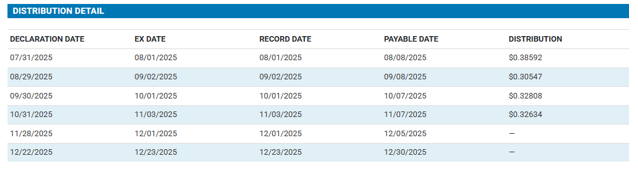
CAIE has quickly gained traction, amassing over $400 million in assets within five months. Its appeal lies in seeking higher, steady income—currently distributing around 14% annualized—without relying on bonds. The most recent monthly distribution (10/31/25) was 14.25%. Unlike long-dated put-writing strategies, CAIE’s income is tied to equity performance and can cushion moderate volatility.
Autocallable ETFs like CAIE offer a compelling alternative in the income space, especially for investors seeking high yields with partial downside protection and tax efficiency. While not without risks, their structure and strategy provide a differentiated solution compared to options-income ETFs.
Autocallable Yield Advantage is clear, yet historically difficult to access
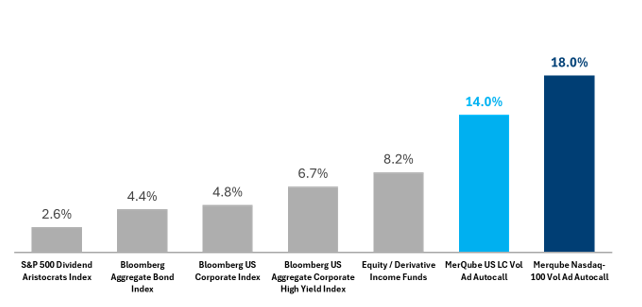
Chart source: Bloomberg and Morningstar Direct. Data as of 10/1/2025. Unmanaged index returns, unlike fund returns, do not reflect fees, expenses or sales charges. Investors cannot invest directly in an index. Total return assumes the reinvestment of income. Current performance may be higher or lower than the performance data shown. Yields represented by trailing 12-month yield for: Top Derivative Income Funds (Represented by the top 10 Funds by AUM as of 9/30/25 in the derivative income category excluding single stock funds) and yield to worst for the Bloomberg Aggregate Bond Index, Bloomberg US Corporate Index and Bloomberg US Aggregate Corporate High Yield Index. Yield represents weighted average coupon for: MerQube US Large Cap Vol Advantage Autocallable and MerQube Nasdaq-100 Vol Advantage Autocallable Index. Investors should consider the risks of investing in CAIE and CAIQ and review the prospectus prior to investing. Before investing, carefully consider the fund’s investment objectives, risks, charges and expenses. Please see the prospectus and summary prospectus containing this and other information which can be obtained by calling 1-866-363-9219. Read it carefully before investing. An investment in the Fund(s) is subject to risks, and you could lose money on your investment in the Fund(s). There can be no assurance that the Fund(s) will achieve its investment objective. Your investment in the Fund(s) is not a deposit in a bank and is not insured or guaranteed by the Federal Deposit Insurance Corporation (FDIC) or any other government agency. The risks associated with an investment in the Fund(s) can increase during times of significant market volatility. The Fund(s) also has specific principal risks, which are described below. More detailed information regarding these risks can be found in the Fund’s prospectus.
Performance data quoted represents past performance, which is no guarantee of future results. Current performance may be lower or higher than the performance quoted. The principal value of an investment will fluctuate so that your shares, when sold, may be worth more or less than their original cost.
Introducing: Calamos Nasdaq® Autocallable Income ETF (CAIQ)
Building on CAIE's early success, Calamos recently launched the Calamos Nasdaq® Autocallable Income ETF (CAIQ), the first ETF to deliver an autocallable income strategy based on a Nasdaq-100® index. With CAIE and now CAIQ, Calamos has delivered an entirely new derivative income category to the ETF space. These represent a fundamental shift in how investors may now derive tax-efficient income from equities. CAIE proved the categorical demand, and now CAIQ is extending this transformation to the Nasdaq-100.
Before investing, carefully consider the fund’s investment objectives, risks, charges and expenses. Please see the prospectus and summary prospectus containing this and other information which can be obtained by calling 1-866-363-9219. Read it carefully before investing.
Related: Investors Embrace Autocallable ETF Strategy, Driving $300M+ AUM in Just Four Months
1CAIE DISTRIBUTION DETAIL
An investment in the Fund(s) is subject to risks, and you could lose money on your investment in the Fund(s). There can be no assurance that the Fund(s) will achieve its investment objective. Your investment in the Fund(s) is not a deposit in a bank and is not insured or guaranteed by the Federal Deposit Insurance Corporation (FDIC) or any other government agency. The risks associated with an investment in the Fund(s) can increase during times of significant market volatility. The Fund(s) also has specific principal risks, which are described below. More detailed information regarding these risks can be found in the Fund’s prospectus.
The principal risks of investing in the Calamos Autocallable Income ETF and the Calamos Nasdaq Autocallable Income ETF include: autocallable structure risk, contingent income risk, early redemption risk, barrier risk, authorized participant concentration risk, calculation methodology risk, cash holdings risk, correlation risk, costs of buying and selling fund shares, counterparty risk, credit risk, derivatives risk, equity securities risk, index risk, interest rate risk, investment in a subsidiary, laddered portfolio risk, liquidity risk, market maker risk, market risk, new fund risk, non-diversification risk, premium-discount risk, secondary market trading risk, swap agreement risk, tax risk, trading issues risk, valuation risk, and volatility target index risk.
Autocallable Structure Risk --The Fund’s returns are correlated to the performance of a synthetic portfolio of autocallable notes tracked by the Laddered Autocall Index.
Unmanaged index returns, unlike fund returns, do not reflect fees, expenses or sales charges. Investors cannot invest directly in an index. Total return assumes the reinvestment of income. Current performance may be higher or lower than the performance data shown. Yields represented by trailing 12 month yield for: US Equity- S&P 500; U.S High Yield - Bloomberg US Aggregate Corporate High Yield Index; US 10-year - 10-year US Treasury yield; Equity Premium Income: Cboe S&P 500® 2% OTM BuyWrite Index; Autocallable Income: MerQube US Large Cap Vol Advantage Autocallable Index. MerQube US Large Cap Vol Advantage Autocallable Index is not a proxy for Calamos Autocallable Income ETF (CAIE). The results of the MerQube index will differ to those of CAIE. Investors should consider the risks of investing in CAIE and review the prospectus prior to investing. Performance data quoted represents past performance, which is no guarantee of future results. Current performance may be lower or higher than the performance quoted. The principal value of an investment will fluctuate so that your shares, when sold, may be worth more or less than their original cost.
Autocallable notes have specific structural features that may be unfamiliar to many investors:
--Contingent Income Risk: Coupon payments from the Autocalls are not guaranteed and will not be made if the Underlying Index falls below the Coupon Barrier on observation dates. This means the Fund may generate significantly less income than anticipated during market downturns.
--Early Redemption Risk: Autocalls in the Portfolio may be called before their scheduled maturity if the Underlying Reference Index reaches or exceeds the Autocall Barrier on observation dates. This automatic early redemption could force reinvestment of that portion of the portfolio at lower rates if market yields have declined.
--Barrier Risk: If the Underlying Reference Index falls below the Protection Level Barrier at the maturity of an Autocall in the Portfolio, that portion of the Portfolio will be fully exposed to the negative performance of the Underlying Reference Index from its initial level. This conditional protection creates a binary outcome that can result in sudden, significant losses if barriers are breached.
Weighted Average Coupon: The weighted average coupon of all autocallables as of last operation date
Total return assumes the reinvestment of income. Current performance may be higher or lower than the performance data shown. Yield represented by trailing 12 month yield for: Autocallable Income: MerQube US Large Cap Vol Advantage Autocallable Index. MerQube US Large Cap Vol Advantage Autocallable Index is not a proxy for Calamos Autocallable Income ETF (CAIE). The results of the MerQube index will differ to those of CAIE.
Nasdaq® is a registered trademarks of Nasdaq, Inc. (which with its affiliates is referred to as the "Corporations") and is licensed for use by Calamos Advisors LLC. The Fund has not been passed on by the Corporations as to their legality or suitability. The Fund is not issued, endorsed, sold, or promoted by the Corporations. THE CORPORATIONS MAKE NO WARRANTIES AND BEAR NO LIABILITY WITH RESPECT TO THE FUND(S).