
Trending

You only have to look at the stock market to see that people perceive artificial intelligence as an expanding universe of potential (as well as a threat–another topic for another time). But that’s not the only place where expectations for the technology are sky-high. We see it in the executive suite and boardroom, too.
“Why are we spending so much on marketing,” they say, “when Claude (or ChatGPT or Gemini) can do it faster and with greater precision?”
Of course, nobody is asking a chatbot to run their entire marketing program (yet!). But many of the people who are inclined to keep the purse strings pulled taut have begun to get excited about AI. After all, AI can do things that would have seemed miraculous just five years ago—write persuasive emails, generate photos that are indistinguishable from the real thing, analyze data and write reports, automate repetitive tasks, even code websites and apps.
With such sophisticated tech at hand, why would we continue to invest so heavily in a traditional marketing team and tools? Why not scale down the team to the bare essentials and let the robots do all the heavy lifting?
It’s a reasonable question. And maybe someday I will be more sympathetic to this point of view. But not yet.
Today, handing most tasks over to AI without a lot of expert oversight means dancing with disaster. Why? Because many use cases for AI in marketing just aren’t ready for the real world. And I think key pieces, such as producing thought leadership content, won’t be for a very long time. At the same time, the LLM technology behind the revolution still has serious unsolved problems.
Let’s start with AI’s most publicized bugaboo: its proclivity to make stuff up. If nobody is fact-checking your emails, blogs and social media posts, you risk embarrassing your firm or even exposing it to brand harm. While the AI platforms have made some incremental progress on this front, it remains a serious challenge and worry.
Then you have to wrestle with implications of all that AI-generated content. I’ve argued why experts should avoid using AI to write their content: Thought leaders, by definition, need to develop their own voice and point of view, neither of which a chatbot is any good at. And detecting AI text is becoming easier than ever. Pangram, a leading AI detection company, has released extensions for Chrome and Firefox browsers. Now, readers can just highlight some text in their web browser and right-click to find out if it was generated by AI. Easy peasy.
While I believe expert educational content should be human-written, I don’t think that standard has to apply to every page, email and post a firm produces, as long as a person reviews and edits them before they are released into the wild. That said, even this situation poses a theoretical risk of reputational damage.
As a person who thinks deeply about branding, I worry about perceptions. Will the availability and convenience of tools like Pangram’s browser extension make everything online fair game? Will people troll the internet looking for firms to shame publicly because they used AI (to write their homepage copy? (Or they think they did. In some cases human-written content is mistakenly identified as being in part or in whole AI-produced.) We are already seeing signs of this happening—and some companies are fighting back by making a point of not using AI.
I’m not naive. I understand that AI has too many legitimate marketing applications to be ignored. It gives marketers superpowers they never had before—such as the ability to comb through and make sense of large amounts of data. It can take the drudgery out of internet research (but verify your sources!). It can dramatically reduce the time it takes to respond to RFPs. It can also speed up the production of marketing emails, landing pages, charts, infographics and more.
Major marketing platforms routinely build AI into their products, as well, making it easy to extract insights from the data without needing a computer science degree.
So here’s what any firm leader needs to know today. AI is a useful tool that makes skilled marketers more productive. It is not replacing many, if any of them, at this point. And the converse is true too: if you ask an unskilled person to use AI to do a marketing task, the results are likely to be poor.
You can’t invest in AI alone and expect results. The results come not from the tool itself, but from the experience, knowledge and good judgement of the person who wields the tool. Nor can you expect a single marketer, no matter how skilled and competent, to run a sophisticated modern marketing program alone, no matter how many AI agents they deploy. Each task requires human attention and decision-making.
An AI-centric marketing program—one with minimal human oversight—would also likely push your marketing toward the middle. That means doing more of the things ordinary firms do, delivered with similar messaging. Undifferentiated marketing is unremarkable marketing.
Each year, Hinge conducts a study of hundreds of professional services firms to determine what the top-performers do differently. They do not shy away from AI. In fact, it is a top marketing priority. But they also invest heavily in marketing. They spend 140% more on marketing than their no-growth peers. Here’s the data:
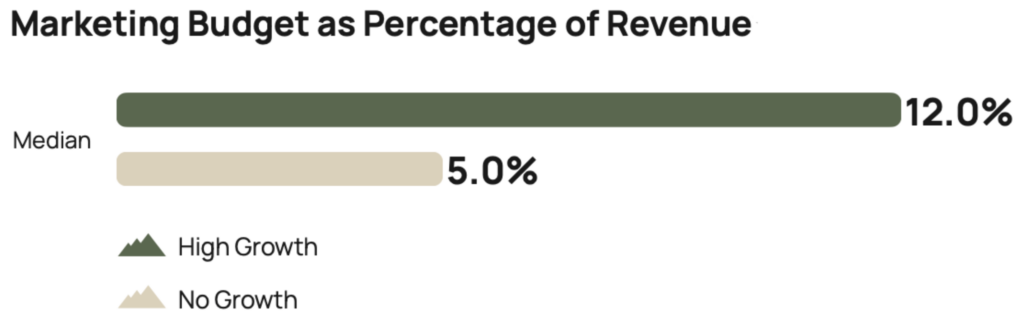
Far from running away from marketing, the most successful firms are embracing it. They are building skilled internal marketing teams, outsourcing certain tasks to specialists and going to great lengths to master the AI tools and marketing platforms at their disposal.
And they are enjoying the fruits of their harvest.