Trending

One of the biggest mistakes investors make is assuming confidence equals accuracy.
Every day, market forecasts are delivered with conviction. Recession calls. Election predictions. Interest rate projections. “This time is different” narratives. The more confident the expert sounds, the easier it becomes to believe action is necessary.
But there is one major problem.
The people making these forecasts are usually wrong. And not just slightly wrong.
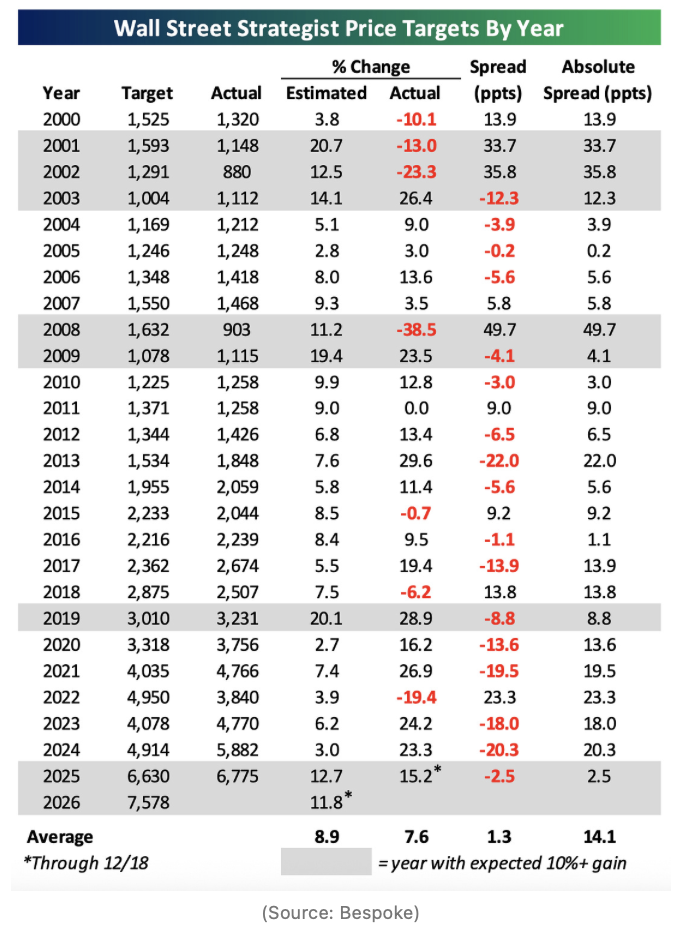
According to data from Bespoke Investment Group (see image at end of article), market strategists have missed actual market returns by an average of roughly 14% per year since 2000.
Yet investors continue reacting to forecasts as if certainty exists.
That is why one of the most important jobs advisors have is helping clients remember.
- Remember how often predictions fail
- Remember how emotional headlines distort perception
- Remember that long term plans were built specifically for periods of uncertainty
One of the reasons forecasts are so persuasive is because the brain craves certainty.
Uncertainty is uncomfortable. The human brain interprets uncertainty as risk, even when no immediate danger exists. So when a well known expert appears on television with charts, economic data, and a high degree of confidence, skepticism naturally starts to decline.
Investors begin thinking:
“Maybe they see something I don’t.”
“Maybe we should make a change.”
“Maybe this time is different.”
This is completely normal human behavior.
The issue is not that investors are irrational. The issue is that confident predictions create the illusion of certainty and control in an environment where they are limited.
The Forecasting Trap
One of the most dangerous things about market forecasts is that they often sound logical in the moment.
A strategist can always build a convincing case:
- Inflation
- Elections
- Geopolitical tensions
- Federal Reserve policy
- Valuation concerns
And sometimes those forecasts will be correct. After all, a broken clock is correct twice per day. And being occasionally right reinforces belief in future predictions.
But markets are complex systems with countless moving parts. Forecasts are usually based on linear thinking in a world that rarely behaves linearly.
That is why long term investing cannot depend on predictions.
If investors constantly adjusted portfolios based upon expert forecasts, they would likely spend much of their investing lives reacting emotionally to narratives that never fully materialize…and not participate fully in the wealth-generating power of the markets.
The Real Value of a Financial Plan
A financial plan is not designed only for calm periods.
It is specifically designed for moments when emotions intensify and the pressure to act feels overwhelming.
That is why reminding clients about the poor track record of forecasts is so important. It helps create emotional distance between alarming narratives and portfolio decisions.
The goal is not to ignore risks.
The goal is to avoid allowing predictions to override discipline.
One of the most powerful questions advisors can ask clients during uncertain periods is:
“Has your long term plan changed, or has the headline changed?”
Most of the time, it is only the headline.
Why Investors Continue Falling For Forecasts
Even highly intelligent investors fall into this trap because forecasts offer psychological relief.
Predictions create the feeling that uncertainty can be managed if we just listen to the right expert.
But successful investing has never been about predicting the future consistently.
It has been about building systems that help investors stay disciplined when the future feels uncertain.
That may include:
- Reducing exposure to prediction driven media
- Revisiting historical market recoveries
- Using written investment principles
- Working with an advisor who provides perspective instead of panic
The investors who often struggle the most are not necessarily the least informed.
They are frequently the ones consuming the most short-term forecasts.
Remembering Matters
Memorial Day is ultimately about remembrance.
As investors and advisors, remembering also matters.
- Remembering how unpredictable markets are
- Remembering how often forecasts fail – and by how much
- Remembering that confidence and accuracy are not the same thing
- Remembering that long term outcomes are usually driven more by investor behavior than expert predictions
Because when uncertainty rises, investors do not need more forecasts.
They need perspective.