
Trending

Therapists often say that we can’t change what we don’t acknowledge.
Most people don’t realize that our food system is showing extreme signs of weakness. Skyrocketing beef prices, for example, are a sign of a weak system that is susceptible to breaking. According to a February 13, 2026 Food Ingredients First article, ground beef hit US$6.69 per pound in December 2025 — up 19.3% year-over-year and 72% since 2020 — with the USDA forecasting a further 6.9% wholesale increase in 2026. This isn’t due simply togeneral inflation. This is because the U.S. cattle herd fell to a 75-year low of 86.2 million head as years of drought and animal-borne pandemics impacted supply.
This is also not a one-off situation. The same is occurring with skyrocketing egg prices due to avian flu. In fact, rising prices, trade wars, and extreme weather are all negatively impacting food distribution.
So why aren’t we acknowledging this?
I propose that we don’t have a neutral language to negotiate the problem. With virtually all subjects at the moment being polarized and politicized, augmented by certain industry interests and the politicians that support them, it’s almost impossible to say that the food system needs an overhaul without being accused of playing political sides.
So, tell me, what side is one on if they propose better business models for more nutritious output?
What political side is one on if they propose introducing products that need fewer inputs, but produce more outputs, otherwise known as efficiency?
What political side is one on if they propose that more efficiency means better profit margins and more stable, consistent supply chains, otherwise known as resiliency?
What political side is one on if they propose new innovations for farming equipment, better soil management, better cover crops, and smarter technology for less for food waste, and more protein diversity for less dependency on a single kind of protein?
What political side is one on if they propose investing in the technology to control IP in order to stabilize and establish something as critical as food security on the global stage?
It seems to me that none of these have a political side and that moving forward on all of them, and thus revamping the system as a whole, is pretty important to the population as a whole.
As a quotidian example of how we can’t seem to get out of our own way to even begin normal conversations about our food system, look at how we have politicized processed foods in a convenient way, choosing to simply ignore some basic truths. What we like, we decide isn’t processed. What we don’t like, we decide is processed.
The following foods are items most people love, eat, accept, don’t discuss, and give a hall pass to…yet they are highly processed. This rhetoric is are supported by the press and politicians.
Protein Powder
Fast food or store-bought hamburgers
Sandwich meat (ham, bologna, turkey)
Bacon, sausages and hotdogs
Most store-bought breads, hamburger buns, and hot dog buns.
Meanwhile, mention a plant-based burger and people are up in arms about it being processed, which varies greatly depending on the product. Never mind that the meat industry created the sector called ‘Processed Meat’ and that there is a whole section in the store dedicated to the highly processed breakfast sausages, bacon, ham, bologna, turkey, and hotdogs; all of which are Group 1 carcinogens, per the World Health Organization.
It seems to me that, despite the industry rhetoric and press initiatives to control the conversation, we are going to need to be realistic about the foods we eat. For example, when ordering a ground-beefhamburger, how many of us order the side salad instead of french fries? Be real. It’s never the salad and french fries are deeply processed. We also need to get serious regarding the need to fix the system to get healthier personally, but also healthier and more resilient from a larger systems perspective.
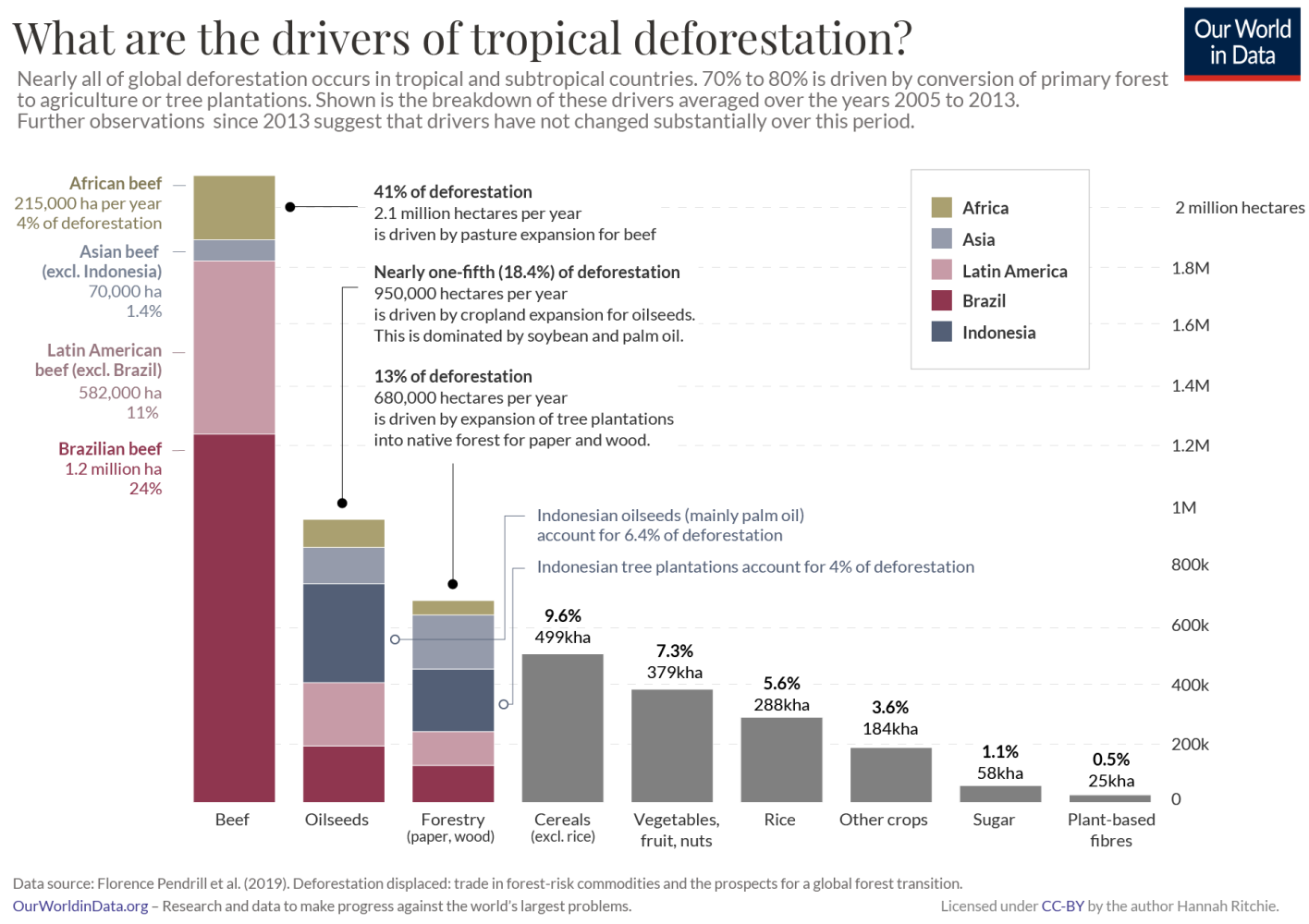
Our World In Date chart showing that beef is responsible for 41% of the world’s tropical deforestation, a critical natural capital.
As discussed in my last article, “Our Food System Is Fragile, Fractured and F-Bombed“, we are going to need a strategy in order to implement a system overhaul and to do that we need a common language that acknowledges where we are, how we spend, and where the weaknesses lie: in protecting industry interests, misinforming consumers, poor consumer habits, food waste and insecure supply chains due to specific protein dependencies.
The average American ate 270 pounds of meat a year in 2023- the equivalent of three quarter pound hamburgers a day-and we are going to have to find a way to continue to supply that level of protein with at least some other options than animal protein or the supply chain weaknesses due to the disproportionate use of natural capital will only continue. We also need to come clean on the fastest way to innovate ourselves to a better position: meaningful investment. We need to do all this before more supply chain breakdowns from rising prices, weather or trade wars become existential.
The last thing we need is another era of empty shelves lacking in flour and meat like we had during COVID-19.
Let’s hope that we soon get our heads in the food game and stop wasting time on politics or the melting food system will be more costly to us than just expensive burgers.