
Trending

The Fed Chair — Much Ado About Nothing?
Everyone thinks the Fed controls the economy when the opposite is true. This ‘dumb sheep’ take on the Fed was the view of the late great economist, Fisher Black. No disrespect to Kevin Warsh. But Fisher would be having a great laugh at the hullabaloo surrounding the choice of the new Fed Chair.
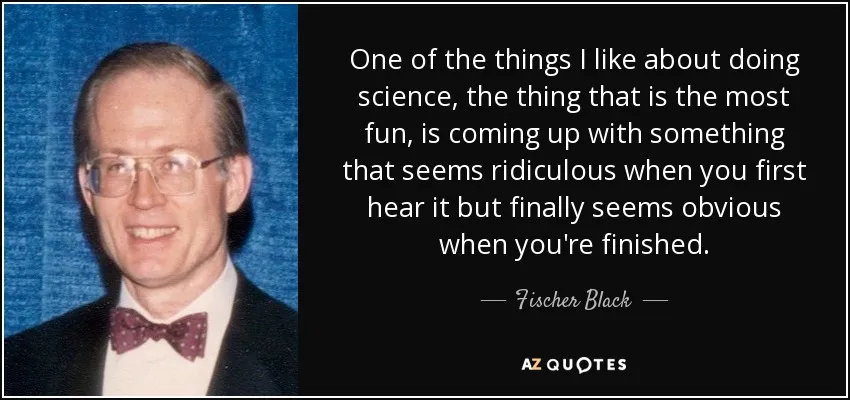
According to Fisher, the Fed sets interest rates to stay in line with rates set by the private financial market — the private actors setting the demand for and providing the supply of loans — short, medium, and long term. In short, the Fed goes along to get along. It’s effectively a dumb sheep following the market — the price-setting of over 30 million US businesses and the interest-rate-setting and asset-price-setting of the $300 trillion global financial market.
Fisher — An Aside
Fisher was an eccentric. He held a notebook, recording furiously every word you said. There was a method in his seeming madness. It made you think twice about what you emitted from your mouth. Fisher was intense, but the sweetest person. He differed if he differed, but always agreeably. And his eyes and smile lit up, accompanied by rapid note taking, when you said something on target that he hadn’t considered. As for his laugh. It was fantastic. He was a genuine oxymoron — an ecstatic academic.
I found some, actually much of what Fisher said hard to decipher. But when you’re in the presence of the co-parent, together with Robert Merton and Myron Scholes, of the Nobel Prize-winning Black-Scholes-Merton option pricing formula, you listen up. Our conversations were one part puzzlement, one part awe, and one part enlightenment. Over time, the puzzlement became revelation.
Fisher, passed at a young age to his family, colleagues, and the world’s enormous loss. He was a giant in finance. But he was interested in all of economics. When Fisher left MIT to work with Goldman Sachs, he called me. In fact, he called me at 11 AM on his first day at work. He wanted to discuss consumption taxation.
“Fisher,” I said, “This is your first day at Goldman. Let’s see. You’ve been at the job for two hours. I imagine they are paying you well. And you’re calling me to discuss consumption taxation?”
“I just lost ten million dollars. I’d like to discuss consumption taxation.”
“With you.”
We discussed consumption taxation for the next hour.
Fisher on the Fed
Fisher’s view of the Fed struck me, at the time, as passing strange. After all, every macro economist and his brother were busy trying to demonstrate exactly how the Fed impacted the economy. Fisher’s heresy can be understood based on the Quantity Theory of Money, that dates to Copernicus in 1517.
MV=PY,
where M is the supply of money, V is the velocity of money — how fast it circulates through the economy, P is the price level, and Y is output. If the economy uses all its inputs to produce output, Y is given. If V is constant, then any changes in M change P. For example, if the Fed prints (electronically, these days) money, say doubling M, it will double P.
Fisher claimed that causality ran the other way. If every company believes all other companies are doubling their prices, it will be in every company’s interest to do likewise. So, P will double forcing the Fed to double M. If it doesn’t, Y will fall in half.
Yes, faster money is akin to more money. So V could double to keep Y from falling. But the public needs an incentive to treat money as a hot potato. Higher interest rates are that incentive because the quicker you use your money to buy assets, the quicker you earn higher returns. Thus if the Fed keeps M fixed, the market will raise interest rates to satisfy the equation. The notion that the market, not the Fed, controls interest rates was also a key part of Fisher’s thinking.
In particular, if the market keeps raising P with the Fed accommodating by raising M, we’ll have ongoing inflation. In this case, lenders will require a higher nominal interest rate to compensate them for being repaid in watered-down dollars. For its part, the Fed will raise the federal funds rate — the rate it charges banks to borrow money — to stay in line with other interest rates and make sure it, too, doesn’t get hurt by inflation. Hence, the drama around the Fed raising or lowering rates is, in Fisher’s view, mostly theatre.
Pressuring the Fed
As I write on 1/1/26, The New York Time’s top print story is “Trump’s Push Will Test Spine of Fed Choice.” The President wants the Fed to lower interest rates. This, he believes, will stimulate investment, raising Y. Most economists think it will stimulate prices. After all, Kevin will need to print money to buy bonds to raise their prices and lower interest rates. According to the Quantity Theory, which, again, takes V and Y as fixed, more M means a higher P. Indeed, the anticipation of more M may already be raising P, i.e., producing higher inflation.
Just the Facts, Ma’am
If the Fed were omnipotent, as the President appears to believe, why did it let prices rise by 25 percent over the past five years? If the Fed were omnipotent, why did it let prices double in the 1970s? If the Fed were omnipotent, why didn’t it prevent the Great Recession of 2008 and the equally great recession of 1981? If the Fed were omnipotent, why did it oversee 22 recessions and one great depression since its founding?
Fisher’s answer might run like this. Fed policy is largely set by the market. I.e., it accommodates market forces, not the other way around. Yes, Warsh can kowtow to the President for a bit. But if following the President’s diktats leads markets to object with, say, the S&P dropping 1000 points, it will be TACO time and Warsh will be told to change course.
What Really Controls Monetary Policy is Fiscal Policy
The major endogeneity of Fed behavior involves out-of-control fiscal policy. There have been 56 hyperinflations since 1900. None of these reflected intentional policy by the relevant countries’ central banks. All reflected governments that spent vastly more than they could cover in taxes forcing their central banks to make (print) money to make money. These episodes fully fit Fisher’s view. It wasn’t the Hungarian central bank’s choice to let prices in 1946 rise at 41.9 quadrillion percent per month, leading prices to double every 15 hours. The government was broke and the central bank went along to get along. Mechanically, a) the Hungarian government sold bonds to get money to pay its bills, b) the central bank printed money to buy back the bonds (to “keep interest rates low”), and c) there was far more M relative to Y. This led P to rise. But V also rose dramatically as inflation raised nominal interest rate making it nuts to hold money for more than a few hours. The increase in V helped accelerate inflation.
As described here, our government is beyond bankrupt. As the US Treasury sells more and more bonds, the Fed will be forced to buy up more and more bonds to “keep interest rates low.” This spells high inflation, if not hyperinflation. Whether it’s this Fed Chair or that Fed Chair won’t matter. They will all need to go along by printing money or leave the government unable to pay, at the margin, for anything more. Yes, if they have the backbone of Paul Volcker, they can say, ‘no mas’, let interest rates go nuts, and coordinate everyone’s expectations and actions on financial default and a major recession. But that’s a tremendously expensive way to enforce fiscal discipline.
So, three cheers for Kevin. But don’t expect him to matter. He’s, as Dylan sang, just a pawn in their game — the private sector’s price-setting game and the government’s destitution game.
Jawboning
To the extent the Fed has power, it is in coordinating the price-setting and employment decisions of our nation’s 30 million businesses. Our economy exhibits multiple equilibria — multiple places the economy can go if everyone believes that’s where it’s going. The Great Recession provides an excellent example, as this paper argues.
If the Fed Chair is calm, collected, and reassuring, they’ll be better able to keep the economy and inflation on an even keel. If they panic when the economy panics, they’ll make matters worse. Had Fed Chair Ben Bernanke traveled to the Lehman Brothers building the day it failed and taken a sledge hammer to the building, he would have demonstrated that nothing real had changed. Yes, the current occupants were filing out, but new occupants would shortly file in. Had he also drawn blood from those filing out to show that no one had died and pointed out that they would soon be re-employed, possibly in the same building, he might have ended the panic on the spot. He could also have said that Lehman was just one of a multitude of banks and other financial intermediaries and he was running the world’s largest and safest bank — The Federal Reserve, which he was open to the public as needed. This didn’t happen. Instead, we saw President Bush and Treasury Secretary Paulson panic along with many of our other “leaders.” And despite TARP, Quantitative Easing, and a host of other Fed and Treasury financial interventions, the economy failed “greatly.”
Bottom Line
The Fed’s Chair and the Fed’s moves are of constant fascination to journalists who butter their bread with endless articles speculating on whether the Fed will raise or lower the one interest rate it controls. But the Fed Chair is ultimately at the mercy of the real behavior of the private sector and the fiscal authorities. That’s where we should all focus, not on which puppet is attached to which strings.
Related: How the World’s Nuclear Powers Are Responding to Trump’s Escalating Personalism