
Trending

The $84 trillion wealth transfer isn’t just about assets—it’s about values, stories, and guiding the next generation beyond entitlement toward resilience and responsibility.
Entitlements and Ordinary People
Robert Redford, who passed away recently, never won an Oscar for acting. But in 1980, he won Best Director for Ordinary People, one of my favorite films. The story follows a wealthy suburban Chicago family after tragedy strikes: one son dies in a boating accident, and the surviving brother (Timothy Hutton) is consumed by guilt. What makes the movie timeless is not its depiction of wealth but of humanity—the vulnerability, the silence, the fractures that money and status can’t heal. It reminds us that all families, even those with resources, face demons behind closed doors.
As $84 trillion in assets prepares to shift hands over the next two decades*—the so-called Great Wealth Transfer—families will not pass down just money. They will pass down stories, values, and emotional legacies. For advisors working with High-Net-Worth (HNW) families, the challenge is to help clients transform awkward, anxious money talks into purposeful conversations that build harmony and stewardship across generations.
Enough vs. Entitlement
At the heart of generational planning lies a tension: when is wealth “enough,” and when does it tip into entitlement?
Psychologist Steven Stosney identifies two corrosive forms of entitlement:
- Societal entitlement—the belief that one’s needs outweigh everyone else’s.
- Compensatory entitlement—the conviction that past suffering justifies present indulgence.
Both derail family dialogue. By contrast, families that practice reciprocity—giving and receiving with fairness and empathy—develop resilience. Wealth managers can reinforce this Golden Rule thinking, showing clients how reciprocity creates legacies far stronger than unearned privilege.
From Affluenza to Abundance
The challenge of entitlement is hardly theoretical. Thomas Thiegs of Ascent Private Capital Management sees it daily: young heirs demanding luxury without effort, echoing Willy Wonka’s infamous line—“Daddy, I want it now!” His antidote? Shaping mindsets of appreciation (see chart).
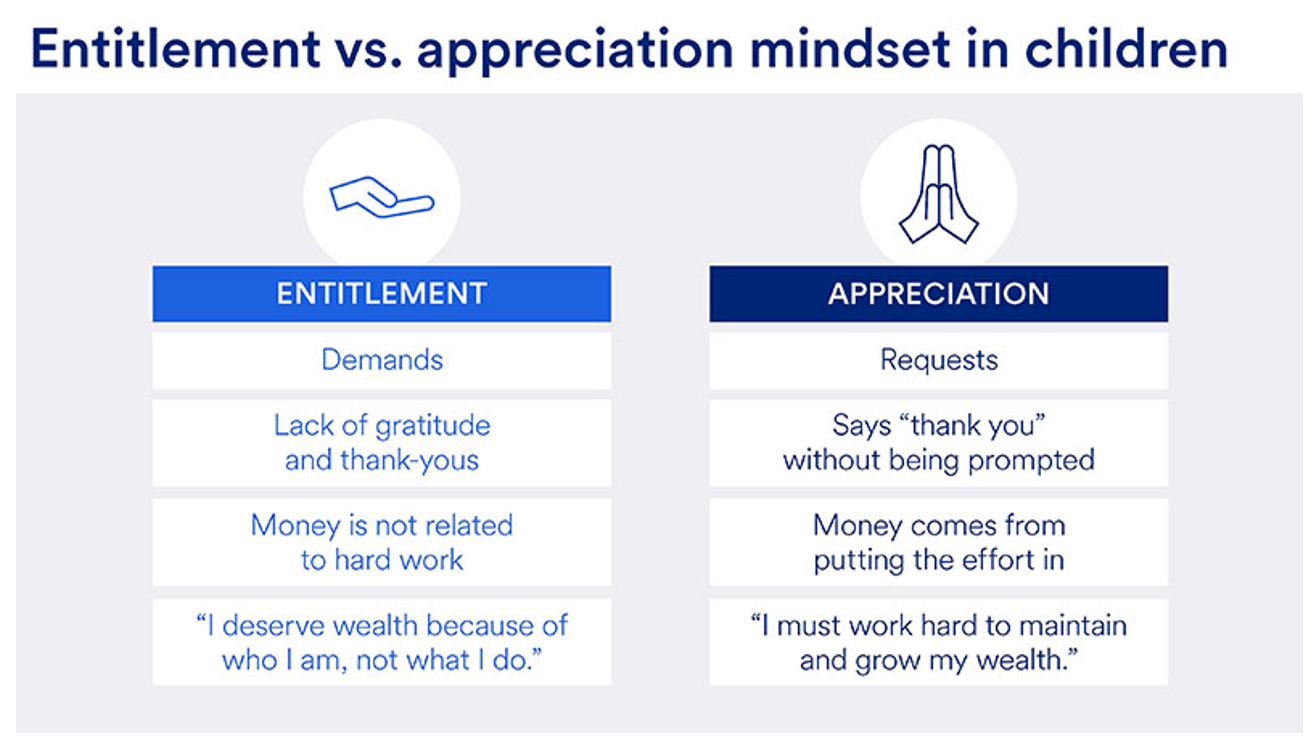
Source: Ascent Private Capital Management of U.S. Bank.
Practical steps include:
- Linking purchases to effort—connecting vacations, college funds, or even a car to the work that made them possible.
- Volunteering as a family—transforming privilege into purpose.
- Regular “entitlement check-ins”—asking whether traditions are building gratitude or breeding complacency.
Entitlement stunts emotional growth; appreciation strengthens it. Families that internalize this distinction create enduring abundance.
Rebooting the Family Money Talk
Edward Jones research highlights a troubling gap: while 71% of parents say they’re comfortable talking about money, only 27% actually do. Too many treat inheritance like a surprise party—a big reveal, then silence.
Better models exist:
- Legacy Letters capturing values and stories.
- Family Constitutions outlining decision-making and conflict resolution.
These living documents foster dialogue, not disclosure. They help heirs connect money with family values -- and the responsibility that comes with wealth.
Nurturing Healthy Abundance
Sometimes, entitlement shows up in subtle ways. Brian Brogan, a Family Office advisor, recalls working with a client’s son who flaunted a $75,000 BMW. Brogan suggested he trade it for a Toyota—sparking a lesson in “healthy pride” rooted in authenticity, not excess.
In his family governance work, Brogan often focusing on control, access, and love as key elements. He’s often called upon to assess family dynamics and red flags. He equates running family meetings to group therapy, highlighting the need for specific skills to manage dynamics and avoid causing harm. His best clients are complex families who are high-performing and open to improvement. He also taps into his extensive clinical experience with mental health and addiction, “Inherited wealth often exacerbates existing family dynamics and character trait issues and can lead to entitlement and meta-communication issues within families,” explains Brogan.
The best clients, Brogan says, are those willing to do the work: open to group-therapy-like sessions, honest about control, love, and access. Sometimes, advisors must even “take a hit”—absorbing tension to help a family move forward. It’s tough work, but it can unlock legacies that last.
Framing Wealth Around Purpose
Bob McCarty of EP Wealth believes entitlement rarely takes root when families have defined why they hold assets. He organizes planning into three horizons—short-term lifestyle, mid-term ventures, and long-term philanthropy.
By reframing wealth around purpose and modeling behaviors—whether philanthropy through donor-advised funds or intergenerational gifting—advisors help families ground their abundance in gratitude.
The Non-Financial Inheritance
At RetireMentors, my coaching often focuses on the legacies no balance sheet captures: grit, resilience, enduring family stories. These conversations sometimes transform families more than tax strategies or investment plans. As one client told me, “Your family’s true net worth lives in its stories. Dollars come and go—but values last.”
Toward Abundant, Purposeful Wealth
The Great Wealth Transfer could either fracture families or strengthen them. Advisors who weave financial strategies with emotional intelligence—who help clients replace affluenza with abundance—will stand at the center of the most important legacy conversations of our time.
Like Ordinary People, the story is not really about money. It’s about relationships—fragile, imperfect, enduring. Wealth managers who remember that will help families write endings defined not by entitlement, but by gratitude, resilience, and purpose.
Related: Permission To Prosper: Helping Retirees Let Go of Guilt and Embrace the Life They’ve Earned
* Cerulli Associates: Cerulli Anticipates $84 Trillion in Wealth Transfers Through 2045