
Trending

Written by: David Stonehouse | AGF
As the bull market in capital market assets enters its fourth year, we anticipate favourable returns are in store for investors, although the setup leaves less room for error.
After three years of strong results for global equities and steady returns for fixed income following the bear market of 2021-22, investors can rightly contemplate whether the good times will continue next year. In our view, the outlook continues to be constructive for several reasons, although investors should remain flexible, open-minded and attentive to potential risks. As has become typical in recent years, the path forward is unlikely to be smooth and devoid of hazards.
The chief concern of 2025 has clearly been the U.S. administration’s aggressive pivot to a tariff policy not witnessed in several generations. While there have been many twists and turns in this story, it is apparent that tariffs are not going away. However, this may not be as big a negative for economic and capital market prospects as it might appear on the surface. First, tariffs no longer have the same capacity to shock the system, as they are a clear and present issue. Second, as tariff negotiations gradually converge toward signed deals, businesses and consumers are increasingly able to adapt their behaviour to incorporate the new world, which should allow them to gradually resume economic activity as clarity emerges. All other things being equal, the adverse impact of tariffs on 2025 could become less unfavourable in 2026.
In our view, the outlook continues to be constructive for several reasons, although investors should remain flexible, open-minded and attentive to potential risks.
A second factor weighing on 2025 has been labour. Trump’s immigration/deportation policy has reduced U.S. labour force supply, which along with tariffs and cutbacks in government headcounts has resulted in sharply lower monthly employment increases. To a lesser extent, a similar dynamic has played out in Canada. This has raised concerns about an economic slowdown. Fortunately, the U.S. Federal Reserve (Fed) along with the Bank of Canada have become more attentive to this risk and responded by resuming their interest rate easing cycles. We anticipate that the Fed will cut interest rates several more times in the coming year, while the Bank of Canada is likely much closer to the end of its easing cycle due to its earlier and more aggressive policy moves. Given the lower starting point of economic growth, this added stimulus should result in faster economic growth in 2026.
Of course, concerns about the politicization of the Fed abound, and we expect that the next Fed chair (anticipated to be announced by year-end) will adopt a dovish stance in line with the Trump administration’s preferences. While this policy has potential ramifications in the long run, for 2026 it is likely to provide an added boost to the economy and potentially to the capital markets.
One area with unequivocally brighter prospects for 2026 is fiscal policy. In the U.S., the One Big Beautiful Bill Act (OBBBA) is set to provide significant tax cuts to consumers in the first half of next year, while accelerated tax write-offs associated with capital expenditures and research and development should boost corporate activity. Canada is pursuing a similar policy under Prime Minister Mark Carney and expansionary fiscal policies exist to varying extents in other jurisdictions such as Germany and Japan. China also appears poised to stimulate its economy more substantially next year as it attempts to manage trade tensions with the U.S. All told, these actions may provide a tailwind that boosts global economic growth prospects relative to 2025.
Of course, when it comes to fixed income, high government debt levels in much of the world have caused heightened concern in sovereign bond markets, with rising long bond yields reflecting these worries. However, broadly speaking, yields have remained rangebound in the last few years, and policymakers have tools at their disposal to contain any rise in yields to a manageable level in our view, at least in 2026. In addition, while 2026 is unlikely to provide nearly as many rate cuts globally as we witnessed in 2025, central banks remain in easing mode on balance, which may keep shorter-term interest rates trending lower. Longer-term interest rates will have to contend with the deficits cited above, but should benefit from an inflation environment that, while elevated versus the last couple of decades, has continued to normalize. We anticipate that inflation is bound to remain reasonably stable given poor housing markets, which should keep the housing component of inflation in a disinflationary trend. Offsetting this, commodities have been firming as economic growth prospects improve and raw materials consumption heats up with the transition to a more energy-intensive economy, which could result in some increase in headline inflation. On balance, this setup should be sufficient for fixed income to generate a fourth successive year of returns in the vicinity of mid-single digits.
Finally, while 2026 is not a major election year globally, the U.S. midterm elections loom large, as does the upcoming 250th anniversary of the Declaration of Independence next July. It is likely that the Trump administration will deploy as many policies as it can to elevate consumer sentiment next year, celebrate Independence Day on a high note, and boost Republicans’ chances of winning the midterm elections.
Coupled with the factors listed above, this backdrop sets the equity markets up for a fourth successive year of gains in our view, although returns may be somewhat more moderate than the last three years as the bull market matures. Tactically, we have a neutral stance on equities as of the fourth quarter of 2025 due to concerns about a potentially overextended rally off the April lows, elevated sentiment and a temporary economic slowdown because of tariffs and the recent U.S. government shutdown. However, we anticipate that pullbacks may well represent an opportunity to upgrade our equity recommendation to overweight. Regionally, we have shifted our allocation from the U.S. (now neutral) to emerging markets, which have improving growth prospects and more attractive valuations. We also continue to favour Japan due to ongoing structural reforms.
In the meantime, we are maintaining an overweight position in cash, which we hold ready to deploy in the event of a consolidation in equities, and are moderately underweight fixed income, whose prospects remain solid but are not expected to deliver as strong returns as equities. Within fixed income, credit spreads are near cyclically tight levels, but again we believe these conditions are supported by strong cash flow generation and a solid economic outlook, so we continue to favour high yield credit over investment grade bonds. We have also increased our recommended allocation to emerging market debt, which is primed to benefit from solid growth and a U.S. dollar whose secular strength appears to have peaked, in our view.
Q4 2025 Asset Allocation Outlook
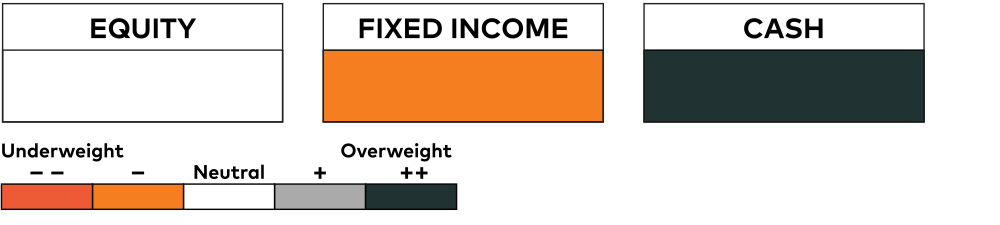
Source: AGF Investments, as of October 7, 2025
Of course, we also acknowledge that challenges lie ahead in 2026. Prominent among those is stretched equity valuations: after a prolonged bull market centred around U.S. large-cap growth equities, valuations are nearing historically high levels and leave less room for further expansion, while exposing investors to greater downside risk in the event of a correction. However, corporate fundamentals continue to deliver strong earnings growth, which could reasonably underpin equities in 2026 presuming the economy does accelerate.
Additionally, geopolitical tensions in numerous global hotspots continue with few respites. While investors have become conditioned to buying dips associated with geopolitical flare-ups since they haven’t caused major economic disruption, there is the potential in the future for a confrontation to develop into a more prolonged and sizable affair than we have seen in the past few decades.
Third, despite our base case of economic re-acceleration, downside risks could manifest themselves in the form of rising unemployment, stalled trade talks due to either tensions or court rulings, or an unwelcome rise in inflation. It will be critically important for Canada to make a strong case for low tariff levels as the U.S. Mexico Canada Agreement (USMCA) trade deal is renegotiated.
Finally, artificial intelligence (AI) presents both tremendous opportunities and potential risks. Increasingly widespread adoption could start to hamper hiring intentions while also boosting productivity and disinflation, and the possibility of an AI bubble bursting (the conditions for which we believe are not currently in place) could cause both a bear market and an economic slowdown.
As the year progresses, these challenges could undermine our favourable stance, although we believe our constructive outlook should prevail. Regardless of the outcome, 2026 is likely to present a dynamic environment that will require investors to employ discipline, flexibility and prudent risk management as they navigate through the year.
Related: Making A List and Checking It Twice