

Trending

Today’s headline is a bit of a litmus test. Older readers and Yankees fans will attribute it to Yogi Berra, maxim generator extraordinaire, while younger readers and non-baseball fans will attribute it to Lenny Kravitz and his hit song. Either way, this morning it refers to the horserace for the new Federal Reserve Chair, with the relative odds of the “two Kevins” shifting dramatically. This has implications for bond yields, and by extension, stock prices.
In a Wall Street Journal interview on Friday, President Trump referred to Kevin Warsh, not Hassett, as the person at the top of his list, saying:
Yes, I think he [Warsh] is. I think you have Kevin and Kevin. They’re both—I think the two Kevins are great,” he said. “I think there are a couple of other people that are great.
Prediction markets had heavily favored Hassett as the preferred Kevin prior to that statement but now show a two-horse race. Earlier this month, the “Yes” for Hassett on ForecastEx touched 90, though it had slipped to 73 in the days leading up to Friday as the expected appointment failed to materialize as quickly as some hoped. It last traded at 47, essentially a coin-flip; meanwhile, the “Yes” for Warsh leapt from 14 to 40 during that time frame.
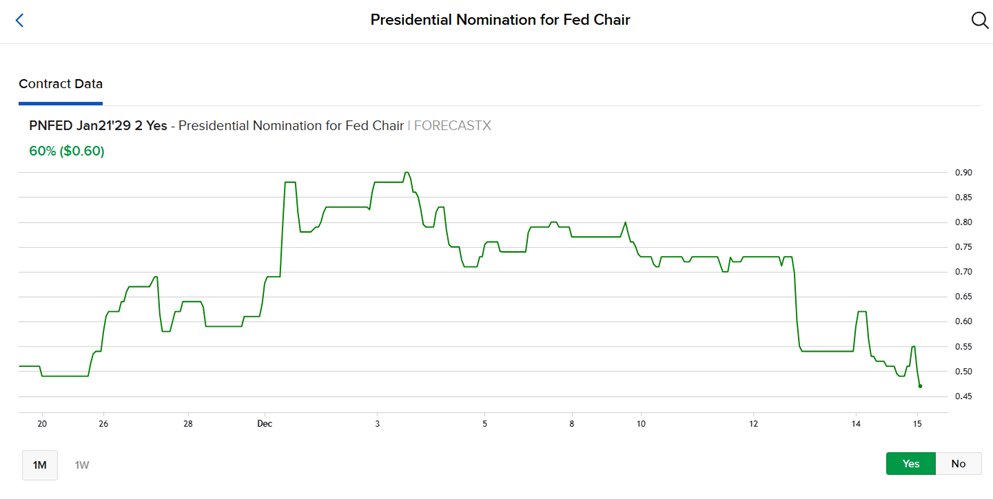
Source: ForecastEx
Source: ForecastEx
One might ask why the odds for Warsh aren’t higher, especially after CNBC reported this morning that Hassett’s candidacy has gotten pushback from people close to President Trump. My personal view, quite frankly, is based on the President’s well-honed sense of the media. It is boring if there is a clear frontrunner; a two-person race creates drama and thus attention. It may of course be extreme to consider this a real-life episode of “The Apprentice, Fed Chair Edition”, but if anyone knows how to generate ratings from a reality-show style competition, it is the President.
(We first used the reality show analogy in a June podcast. Interestingly, the two names that we discussed at the time, Fed Governors Michelle Bowman and Christopher Waller are both considered dark horse candidates now. Waller has a “Yes” of 5, while Bowman has a 2. The latter is below Treasury Secretary Bessent’s 3 and tied with former World Bank President David Malpass.)
Why does this matter, then? Investors clearly prefer greater central bank independence. That is undoubtedly why the President has switched from advocating for Chair Powell’s firing toward simply criticizing him ahead of his imminent term expiration. It is also believed to be the rationale behind those advocating for consideration of Kevin Warsh over Hassett. The latter is viewed as more partisan, though he downplayed the idea that the President would have much of an influence on policy in an interview this weekend. You can decide whether that was in response to the recent WSJ report or not.
In either case, that may be why longer-term Treasury yields ticked lower this morning. A Fed that heeds the call of lower rates regardless of data would spur inflation expectations. Those would spur higher long-term interest rates, and in turn, lead to a steeper yield curve. In theory, that would pressure stock prices, though stocks have been shown to shrug off higher yields for lengthy stretches. Stocks can weather modest inflation, though major inflationary cycles do ultimately impinge upon valuations.
Finally, in the short term, we have some levels to watch. This morning’s reflexive “buy the dip” rally ended rather quickly. But the S&P 500 managed to hold Friday’s test of the 6,800 level, halting the morning’s declines. A break below that could get nastier. Also, bitcoin has run into a bit of trouble again. While it is holding above its own recent lows, the trend has become unpleasant.
And one more thing: a reader wisely pointed out an error in the FOMC table that we published last week. (Yes, I read the comments. Please keep them coming.) We have updated the table with last week’s data and amended the bad data point for the March 2025 FOMC meeting.
SPX 2-Days, 2-Minute Candles
Source: Interactive Brokers
Bitcoin 6-Months, Daily Candles with 50-Day Moving Average (blue line, top), 100-Day Moving Average (yellow line, top), Bollinger Bands (top), MACD 12,26,9 (middle), 14-Day RSI (bottom)
Source: Interactive Brokers
Source: Interactive Brokers
Related: The Fed’s ‘Goldilocks Cut’: Why Markets Rallied—Then Panicked—After the FOMC Meeting