
Trending

Written by: Brian Manby, CFA
Key Takeaways
-
Morningstar’s recent upgrades of the WisdomTree U.S. Quality Dividend Growth Fund (DGRW) to 4 stars and the WisdomTree Dynamic International Equity Fund (DDWM) to 5 stars highlight how disciplined, quality and risk-focused strategies are delivering consistent outperformance in today’s more volatile equity environment.
-
DGRW has delivered strong downside protection, outperforming the S&P 500 in roughly 96% of major drawdowns since 2025, reinforcing its role as a resilient core U.S. equity allocation.
-
DDWM uses dynamic currency hedging to reduce volatility and has added cumulative returns since 2016, offering investors a more efficient way to access international equities while mitigating FX risk.
At WisdomTree, we’ve long believed that disciplined, rules-based approaches that are grounded in quality and risk awareness can lead to better investor outcomes over time.
That philosophy is once again being tested and recognized as two of our flagship equity strategies were recently upgraded by Morningstar. The WisdomTree U.S. Quality Dividend Growth Fund (DGRW) moved from 3 to 4 stars, while the WisdomTree Dynamic International Equity Fund (DDWM) newly earned 5-star status.
While star ratings are inherently backward-looking, they often reflect the consistency of a strategy’s design and its ability to effectively navigate a range of market environments. In both cases, these upgrades underscore a key theme central to investing: maintaining upside participation while managing downside risk.
DGRW: Quality & Dividends When They Matter Most
DGRW was built on a simple premise: companies with strong profitability metrics and the potential grow their dividends may offer resilient equity exposure. Over time, that combination demonstrated the ability to hold up better when markets sour, a particularly valuable trait.
Rather than focusing solely on long-term averages, it’s also instructive to examine how strategies behave during the most challenging moments. Over the past decade-plus, a one-standard deviation move for the S&P 500 was approximately 1.13%. Since November 2015, there’s been about 245 trading days where the index fell to this extent or more.
Fortunately, DGRW outperformed about 84% of the time.
Figure 1: Excess Return: DGRW vs. S&P 500 When the S&P 500 Falls More Than 1σ
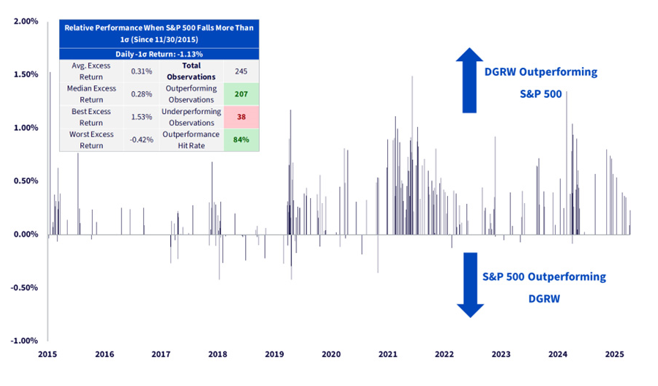
Source: WisdomTree, S&P as of 3/17/2026. DGRW total returns represented at Net Asset Value (NAV). Past performance is not indicative of future results. You cannot invest directly in an index.
Perhaps even more impressive is DGRW's recent record. From the start of 2025 into 2026, there have been 28 one-standard deviation downside moves for the S&P 500. DGRW underperformed on only one occasion, which was by a negligible 8 basis points (bps) on March 4, 2025. That’s a 96% hit rate over the last ~15 months.
Even in more modest down movements, DGRW exhibited consistent success. If we broaden our analysis to look at half-standard deviation (~57 bps) downside moves, DGRW outperformed over 75% of the time.
Figure 2: Excess Return: DGRW vs. S&P 500 When the S&P 500 Falls More Than 0.5σ

Source: WisdomTree, S&P as of 3/17/2026. DGRW total returns represented at Net Asset Value (NAV). Past performance is not indicative of future results.
From 2025 to date, there have been 54 such observations with DGRW only falling worse than the S&P 500 on three occasions, a 94% hit rate.
This is not incidental. It reflects the strategy’s intentions, including:
-
A quality screen emphasizing high return-on-equity (ROE), return-on-assets (ROA), sales growth and earnings growth, and
-
A dividend-growth focus that tilts toward companies with durable cash flows, resulting in
-
A portfolio that, by construction, tends to avoid the speculative segments of the equity market
At times, these attributes have delivered a smoother ride when the broader market gets bumpy. And importantly, that downside resilience has not required sacrificing participation in up markets, either. DGRW still allocates to the top 200 dividend-paying U.S. equities based on our quality and composite growth parameters.
DDWM: Volatility Reduction by Eliminating Currency Noise
International investing introduces an additional layer of complexity via currency exposure. For U.S.-based investors, unhedged international equities embed a second source of volatility, which is often unrelated to the underlying fundamentals of the equities themselves.
DDWM was designed to address this directly through its dynamic currency hedge. Rather than making a static decision to hedge or not hedge, DDWM actively adjusts its hedges for each currency exposure on a monthly basis, based on an assortment of technical and momentum-based signals.
As a result, it intends to remove uncompensated currency risk that may erode equity returns over the investor’s holding period.
The result has been a consistent pattern since the fund’s inception in 2016. Over each calendar year, the dynamic currency hedge applied to DDWM's underlying index consistently reduced volatility from EAFE FX exposures. Oppositely, the unhedged foreign currency experience steadily added volatility to an investor’s international equity allocation.
Figure 3: Volatility by Calendar Year

Source: WisdomTree, MSCI as of 12/31/2025. You cannot invest directly in an index.
This is an important distinction. Currency movements can introduce noise, which sometimes amplifies drawdowns and masks underlying equity performance. By systematically managing that exposure, DDWM aims to deliver a more efficient international equity experience.
Historically, the dynamic hedging model’s returns have rewarded this approach.
Figure 4: Cumulative Returns of the Dynamic EAFE FX Hedging Model (2016–2026)
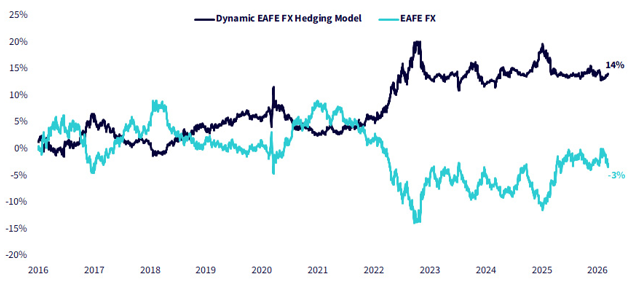
Source: WisdomTree, MSCI as of 3/17/2026. Returns for the Dynamic EAFE FX Hedging Model are represented by the Net Asset Value (NAV) returns of DDWM and the WisdomTree International Equity Fund (DWM), which is the same product as DWM without the dynamic currency hedge. Hence, the impact of the dynamic currency hedge is isolated in the time series. EAFE FX returns are represented by the different in net total returns for the MSCI EAFE Index measured in USD and Local Currency. Past performance is not indicative of future results. You cannot invest directly in an index.
Since inception in January 2016, the dynamic hedging model produced 14% cumulative returns. This may seem like a small amount spread out over a decade, but it’s more impactful when you realize that the unhedged EAFE foreign currency experience produced cumulative losses over the same period.
The Morningstar upgrade to 5 stars reflects not just strong absolute and risk-adjusted returns, but also the effectiveness of this approach across varying market regimes, including periods of significant currency swings.
A Shared Philosophy
Though DGRW and DDWM operate in different regions, they share a common DNA that is based on rules-based, transparent methodologies, a focus on quality and fundamental strength, and an emphasis on risk management.
Importantly, both strategies challenge the notion that investors must fully accept market volatility to access equity returns. Instead, they demonstrate that thoughtful portfolio construction can potentially reduce downside participation without abandoning upside opportunity.
In an environment where uncertainty—whether driven by macroeconomic shifts, interest rate dynamics, or currency volatility—remains elevated, the ability to stay invested while managing risk is essential.
DGRW offers a way to stay invested in U.S. equities with a historical tendency to hold up better during downswings, while DDWM provides international exposure while systematically addressing one of its biggest warts in incremental volatility.
The recent Morningstar upgrades are a reflection of what we’ve long aimed to deliver: strategies that are not only competitive over time, but also built to navigate the path getting there.
Related: Japan’s Moment: Elections, Flows & Global Opportunities
Important Risks Related to this Article
There are risks associated with investing, including possible loss of principal.
DGRW: Growth stocks, as a group, may be out of favor with the market and underperform value stocks or the overall equity market. Growth stocks are generally more sensitive to market movements than other types of stocks. Dividends are not guaranteed, and a company currently paying dividends may cease paying dividends at any time. The Fund is non-diversified, as a result, changes in the market value of a single security could cause greater fluctuations in the value of Fund shares than would occur in a diversified fund. The Fund invests in the securities included in, or representative of, its Index regardless of their investment merit and the Fund does not attempt to outperform its Index. The composition of the Index is governed by an Index Committee and the Index may not perform as intended.
DDWM: Foreign investing involves special risks, such as risk of loss from currency fluctuation or political or economic uncertainty. The Fund invests in derivatives in seeking to obtain a dynamic currency hedge exposure. Derivative investments can be volatile, and these investments may be less liquid than other securities, and more sensitive to the effects of varied economic conditions. Derivatives used by the Fund may not perform as intended. The Fund invests in the securities included in, or representative of, its Index regardless of their investment merit, and the Fund does not attempt to outperform its Index.
Please read the Fund’s prospectus for specific details regarding the Fund’s risk profile.
For each fund with at least a three-year history, Morningstar calculates a Morningstar RatingTM metric each month by subtracting the return on a 90-day U.S. Treasury Bill from the Funds load-adjusted return for the same period, and then adjusting this excess return for risk. The top 10% of the funds in each broad asset class receive 5 stars, the next 22.5% receive 4 stars, the next 35% receive 3 stars, the next 22.5% receive 2 stars and the bottom 10% receive 1 star. The Overall Morningstar RatingTM for a fund is derived from a weighted average of the performance figures associated with its three-, five- and ten-year (if applicable) Morningstar RatingTM metrics.
DGRW was rated against the following numbers of U.S.-domiciled Large Blend funds over the following time periods: 1,208 funds in the last three years, 1,120 funds in the last five years, and 880 funds in the last ten years. With respect to these Large Blend funds, DGRW received a Morningstar RatingTM of 2 stars, 4 stars and 4 stars for the three-, five- and ten-year periods, respectively.
DDWM was rated against the following numbers of U.S.-domiciled Foreign Large Value funds over the following time periods: 325 funds in the last three years, 308 funds in the last five years, and 238 funds in the last ten years. With respect to these Foreign Large Value funds, DDWM received a Morningstar RatingTM of 3 stars, 5 stars and 5 stars for the three-, five- and ten-year periods, respectively.
Past performance is not indicative of future results.
U.S. investors only: Click here to obtain a WisdomTree ETF prospectus which contains investment objectives, risks, charges, expenses, and other information; read and consider carefully before investing.
WisdomTree Funds are distributed by Foreside Fund Services, LLC, in the U.S.
This WisdomTree article is provided as part of a paid sponsorship.