
Trending

Key Takeaways
-
Stablecoin payments help businesses combine blockchain settlement speed with value linked to fiat currencies.
-
A stablecoin payment solution can support checkout, invoices, fiat settlement, stablecoin settlement, reporting, compliance, and payout capabilities.
-
Stablecoins are useful for ecommerce businesses, SaaS companies, international merchants, marketplaces, affiliate networks, global payroll, and cross-border supplier payments.
-
The right crypto payment provider should fit the company’s payment use case, regions, settlement needs, and compliance requirements.
Stablecoin payments are becoming part of daily business payments for ecommerce businesses, SaaS companies, international merchants, marketplaces, affiliate networks, and companies managing cross-border supplier payments. Assets such as USDT and USDC give businesses a way to use blockchain-based payment flows while keeping value close to a fiat currency.
For many merchants, the main interest is settlement speed, global reach, and more predictable payment value. A crypto payment provider can help companies accept stablecoin payments, manage stablecoin settlement, convert funds through fiat settlement, and send payouts to partners, suppliers, sellers, affiliates, or contractors.
What You Need to Know
Stablecoins are digital assets designed to track the price of fiat currencies, most commonly the US dollar. USDT and USDC are widely used examples, although availability can depend on region, network, provider policy, and compliance requirements.
A stablecoin payment solution can support customer checkout, invoices, payment links, API integration, business wallets, settlement, reporting, and payout capabilities. This makes stablecoins useful for both incoming payments and outgoing business payments.
Stablecoin settlement means a merchant receives funds in stablecoins rather than accepting full exposure to volatile crypto assets. Fiat settlement means the provider converts received crypto or stablecoins into currencies such as EUR, USD, or GBP.
The Challenges of Traditional Business Payments
Traditional business payments can involve delayed processing, currency conversion costs, banking cut-off times, regional restrictions, manual reconciliation, and intermediary fees. These issues become more visible when a company works with customers, suppliers, contractors, or partners across several countries.
Ecommerce businesses may face payment declines from international customers. SaaS companies may deal with overseas invoices and currency conversion. Marketplaces and affiliate networks may need to send many smaller payouts across regions. Global payroll and cross-border supplier payments can also create repeated administrative work for finance teams.
Stablecoin payments give companies another option for these payment flows, especially where businesses need faster settlement, digital records, and more flexible payout capabilities.
Why Stablecoins Are Gaining Adoption
Stablecoins are gaining adoption because they can support faster cross-border payments while keeping value linked to fiat currencies. This combination makes them easier for finance teams to understand than highly volatile crypto assets.
A merchant accepting Bitcoin may need to manage price movement during payment processing. A merchant accepting USDC or USDT can keep the transaction value closer to the selected fiat reference. This can make stablecoin payments suitable for invoices, ecommerce checkout, affiliate payouts, and supplier payments.
Stablecoins also work well for companies with crypto-native customers or partners. A SaaS platform can invoice clients in USDC, an affiliate network can pay partners in USDT, and a marketplace can support seller payouts across several countries.
Business Benefits of Stablecoin Payments
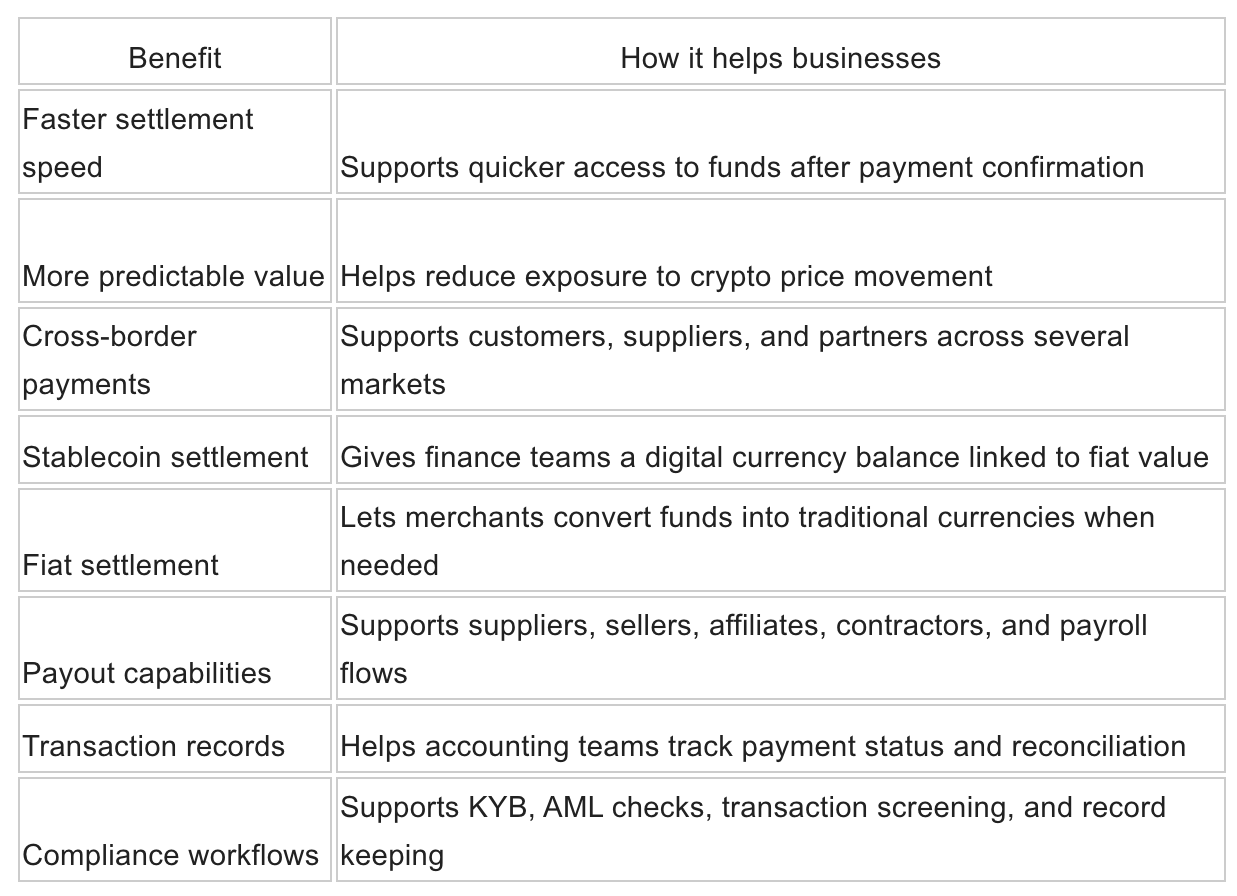
A reliable stablecoin payment solution should connect payment acceptance with settlement, compliance, reporting, and outgoing payments. This helps businesses use stablecoins as part of normal finance operations.
Common Use Cases
For ecommerce businesses, stablecoin payments can support international checkout, digital goods, high-value orders, and customers who prefer USDT or USDC over card payments.
For SaaS companies, stablecoins can support invoices, annual subscriptions, B2B customers, and international accounts where card limits or bank transfers create friction.
For international merchants, stablecoin settlement can help manage customer payments across several regions while keeping value close to fiat.
For marketplaces, stablecoin payouts can support sellers, vendors, creators, and service providers across different countries.
For affiliate networks, stablecoin payments can simplify frequent partner payouts, especially when recipients already use digital wallets.
For global payroll, companies can pay contractors or remote workers in stablecoins where permitted and supported by local rules.
For cross-border supplier payments, stablecoins can reduce payment delays and give both sides a traceable digital transaction record.
Conclusion
Businesses are moving to stablecoin payments because they need faster settlement, more flexible global payments, and better options for cross-border business payments. Stablecoins such as USDT and USDC can support customer payments, supplier transfers, affiliate payouts, marketplace settlements, and contractor payments while keeping value close to fiat currencies.
CryptoProcessing can be relevant for merchants reviewing stablecoin payments, crypto payments for business, fiat settlement, stablecoin settlement, compliance, and payout capabilities. Other providers may suit different regions, networks, assets, and technical requirements.
A business should begin with its payment flow: who pays, which assets are accepted, how funds settle, which teams need reports, and whether payouts are part of daily operations. Once these requirements are defined, stablecoin payments can become a useful part of the company’s long-term payment setup.
Related: Tokenization and AI Are Building a Whole New World of Money