
Trending

With every passing month, more buyers are using AI to research professional services providers. And one question that some buyers will ask is how much you charge for your services. And guess what? The chatbots are here to supply an answer. (Or at least some of them are.*)
Whoa! Where do these prices come from?
It depends. If pricing is not available on your website, chatbots will preface their answer with a caveat that your firm does not publish a standard price list. But do they stop there? No, of course not.*
Dutifully, cheerfully, the chatbot will churn out a set of prices for some of the services you offer, or perhaps hourly rates for various employee tiers. These prices may or may not be in the ballpark. But unless you publish your prices on your website, one thing is for certain: the prices don’t reflect your actual fees.
Where the information actually comes from depends. The chatbots check your website first. Because most firms keep their pricing secret—or because every engagement is unique and every proposal is custom, so what’s the point?—the bots are forced to look elsewhere.
In our experiments, they seem to look first for any pricing information on the web that is connected to your firm. That might be a “Starting at” price that you listed (probably years ago) on a public directory or certification site. As you can imagine, these prices can be wildly misleading.
In the case of global consultants McKinsey & Company, they submitted a full Covid-response proposal to the state of New Jersey. Journalists investigating the contract got access to the proposal through a public records request and published it online. AI chatbots use that information to make broad assumptions about McKinsey’s pricing.
If a chatbot can’t find any pricing information for your firm, it may search for general pricing information from other firms in your industry. Often it presents these prices with little or no explanation of their source.
Let’s look at a real-world example generated from ChatGPT, which is by far the most commonly used AI chatbot. Below, I ask what a leading accounting firm charges for its services:
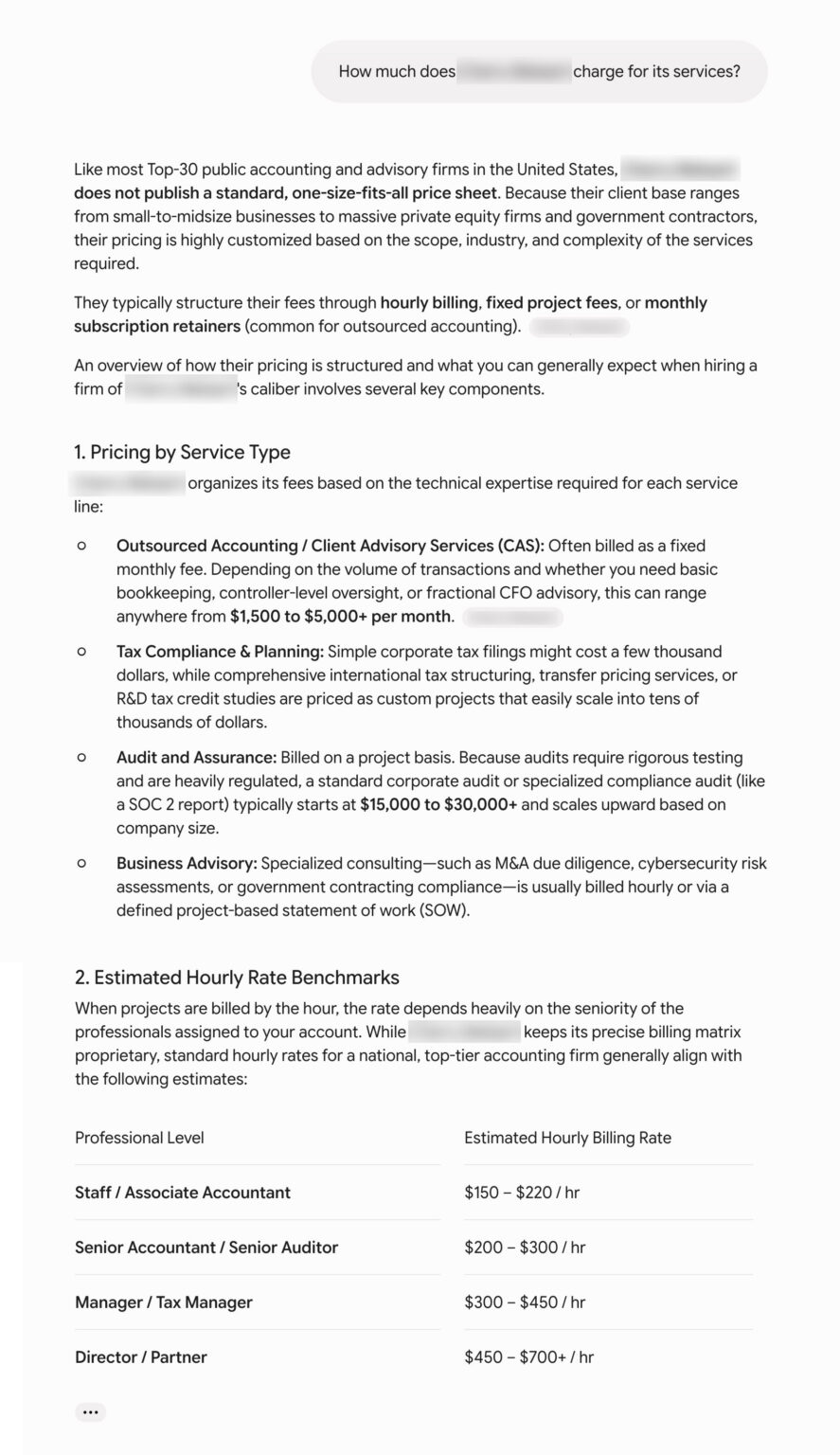
The first thing to note is that ChatGPT offers few links to identify its sources. (Perplexity, by contrast, is less stingy and likes to provide links to sources). Are these prices based on actual pricing data from this firm? No. Where do they come from? Your guess is as good as mine.
Is it, however, easy for a buyer to assume that these prices are generally correct (even if they aren’t)? Oh, yes.
Even though the ChatGPT response says that the firm “does not publish a standard, one-size-fits-all price sheet,” it nevertheless serves up specific price ranges and hourly rates.
Note how the bot uses language that is confident and authoritative: “They typically structure their fees through hourly billing, fixed project fees, or monthly subscription retainers.” And “[Firm name] organizes its fees based on the technical expertise required for each service line.” It then goes on to describe the services and quote fees for each.
None of this information is real, but it feels real. Which can be a big problem if the prices are unrealistic or don’t reflect the way you price engagements.
Maybe it’s chatbots’ conversational style. Or maybe it’s the fact that they can access seemingly anything on the internet. Whatever the reason, buyers feel like they can ask these robots questions that they can’t possibly reliably answer. And at least some of them are asking about pricing as they research prospective firms.
The problem, of course, is that if the pricing seems too high or lacks context, a buyer may rule you out. Or if the prices are too low, they may reach out to you with unrealistic expectations, putting you at a disadvantage from the start.
It’s not clear yet whether AI pricing hallucination is a big or small problem. Today, it is very difficult to even know what proportion of professional services buyers are using AI to research and select firms. But based on what we hear from our clients, and based on our experience at our own firm, more than a handful of prospects are using AI chatbots to evaluate firms.
This evidence is supported by consumer data from Similarweb, whose 2026 Brand Visibility Index indicates that 30% of buyers are using AI tools to research and compare tools. This study also indicates that a quarter of buyers are using AI to compare pricing.
What Can You Do About AI Pricing Misinformation?
If you are worried about AI delivering inaccurate pricing information, first determine if you have a problem. Sign up for free accounts with all five of the most popular AI tools (ChatGPT, Gemini, Copilot, Claude and Perplexity). Then type in a query like, “How much does [Your Firm Name] charge for its services.” If your firm is small or if there are other companies with names similar to yours, you may also want to include your URL so that the bot knows who you are.
If all of the bots return no pricing information, you are probably okay. If any of them do provide pricing, however, you will need to decide whether or not the generated information poses a problem. Many firm leaders may decide that what is presented is broad or generic enough that it poses no harm.
But what do you do if what you see completely misrepresents your pricing model?
One possible solution is to address pricing directly on your website. You don’t necessarily have to publish a detailed list of fees for every service you offer. Instead, you can describe in broad strokes what a typical engagement costs and what factors might affect that number or range. If you want to call attention to it, this information could go on a dedicated pricing page. Or if you prefer to make your pricing less prominent, you could make it an item in an FAQs section. As long as the page can be crawled by the bots, they should find it.
Firms keep their pricing hidden for many reasons, but as people increasingly turn to AI to find and vet firms, executives may need to rethink how secretive they are about fees. For now, we’re keeping an eye on this fascinating—some would say scary—possibility.
Related: Should an Expert Write with AI?