
Trending

This week marked the unofficial start of second quarter earnings season when a series of major financial institutions reported results. Considering the size and importance of five of these banks, I decided to nickname the event “Too Big to Fail Day.” Although they got us off to a fine start, they were overshadowed by a surprisingly good CPI report, Kevin Warsh’s first Humphrey-Hawkins testimony, and a disastrous reaction to IBM’s report.
As usual, banks proved to be an interesting, but not ultimately helpful, precursor to the events to follow. For years, I’ve rued the fact that banks kick off earnings season, and in 2022, I wrote a piece entitled “I Wish I Could Rearrange Earnings Season” to that effect. No other industry’s bottom lines depend upon investment banking revenues, trading profits, and the shape of the yield curve, yet we use this one as a harbinger of what we might expect from a wide range of others. Generally speaking, they did well, with Goldman Sachs (GS) leading with a 9% post-earnings rally and Citigroup (C) bringing up the rear with a 5% decline.
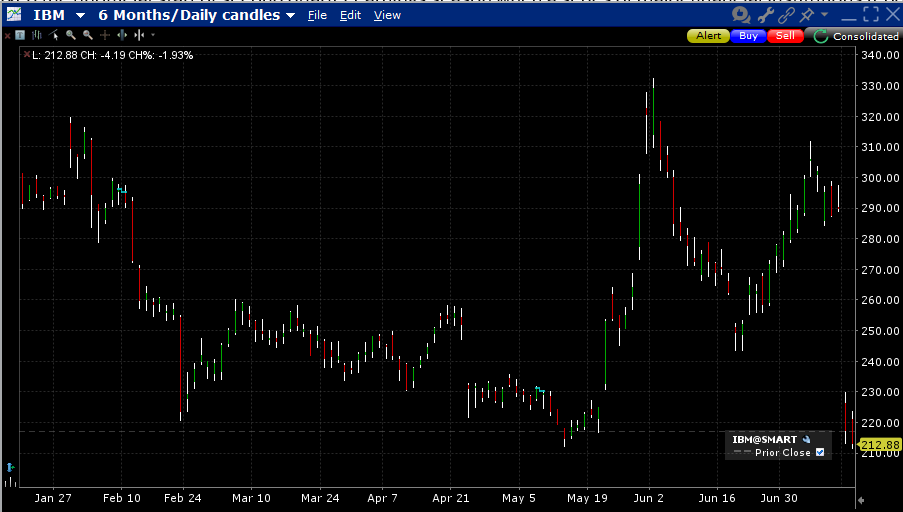
In theory, the big jump in the largest component of the price-weighted Dow Jones Industrial Average (INDU) should have caused that measure to rally. But that was largely offset by a stunning 25% drop in IBM. There is no way to sugarcoat “Big Blue’s” earnings report. Revenues and EPS both missed and the conference call pointed to murky, if not substantially weaker, guidance. While we remain concerned about companies’ ability to exceed lofty expectations for the coming quarter, IBM’s pummeling was not about investors failing to reward a set of good results. This was instead about punishing a company for failing to meet basic expectations.
As we have said numerous times, beating published revenue and EPS expectations is a necessary, but not sufficient, condition for a post-earnings rally, with raising guidance as the sufficient condition. IBM didn’t meet the necessary condition.
But there were indeed some lofty expectations built in nonetheless. While driving yesterday, we heard a guest on a financial channel mention that he thought IBM was undergoing a calamitous fire sale (not an exact quote – I was driving, not taking notes) with the stock plunging to lows not seen since May. My wife beat me to punch, screaming at the radio, “It’s being priced into oblivion but only at a two-month low?” Yes, the company is rightfully to blame for failing to execute, but investors need to bear some of the responsibility for rallying the stock on hopes for quantum computing profits that won’t be materializing for years, if ever.
IBM, 6-Months, Daily Candles
Source: Interactive Brokers
Face it, this market doesn’t do much by half-measures. It seems increasingly rare for stocks to take news in relative stride. Instead, it is becoming increasingly common to see large single-digit, if not double-digit, percentage moves after meaningful news. Sometimes, the news doesn’t have to be all that notable, as we see today with 10% drops in Micron Technology (MU) and SK Hynix ADRs (SKHY). This is the flip side of traders’ love of momentum and leverage. It’s great when it’s going your way, but even more painful than normal when it’s not.
Related: When Great Earnings Aren’t Enough: Has Investor Expectations Gone Too Far?